

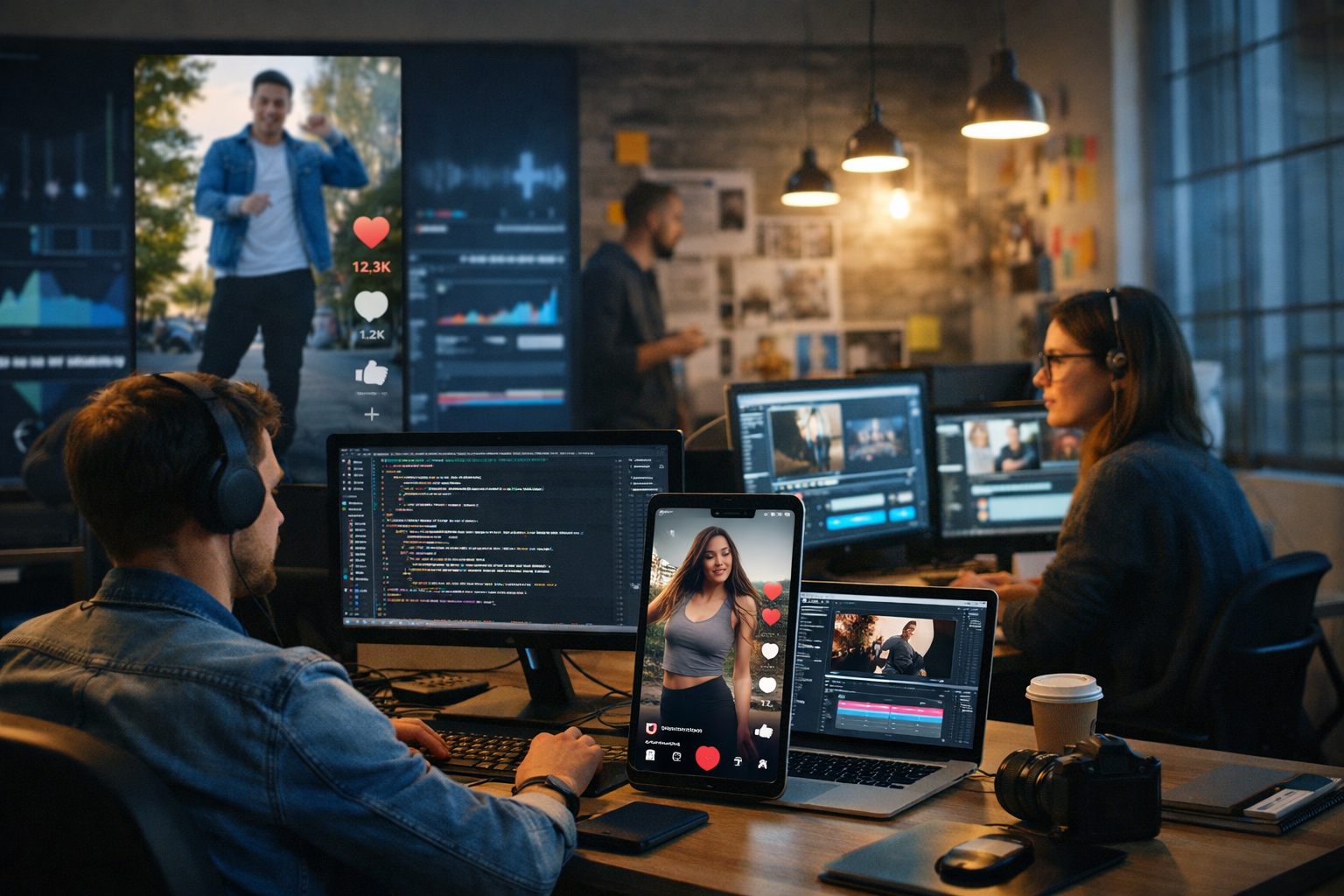
Building a short-video platform that can rival TikTok is not just about cloning features. A successful TikTok-like app is a combination of real-time media processing, intelligent content discovery, social engagement mechanics, and a backend architecture capable of scaling to millions of concurrent users. Before jumping into technical execution, it is critical to understand that TikTok’s growth came from its ability to deliver highly personalized content instantly, regardless of user location or traffic spikes.
A TikTok clone must therefore be designed as a high-performance digital product from day one, with scalability, speed, and personalization at its core. This article explains the full lifecycle of TikTok-like app development—from feature planning and system architecture to infrastructure scaling and monetization—so businesses can build a future-ready product.
Core Features Required to Build a TikTok-Like App That Scales
User Onboarding and Account Management
A frictionless onboarding experience is essential to attract and retain users at scale. Social login options, phone number authentication, and email verification should be fast and secure. At a large scale, authentication services must be optimized to handle thousands of simultaneous login requests without downtime.
User profiles should support avatars, bios, follower metrics, and content history while remaining lightweight to load instantly on any device.
Short Video Recording, Editing, and Uploading
At the heart of TikTok-like app development is video creation. Users expect in-app recording with real-time filters, speed controls, sound overlays, and transitions. Video compression and encoding must be optimized so uploads remain fast even on slower networks.
On the backend, videos should be processed asynchronously to avoid blocking the user experience. A scalable media pipeline ensures videos are encoded in multiple resolutions and formats for smooth playback across devices.
AI-Powered Content Discovery and Recommendation
What differentiates TikTok from other social platforms is its recommendation engine. A TikTok-like app must analyze user behavior such as watch time, likes, comments, shares, and replays to continuously personalize the content feed.
Machine learning models should be trained incrementally, improving recommendations as user data grows. The system must be capable of processing millions of behavioral events per second while maintaining accuracy and speed.
Social Engagement and Interaction Features
Likes, comments, shares, duets, stitches, and direct messaging form the social backbone of a TikTok clone. These interactions generate massive read and write operations on databases. To scale efficiently, social data must be cached, partitioned, and synchronized in real time.
Push notifications also play a key role in driving engagement, requiring an event-driven notification system that can scale globally without delays.
Backend Architecture for Massive Scalability
Microservices-Based System Design
A monolithic backend cannot support TikTok-level growth. TikTok-like app development requires a microservices architecture where each function—authentication, video processing, recommendations, notifications, analytics—runs as an independent service.
This approach allows teams to scale individual components without affecting the entire system. For example, video streaming services can scale independently during peak usage while profile services remain stable.
Cloud Infrastructure and Auto-Scaling
Cloud platforms such as AWS, Google Cloud, or Azure enable elastic scaling. Auto-scaling groups dynamically allocate resources based on traffic load, ensuring the app remains responsive even during viral spikes.
Using container orchestration tools like Kubernetes helps manage service deployment, load balancing, and fault tolerance across regions.
Content Delivery Network for Global Performance
Short-video platforms rely heavily on fast content delivery. A global CDN ensures videos are served from servers closest to users, reducing latency and buffering.
Without a CDN, video playback quality degrades quickly as the user base grows. A scalable TikTok-like app must integrate CDN caching for both static and dynamic media content.
Database Strategy for High-Volume Data
Distributed Databases and Data Sharding
A TikTok-scale app generates massive volumes of data, including user profiles, videos, comments, likes, and analytics. Traditional relational databases alone are insufficient.
Distributed databases with horizontal sharding allow data to be split across multiple servers, improving performance and reliability. User data can be partitioned by geography or user ID to optimize access speed.
Real-Time Data Processing and Caching
Real-time feeds require ultra-fast data access. In-memory caching solutions such as Redis or Memcached reduce database load by storing frequently accessed data.
Event streaming systems process user interactions in real time, feeding data into analytics and recommendation engines without slowing down the app.
Security, Privacy, and Compliance at Scale
A TikTok-like app must comply with global data protection laws while maintaining user trust. Encryption of data in transit and at rest is mandatory. Access control policies ensure only authorized services can interact with sensitive user data.
Moderation tools powered by AI and human review systems help filter inappropriate content, detect abuse, and maintain platform integrity as user numbers grow.
Monetization Models That Scale with User Growth
Advertising and Sponsored Content
In-feed video ads and brand partnerships are the primary revenue drivers. The ad delivery system must be capable of targeting users accurately without affecting feed performance.
Creator Monetization and Virtual Gifting
Allowing creators to earn through virtual gifts, tipping, and brand collaborations increases platform loyalty. Payment systems must be secure, scalable, and capable of handling micro-transactions globally.
Subscription and Premium Features
Advanced editing tools, exclusive content, and ad-free experiences can be offered through subscriptions, adding recurring revenue streams to the platform.
Development Cost of TikTok Like App Explained
The development cost of a TikTok-like app depends on several factors, including feature complexity, technology stack, infrastructure scale, and geographic development rates. A basic MVP with core features may require a moderate investment, while a fully scalable platform with AI-driven recommendations, global CDN integration, and advanced moderation systems significantly increases costs.
Key cost components include frontend development, backend engineering, cloud infrastructure, AI model development, video processing pipelines, security compliance, and ongoing maintenance. Businesses should also budget for continuous optimization as user traffic grows.
Scaling Strategy from MVP to Millions of Users
Launching with an MVP allows faster market entry and user feedback. Once traction is achieved, scaling should be done incrementally by optimizing infrastructure, improving recommendation accuracy, and expanding monetization features.
Continuous performance monitoring, load testing, and system optimization ensure the platform remains stable under increasing demand. Scalability should be treated as an ongoing process rather than a one-time setup.
Conclusion
Building a TikTok-like app that scales to millions of users requires far more than replicating visible features. A successful TikTok clone is built on scalable architecture, intelligent content discovery, high-performance media delivery, and robust cloud infrastructure. From backend microservices to AI-powered recommendations and global CDN integration, every technical decision directly impacts long-term growth.
By investing in a future-ready architecture and focusing on performance from the beginning, businesses can create a platform capable of competing in the short-video market while sustaining rapid user growth.
Frequently Asked Questions
How long does TikTok clone app development usually take?
A basic MVP can take four to six months, while a fully scalable TikTok-like app with advanced AI and global infrastructure may take nine to twelve months or more, depending on complexity.
Is TikTok-like app development suitable for startups?
Yes, many startups begin with a focused MVP targeting a niche audience. With the right scaling strategy, the platform can gradually expand to a broader market.
What makes a TikTok clone scalable to millions of users?
Scalability depends on cloud-based infrastructure, microservices architecture, CDN integration, distributed databases, and real-time data processing systems.
Can AI recommendations be added later?
While possible, adding AI later can be complex. It is more efficient to design the system with AI readiness from the start, even if advanced models are introduced gradually.
What factors most affect the development cost of TikTok like app?
Feature depth, AI complexity, infrastructure scale, security requirements, and ongoing maintenance are the biggest contributors to overall development cost.
