

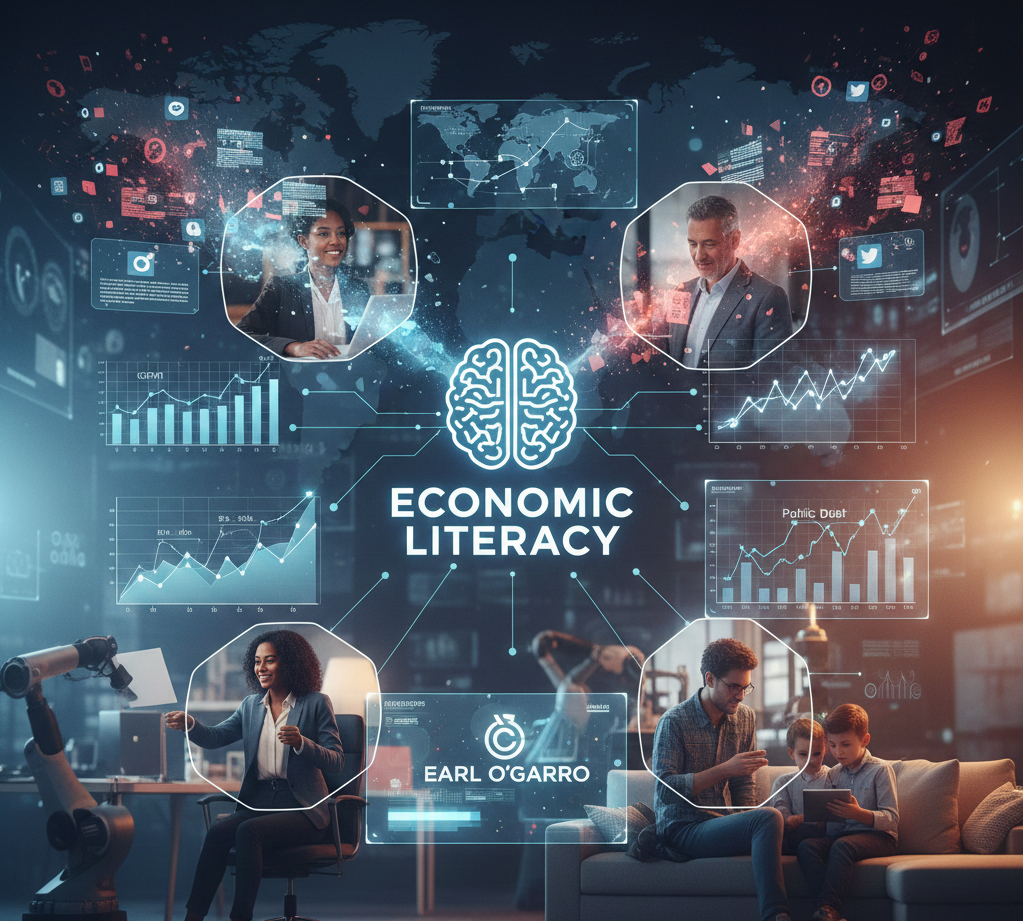
In an era defined by rapid technological change, geopolitical tension, rising public debt, inflationary cycles, and widening inequality, economic literacy is no longer a niche skill reserved for policymakers, academics, or financial professionals. It has become a foundational competency for citizens, entrepreneurs, workers, and voters alike.
Understanding how economies function—how money flows, how governments tax and spend, how markets respond to policy, and how global forces shape local outcomes—empowers individuals to make informed decisions and hold institutions accountable. In a world where economic narratives increasingly shape political discourse and public policy, economic literacy is not simply helpful; it is essential.
This article explores why economic literacy matters more than ever, how it shapes personal and collective outcomes, and why platforms that provide data-driven financial insights—such as Earl O’Garro—play a crucial role in elevating public understanding.
The Expanding Definition of Economic Literacy
Economic literacy once meant a basic understanding of supply and demand, inflation, unemployment, and interest rates. Today, its scope has expanded significantly.
Modern economic literacy includes:
- Understanding how central bank policies influence borrowing costs.
- Recognizing how fiscal deficits affect long-term growth.
- Interpreting data such as GDP, CPI, and labor market trends.
- Evaluating public spending and taxation policies.
- Understanding the implications of global trade and capital flows.
- Identifying misinformation in economic reporting.
It also includes the ability to critically assess political rhetoric that relies on economic claims. Whether discussing tax cuts, welfare programs, trade tariffs, or debt ceilings, economic arguments underpin nearly every major public policy debate.
Without a working knowledge of economic principles, citizens are left vulnerable to oversimplified narratives and emotionally charged messaging that may obscure the true trade-offs involved.
Economic Decisions Shape Everyday Life
Economic forces influence daily life more than most people realize. Consider a few examples:
- Mortgage rates rise due to central bank tightening.
- Grocery prices increase because of supply chain disruptions.
- Wages stagnate in certain industries due to automation.
- Small businesses struggle under shifting tax regulations.
- Retirement savings fluctuate based on market conditions.
Each of these outcomes is rooted in economic dynamics. When individuals understand these dynamics, they can adapt more effectively.
A person who understands inflation, for example, may choose to diversify savings or seek investments that hedge against rising prices. Someone who understands debt cycles may avoid overleveraging during low-interest periods. A small business owner with economic awareness can better anticipate regulatory or fiscal changes.
Economic literacy transforms passive reaction into proactive strategy.
The Information Age and the Risk of Misinformation
The digital age has democratized information—but also misinformation. Economic topics are often reduced to headlines, tweets, and viral commentary that strip away nuance.
Inflation becomes a partisan blame game. Public debt becomes a political talking point rather than a complex structural issue. Market volatility is framed as crisis rather than cyclical adjustment.
Economic literacy provides a defense against this distortion.
When individuals understand basic concepts such as:
- The difference between nominal and real growth,
- The lag effects of monetary policy,
- The structural versus cyclical components of unemployment,
they are less likely to be misled by sensational claims.
Credible, data-driven analysis is increasingly valuable in this environment. Platforms offering expert financial and political insights—like at earlogarro.com help bridge the gap between technical economic data and accessible public understanding.
The Political-Economic Nexus
Economic literacy is deeply intertwined with civic responsibility. Virtually every political decision has economic consequences:
- Infrastructure spending affects employment and productivity.
- Tax reform influences income distribution and investment incentives.
- Healthcare policy impacts labor mobility and fiscal sustainability.
- Energy policy shapes inflation, trade balances, and industrial growth.
Yet many voters evaluate these policies without a clear understanding of their economic implications.
A well-informed electorate is better equipped to:
- Assess campaign promises realistically.
- Recognize long-term fiscal sustainability challenges.
- Evaluate trade-offs between growth and equity.
- Demand transparency and accountability in public spending.
Political narratives often simplify economic realities for strategic gain. Economic literacy enables citizens to move beyond slogans and ask deeper questions:
- How will this policy be funded?
- What are the opportunity costs?
- Who benefits, and who bears the burden?
- What are the short-term versus long-term consequences?
In this sense, economic literacy strengthens democratic institutions.
The Rise of Financial Complexity
Financial systems today are more interconnected and sophisticated than ever before. From derivatives markets to digital currencies, from sovereign debt instruments to algorithmic trading, modern finance operates on layers of abstraction that can be difficult to navigate.
While individuals are not required to become experts in advanced financial instruments, they do benefit from understanding foundational concepts such as:
- Risk and return trade-offs,
- Diversification,
- Asset allocation,
- Liquidity,
- Credit cycles.
Economic literacy also includes awareness of systemic risk—the idea that instability in one part of the financial system can ripple outward. The global financial crisis demonstrated how interconnected economies are. Even individuals far removed from financial markets experienced job losses, housing market collapses, and retirement account declines.
Greater public understanding of financial mechanisms can foster more responsible borrowing, more informed investing, and more prudent regulatory expectations.
Inflation, Debt, and the New Economic Reality
In recent years, inflation has returned as a central economic concern in many economies. For decades, stable prices lulled much of the public into viewing inflation as a relic of the past. That assumption proved fragile.
Understanding inflation requires grasping several interrelated concepts:
- Monetary supply expansion,
- Supply-side constraints,
- Wage-price dynamics,
- Fiscal stimulus effects,
- Global commodity markets.
Similarly, public and private debt levels have reached historic highs in many countries. Debt itself is not inherently problematic; it can finance growth and investment. However, unsustainable debt trajectories can limit policy flexibility and impose burdens on future generations.
Economic literacy equips citizens to engage with these issues constructively. Rather than reacting to rising prices with confusion or fear, informed individuals can analyze root causes and evaluate policy responses more effectively.
Globalization and Interdependence
No economy operates in isolation. Trade networks, capital flows, migration patterns, and geopolitical developments all shape domestic economic conditions.
Supply chain disruptions during global crises revealed how deeply interdependent modern economies are. Energy markets, semiconductor production, and agricultural exports demonstrated that localized disruptions can have global price effects.
Economic literacy in the 21st century therefore requires a global perspective. Individuals benefit from understanding:
- Exchange rates and their impact on trade,
- Trade balances and deficits,
- Geopolitical risk and its economic consequences,
- The dynamics of emerging markets.
This broader awareness allows businesses to plan strategically and citizens to contextualize domestic challenges within global frameworks.
Entrepreneurship and Economic Awareness
Entrepreneurship thrives on economic insight. Business founders must anticipate demand, evaluate competitive landscapes, and respond to macroeconomic conditions.
A startup launched during a low-interest-rate environment may benefit from easier access to capital. However, if interest rates rise sharply, borrowing costs increase and consumer spending may contract. An economically literate entrepreneur recognizes these cycles and builds resilience accordingly.
Small business owners also interact with tax systems, regulatory frameworks, labor markets, and credit institutions. Understanding these economic factors enhances strategic planning and risk management.
Economic literacy, in this sense, supports innovation and growth.
Personal Financial Empowerment
Perhaps the most immediate benefit of economic literacy is personal financial empowerment.
Individuals who understand:
- Compound interest,
- Inflation-adjusted returns,
- Credit scoring systems,
- Budgeting principles,
- Long-term investment strategies,
are better positioned to build financial security.
Moreover, economic literacy reduces vulnerability to predatory financial practices. High-interest debt traps, misleading investment schemes, and unrealistic financial promises often target individuals with limited economic understanding.
When people grasp core financial principles, they are more confident in asking questions, seeking advice, and making deliberate decisions.
Inequality and Social Mobility
Economic literacy also plays a role in addressing inequality. Wealth gaps often correlate with disparities in financial knowledge and access to economic education.
When economic concepts are accessible only to a narrow segment of society, opportunities become unevenly distributed. Those who understand capital markets, tax optimization, and long-term investment strategies accumulate wealth more effectively.
Promoting economic literacy across communities can:
- Improve social mobility,
- Encourage entrepreneurship,
- Reduce dependency on misinformation,
- Empower individuals to advocate for equitable policies.
However, economic literacy alone does not solve structural inequality. It must be paired with access to opportunity, education, and fair institutional frameworks. Still, informed citizens are better equipped to identify systemic barriers and propose viable solutions.
The Role of Independent Economic Commentary
In a media landscape often shaped by partisan framing, independent analysis is increasingly important. Readers benefit from commentary that emphasizes data, context, and critical thinking rather than ideological allegiance.
The work of commentators such as Earl O’Garro exemplifies the value of combining political awareness with financial expertise. Clear, evidence-based interpretation helps readers connect economic data with real-world implications.
Platforms dedicated to delivering structured, analytical perspectives foster deeper understanding. They encourage readers to move beyond headlines and engage with the structural forces shaping markets and policy.
Technology, Automation, and Labor Markets
Technological advancement continues to reshape labor markets. Automation, artificial intelligence, and digital platforms are transforming industries at unprecedented speed.
Economic literacy helps individuals understand:
- Structural unemployment versus cyclical unemployment,
- Skill-biased technological change,
- Productivity growth,
- Wage polarization.
Workers who understand these dynamics can adapt by acquiring in-demand skills and anticipating shifts in labor demand. Policymakers, meanwhile, can design more effective retraining and social support programs when they consider economic realities rather than reactive measures.
Technological disruption is inevitable; informed adaptation is optional.
Economic Literacy and Crisis Preparedness
Economic downturns are cyclical. Recessions, financial contractions, and market corrections are recurring features of economic systems.
While no one can predict the exact timing of crises, economic literacy improves preparedness. Individuals and businesses that understand economic cycles are more likely to:
- Maintain emergency savings,
- Avoid excessive leverage,
- Diversify income streams,
- Build adaptable business models.
Similarly, voters with economic awareness can evaluate stimulus measures, fiscal interventions, and monetary responses during crises with greater discernment.
Preparedness reduces panic. Understanding reduces fear.
Education Systems and the Economic Gap
Despite its importance, economic education often receives limited emphasis in formal schooling. Basic financial literacy courses may exist, but deeper macroeconomic understanding is frequently absent from curricula.
This gap leaves many adults navigating complex financial and policy environments without foundational knowledge.
Integrating economic literacy into education systems could include:
- Practical financial management training,
- Data interpretation exercises,
- Analysis of fiscal policy case studies,
- Critical evaluation of economic news reporting.
Early exposure fosters lifelong competence.
The Responsibility of Media and Analysts
As economic issues dominate headlines—from inflation spikes to government spending debates—media outlets and analysts carry significant responsibility.
Clear communication is essential. Overly technical jargon alienates readers, while oversimplification distorts reality.
Effective economic communication balances:
- Accuracy,
- Accessibility,
- Context,
- Transparency about uncertainty.
Readers benefit from platforms that approach economic issues methodically, drawing connections between data and policy implications without sensationalism.
Public Debt and Generational Accountability
One of the defining economic challenges of the modern era is rising public debt. While borrowing can stimulate growth during downturns, persistent structural deficits raise questions about long-term sustainability.
Economic literacy allows citizens to evaluate:
- Debt-to-GDP ratios,
- Interest payment burdens,
- Intergenerational equity,
- Trade-offs between spending priorities.
Rather than reacting emotionally to large debt figures, informed individuals can assess whether debt is financing productive investment or merely covering recurring shortfalls.
This understanding is crucial for generational accountability. Future taxpayers inherit today’s fiscal decisions.
Environmental Economics and Sustainability
Climate change and environmental sustainability are increasingly economic issues. Carbon pricing, green investment, renewable energy transitions, and environmental regulation all involve complex economic trade-offs.
Economic literacy helps citizens and businesses evaluate:
- Cost-benefit analyses of environmental policy,
- Market incentives for innovation,
- The economic impact of environmental degradation,
- The role of public versus private investment in sustainability.
Balancing growth with environmental responsibility requires informed debate grounded in economic reasoning.
Digital Currencies and Monetary Evolution
The emergence of digital currencies and decentralized financial systems adds another layer of complexity to economic literacy.
Understanding digital assets involves:
- Monetary theory,
- Blockchain technology basics,
- Regulatory frameworks,
- Risk assessment.
While enthusiasm around digital finance is high, so too are risks and volatility. Economic literacy enables individuals to approach innovation with both openness and caution.
Economic Literacy as a Tool for Stability
Ultimately, economic literacy contributes to societal stability.
When citizens understand economic realities:
- Panic-driven market behavior decreases.
- Policy debates become more substantive.
- Democratic accountability strengthens.
- Long-term planning improves.
Economic systems rely on trust—trust in institutions, markets, and governance structures. Transparency and understanding reinforce that trust.
Moving From Awareness to Action
Recognizing the importance of economic literacy is only the first step. Action requires:
- Seeking credible, data-driven sources.
- Engaging with long-form analysis rather than relying solely on headlines.
- Questioning assumptions and verifying claims.
- Encouraging economic education within communities.
Independent platforms that blend political and financial insight provide valuable resources in this effort. By connecting macroeconomic trends with public policy analysis, they help readers interpret complex developments with clarity.
Conclusion: An Essential Competency for a Complex World
Economic literacy is no longer optional. It is a fundamental skill for navigating modern life.
From personal financial decisions to national elections, from entrepreneurship to retirement planning, economic forces shape opportunities and risks at every level. As economies grow more interconnected and policy debates more polarized, the ability to understand economic fundamentals becomes a pillar of responsible citizenship.
Informed individuals make better decisions. Informed voters demand better governance. Informed entrepreneurs build more resilient businesses.
The challenges of inflation, debt, technological disruption, inequality, and global instability are not temporary anomalies—they are defining features of our era. Meeting these challenges requires more than opinion; it requires understanding.
Economic literacy empowers individuals to move beyond reactive commentary and toward thoughtful analysis. It transforms economic headlines from sources of confusion into opportunities for insight.
In a time of complexity and change, that empowerment matters more than ever.
Read more here!
