

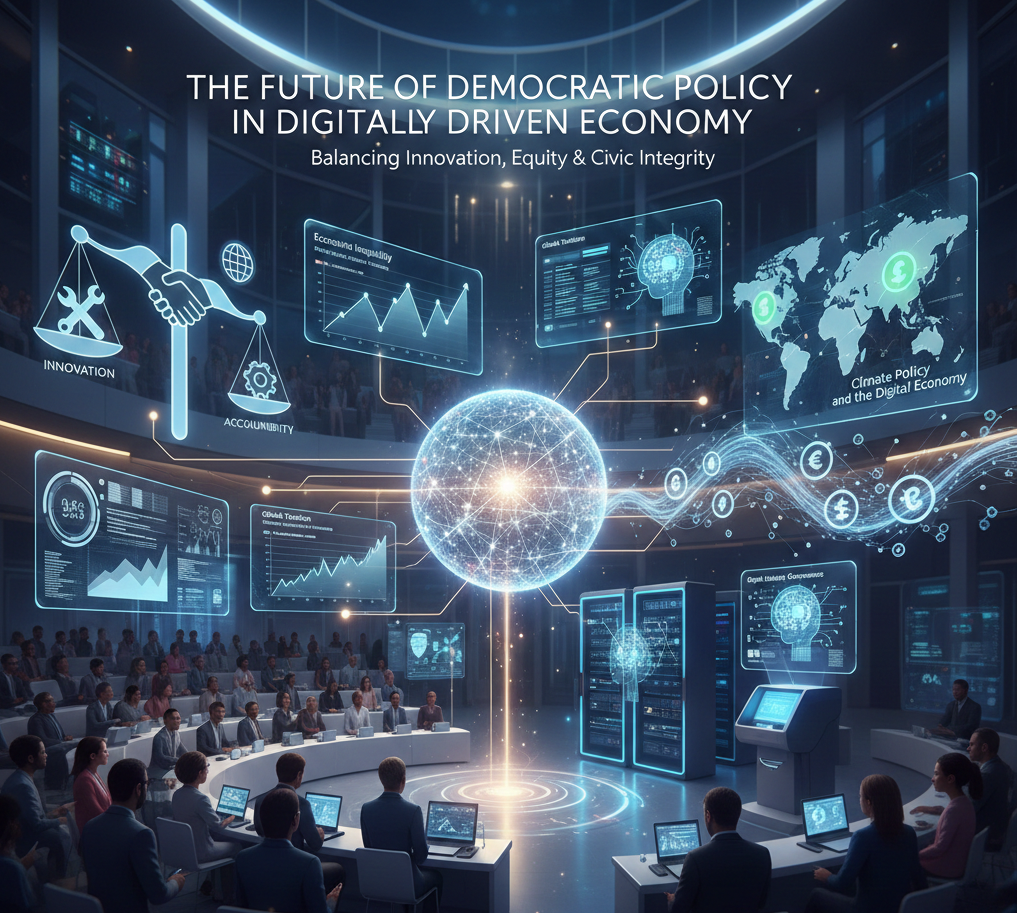
In the early decades of the 21st century, democracy has entered uncharted terrain. The rapid digitization of economies, the rise of platform capitalism, the ubiquity of data, and the increasing influence of artificial intelligence have reshaped how societies produce wealth, distribute opportunity, and govern themselves. From financial markets powered by algorithms to political campaigns fueled by targeted advertising, digital technologies are no longer peripheral—they are central to democratic life.
The future of democratic policy in a digitally driven economy will depend on how effectively governments balance innovation with accountability, growth with equity, and technological dynamism with civic integrity. This transformation demands fresh thinking about regulation, taxation, labor markets, financial oversight, data governance, and democratic participation itself.
This article explores how democratic systems can evolve to meet the demands of a digital economy while safeguarding core values: transparency, fairness, accountability, and equal opportunity.
The Digital Economy: A Structural Shift
The digital economy is not merely an extension of the industrial age; it represents a structural shift comparable to the industrial revolution itself. Unlike traditional sectors built around physical capital, digital markets revolve around intangible assets—data, algorithms, intellectual property, and networks.
Major technology corporations have achieved unprecedented scale by leveraging network effects, where the value of a service increases as more people use it. Platforms such as Amazon, Google, Meta, and Apple illustrate how digital infrastructure can concentrate market power rapidly. Their dominance raises questions about competition policy, consumer protection, data ownership, and political influence.
Democratic policy frameworks built for industrial-era monopolies must now grapple with platform ecosystems that transcend borders, operate at lightning speed, and accumulate data at scale.
Data as the New Economic Currency
Data has emerged as the primary economic asset of the digital age. Every click, transaction, and interaction generates information that can be monetized, analyzed, and weaponized.
In democratic societies, the governance of data will define the contours of future public policy. Questions of ownership, consent, surveillance, and privacy have become central political issues. Regulations such as the European Union’s General Data Protection Regulation (GDPR) signal attempts to reassert democratic control over digital markets.
However, democratic policy must move beyond privacy frameworks. The core challenges include:
- Defining property rights around data.
- Preventing monopolistic control over datasets.
- Ensuring algorithmic transparency.
- Protecting citizens from political manipulation.
The experience of election interference controversies involving platforms like Facebook demonstrates how digital systems can distort democratic processes. The digital economy does not merely influence markets—it reshapes political power.
Democratic Institutions in a Platform Age
Digital transformation affects not only economic structures but democratic institutions themselves. Social media has altered public discourse, accelerated information cycles, and increased polarization. Policymakers now face a paradox: platforms amplify participation while also fragmenting consensus.
Future democratic policy must address:
- Platform accountability – establishing clear rules for content moderation without undermining free speech.
- Political advertising transparency – limiting micro-targeting practices that exploit personal data.
- Digital literacy investment – empowering citizens to navigate misinformation.
- Algorithmic auditing – requiring independent oversight of automated decision systems.
The growing intersection between financial markets and digital technologies further complicates the picture. High-frequency trading, cryptocurrency markets, and algorithmic asset management operate with minimal friction and global reach. Without robust oversight, democratic institutions risk falling behind technological momentum.
For ongoing analysis of how financial systems intersect with political governance, platforms like Earl O’Garro’s expert insights offer data-driven perspectives that bridge public policy and economic realities.
Economic Inequality in the Digital Era
One of the most pressing concerns for democratic societies is inequality. While digital innovation has generated immense wealth, it has also contributed to disparities in income, geography, and opportunity.
The digital economy rewards highly skilled workers and owners of capital disproportionately. Meanwhile, automation threatens routine labor sectors. Gig work platforms provide flexibility but often lack labor protections.
Democratic policy must therefore consider:
- Updating labor laws to account for gig and remote work.
- Expanding social safety nets for displaced workers.
- Investing in digital education and re-skilling programs.
- Reforming tax systems to capture value from intangible capital.
Without policy adaptation, digital growth may widen socioeconomic gaps and undermine public trust in democratic systems.
Taxation in a Borderless Economy
Traditional tax systems are built on physical presence and territoriality. Digital corporations, however, generate revenue across jurisdictions without substantial physical footprints. This mismatch has sparked global debates on corporate taxation.
The OECD-led global minimum tax initiative represents a step toward rebalancing fiscal sovereignty in the digital age. Democratic governments must coordinate internationally to prevent profit shifting and tax avoidance.
Effective taxation policy will be central to funding infrastructure, education, healthcare, and climate initiatives—pillars that sustain democratic legitimacy.
Artificial Intelligence and Policy Governance
Artificial intelligence (AI) introduces new layers of complexity. From predictive policing to credit scoring and automated hiring, algorithmic systems increasingly influence life outcomes.
Democratic governance must confront several AI-related questions:
- How to ensure fairness and avoid algorithmic bias?
- Who is accountable when AI systems fail?
- Should certain uses of AI be prohibited outright?
- How can public sector AI adoption remain transparent?
Regulatory proposals in various jurisdictions suggest tiered approaches based on risk levels. The balance between innovation and ethical oversight will shape public trust in technology-driven governance.
Digital Financial Systems and Monetary Sovereignty
The rise of cryptocurrencies and decentralized finance (DeFi) challenges traditional monetary systems. While digital currencies promise efficiency and inclusion, they also pose risks related to fraud, volatility, and systemic stability.
Central banks are exploring Central Bank Digital Currencies (CBDCs) as a way to modernize payment systems while preserving monetary sovereignty.
Democratic policymakers must weigh innovation against financial stability. Oversight mechanisms should aim to protect consumers without stifling beneficial experimentation.
The intersection of digital finance and political economy is increasingly complex. For readers seeking broader analysis of these evolving dynamics, Earl O’Garro’s financial and political analysis platform provides perspectives grounded in data and policy evaluation.
Civic Participation in a Digital Society
Digitization offers opportunities to enhance democratic participation. Online voting systems, digital town halls, and open data initiatives can increase transparency and engagement.
However, cybersecurity threats, misinformation campaigns, and digital exclusion remain obstacles.
To strengthen democratic resilience, policymakers should prioritize:
- Secure digital identity frameworks.
- Investment in public digital infrastructure.
- Protection against cyberattacks.
- Open government data initiatives to foster accountability.
Democracy in the digital age must be both technologically sophisticated and ethically grounded.
Climate Policy and the Digital Economy
The digital economy intersects with climate policy in profound ways. Data centers consume substantial energy, yet digital tools also enable efficiency gains across industries.
Smart grids, predictive analytics, and AI-driven optimization can accelerate decarbonization efforts. Democratic policy must align digital innovation with environmental sustainability.
Carbon pricing mechanisms, green investment incentives, and infrastructure modernization programs will require coordinated digital integration.
The Global Dimension
No democratic nation operates in isolation. Digital markets transcend borders, creating regulatory arbitrage opportunities and geopolitical tensions.
Competition between democratic and authoritarian models of digital governance adds further complexity. While some regimes emphasize state control and surveillance, democratic societies prioritize civil liberties and market freedom.
The future of democratic policy will involve multilateral cooperation on standards for data governance, cybersecurity, and trade.
Reimagining Social Contracts
At its core, democratic policy in a digitally driven economy must redefine the social contract.
Citizens expect:
- Fair economic opportunity.
- Transparent governance.
- Protection of rights.
- Responsible innovation.
Governments must adapt institutional frameworks without compromising democratic principles.
Education and Human Capital
Digital transformation demands lifelong learning. Democratic policy should emphasize:
- STEM education expansion.
- Digital literacy programs.
- Public-private partnerships for workforce training.
- Accessible higher education funding models.
Human capital investment remains the most sustainable defense against inequality.
Regulatory Agility and Adaptive Governance
Traditional policymaking often moves slowly, while digital innovation evolves rapidly. Democratic systems must cultivate regulatory agility without sacrificing deliberation.
Tools such as regulatory sandboxes, sunset clauses, and dynamic oversight bodies can help bridge the gap.
Adaptive governance models allow experimentation while maintaining accountability.
Conclusion: Democracy at a Crossroads
The future of democratic policy in a digitally driven economy will not be determined solely by technology. It will depend on choices—policy choices, institutional reforms, civic engagement, and international cooperation.
Digital transformation offers extraordinary promise: productivity gains, expanded access to services, new economic sectors, and innovative forms of participation. Yet it also presents risks: inequality, concentration of power, erosion of privacy, and democratic destabilization.
The path forward requires balancing innovation with regulation, efficiency with equity, and globalization with sovereignty.
Democracy has evolved before—from agrarian societies to industrial powerhouses. It now faces another transformative chapter. With deliberate, informed policymaking grounded in data and democratic values, the digitally driven economy can become a force not only for growth but for inclusive prosperity and strengthened governance.
The coming decades will test the resilience of democratic systems. Whether they emerge stronger will depend on how effectively they shape the digital future rather than merely react to it.
Read more here!
