

Compensation is one of the most powerful tools an organization has. It affects retention, performance, engagement, and profitability all at once. Yet in many enterprises, compensation planning is still treated as an annual administrative task instead of a strategic function.
That approach no longer works.
As organizations scale across regions, hire globally, and face increased scrutiny around pay equity, compensation becomes more complex. Leaders need visibility, governance, and forecasting — not just spreadsheets and approval chains.
This is where enterprise compensation management becomes critical.
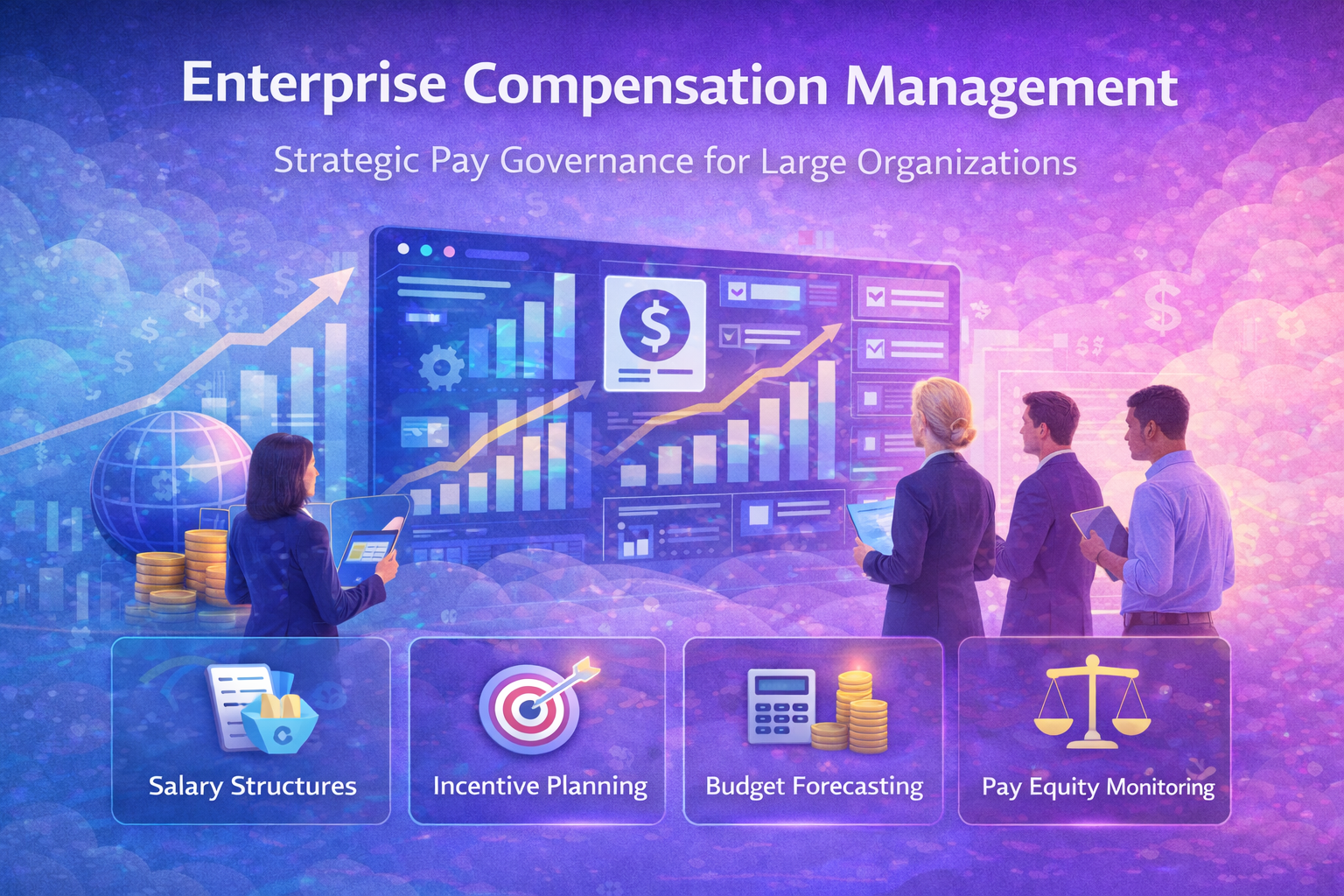
Enterprise compensation management is the structured, technology-enabled strategy for designing, administering, and optimizing pay across large organizations. It integrates salary structures, incentives, budget control, compliance, and performance alignment into one cohesive system.
When done well, it transforms compensation from a reactive cost center into a strategic growth lever.
What Is Enterprise Compensation Management?
Enterprise compensation management (ECM) is the comprehensive approach to planning and governing employee pay at scale. It includes:
- Salary band architecture
- Merit increase planning
- Incentive and bonus allocation
- Budget forecasting and tracking
- Pay equity monitoring
- Structured approval workflows
- Compliance and audit documentation
Unlike payroll systems, which focus on processing pay accurately, ECM focuses on making compensation decisions intelligently.
It connects HR, finance, and executive leadership through shared data and structured governance.
Why Enterprise Compensation Requires Structure
Compensation planning becomes exponentially more complex as organizations grow.
In small teams, pay decisions may be informal. In enterprises with thousands of employees, even small percentage changes can represent millions in payroll impact.
Without structured compensation management, companies face risks such as:
- Salary compression between new hires and existing employees
- Inconsistent merit increases across departments
- Budget overruns
- Lack of transparency in pay decisions
- Compliance exposure in regulated markets
- Reduced employee trust
Enterprise compensation management addresses these risks by centralizing and standardizing pay decisions.
Core Components of Enterprise Compensation Management
To operate effectively at scale, enterprises must manage an AI compensation agent across several interconnected layers.
1. Salary Band Architecture
Salary ranges form the backbone of compensation strategy. Clear minimum, midpoint, and maximum bands ensure:
- Internal equity
- Competitive market positioning
- Structured career progression
Well-designed salary bands reduce negotiation-based disparities and create predictable growth pathways.
2. Merit and Incentive Planning
Compensation cycles typically include annual or semi-annual merit reviews.
Enterprise systems allow organizations to:
- Allocate merit budgets by department
- Track distribution in real time
- Align increases with performance ratings
- Apply consistent placement guidelines
Variable pay programs, including bonuses and incentives, must also align with company objectives to reinforce strategic goals.
3. Budget Governance and Forecasting
Compensation represents one of the highest operational costs in most organizations.
Enterprise compensation management integrates financial oversight by enabling:
- Department-level budget caps
- Real-time payroll impact tracking
- Forecast modeling for future cycles
- Scenario simulations before approvals
This integration ensures compensation decisions remain financially sustainable.
4. Pay Equity and Compliance
Regulatory pressure around pay transparency and equity continues to increase globally.
Structured compensation management systems help organizations:
- Monitor gender and demographic pay gaps
- Detect outliers automatically
- Maintain documentation for audits
- Enforce internal pay guidelines consistently
Proactive equity oversight protects both reputation and compliance standing.
5. Workflow and Governance
Clear approval hierarchies are essential in large organizations.
Enterprise compensation management platforms provide:
- Role-based access
- Manager-level review dashboards
- HR oversight controls
- Executive-level reporting
This governance framework prevents ad hoc decision-making and ensures accountability.
The Strategic Value of Enterprise Compensation Management
When properly implemented, enterprise compensation management delivers benefits beyond administrative efficiency.
Stronger Talent Retention
Transparent and structured pay frameworks increase trust. Employees are more likely to remain in organizations where compensation feels fair and predictable.
Financial Predictability
Integrated forecasting reduces payroll surprises. Leadership can assess compensation impact before approving increases.
Improved Decision Speed
Automated workflows and centralized systems shorten compensation cycles without sacrificing control.
Reduced Bias and Inconsistency
Structured placement guidelines and centralized oversight reduce reliance on individual manager discretion.
Better Alignment With Business Goals
Compensation tied to measurable performance outcomes reinforces strategic priorities across the organization.
Common Challenges in Enterprise Compensation Management
Despite its advantages, ECM implementation presents challenges.
Data Fragmentation
When compensation data lives in multiple systems, visibility is limited and errors increase.
Resistance to Change
Managers accustomed to informal processes may resist structured frameworks.
Global Complexity
Multi-country organizations must manage varying labor laws, currency fluctuations, and regional market differences.
Equity Adjustments
Correcting legacy pay inconsistencies can be financially and politically sensitive.
Addressing these challenges requires executive alignment and thoughtful system design.
The Role of Technology in Modern ECM
Technology has become central to effective enterprise compensation management.
Modern compensation platforms enable:
- Centralized compensation databases
- Automated budget monitoring
- Integrated performance data
- Scenario modeling tools
- Real-time analytics dashboards
Advanced systems may also include AI-driven recommendations and policy-aware automation, further strengthening governance and decision quality.
The shift toward intelligent compensation systems reflects the growing complexity of workforce management.
Enterprise Compensation as a Competitive Advantage
Organizations that treat compensation as a strategic discipline outperform those that treat it as an annual administrative exercise.
In competitive talent markets, companies must:
- Offer competitive salary structures
- Maintain internal equity
- Respond quickly to market changes
- Protect long-term financial stability
Enterprise compensation management provides the infrastructure to do all four.
When compensation is structured, transparent, and data-driven, it supports:
- Employee engagement
- Employer branding
- Leadership credibility
- Shareholder confidence
Future Trends in Enterprise Compensation Management
The future of ECM is moving toward greater intelligence and integration.
Key trends include:
- Predictive compensation modeling
- Real-time equity tracking
- Deeper HR–finance collaboration
- Greater pay transparency
- Global compensation harmonization
As organizations expand and regulatory expectations rise, structured compensation governance will become a baseline requirement rather than a competitive differentiator.
Final Thoughts
Enterprise compensation management is no longer optional for growing organizations. It is the framework that ensures pay decisions are fair, financially responsible, and aligned with strategic objectives.
In large enterprises, compensation affects more than payroll. It influences culture, retention, trust, and long-term growth.
By adopting a structured, data-driven approach to compensation planning, organizations gain control, transparency, and strategic clarity.
The question is no longer whether compensation needs structure.
The question is whether your current system can scale with your workforce.
