
In the rapidly evolving world of digital platforms, businesses must keep pace with the constant demand for flexibility, scalability, and seamless user experiences. Content management systems (CMS) are at the heart of this transformation, as they allow businesses to create, manage, and distribute content across multiple channels efficiently. However, the CMS landscape is shifting. Traditional CMS platforms are giving way to modern, headless solutions like Contentful, which offers increased flexibility and better integration with modern tech stacks.
When evaluating CMS solutions, businesses often face a critical decision: Should they stick with traditional CMS, or should they embrace a headless CMS solution like Contentful? This article compares Contentful CMS and traditional CMS platforms, highlighting their advantages, challenges, and the specific use cases in which each is best suited. Additionally, we’ll explore how Contentful development services can help businesses leverage the full potential of Contentful for modern, flexible, and scalable digital platforms.
What is a Traditional CMS?
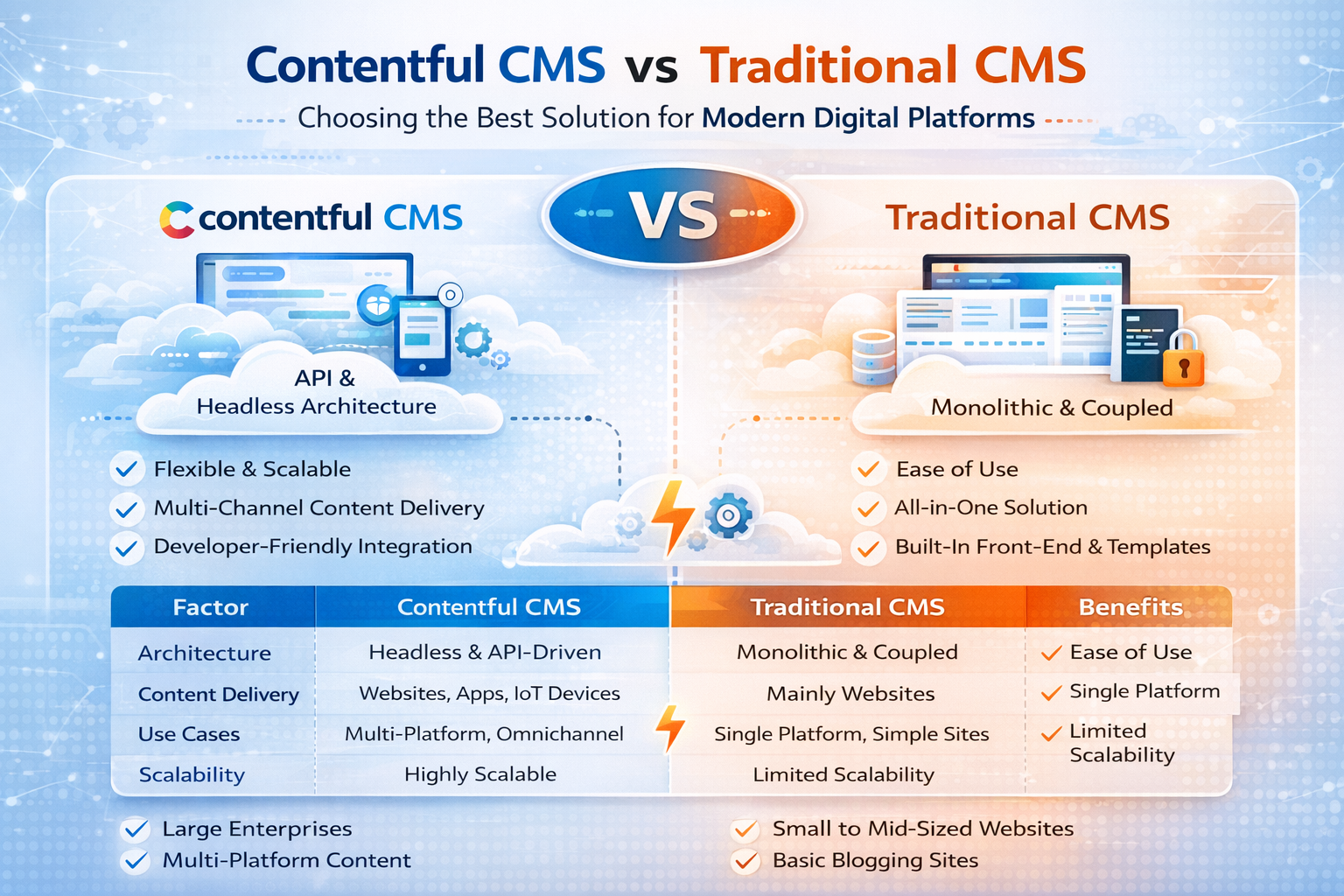
A traditional CMS is a platform designed to handle both the content creation and presentation layers of a website or application. Well-known examples of traditional CMS platforms include WordPress, Joomla, and Drupal. These systems allow businesses to create and manage content easily, with built-in templates and a user-friendly interface for content creators and editors.
Traditional CMS platforms come with a built-in front-end, which is the presentation layer of the website. This means that the content management system controls how content is displayed to the end-user. While these platforms provide a streamlined experience for users with no technical background, they often become cumbersome when handling complex digital ecosystems that require frequent updates across multiple channels.
What is Contentful?
Contentful is a modern, headless CMS that focuses solely on the content management layer, leaving the presentation layer to be handled separately. Unlike traditional CMS platforms, Contentful does not dictate how content is displayed. Instead, it offers content as structured data that can be retrieved via an API and displayed across any platform, such as websites, mobile apps, or IoT devices.
This headless architecture allows businesses to have complete control over how content is presented, making it an ideal choice for modern digital platforms that require multi-channel distribution, flexibility, and scalability. Additionally, Contentful development services enable organizations to customize and integrate the CMS with their existing tech stacks, ensuring that it meets the unique needs of their digital platforms.
Advantages of Traditional CMS
1. Ease of Use
One of the main benefits of traditional CMS platforms is their ease of use. These systems are designed with a user-friendly interface that allows content creators, editors, and even non-technical users to manage and update content easily. With a traditional CMS, everything from content creation to publishing is integrated into one system. There is no need for developers to build custom solutions or handle API integrations.
2. Built-in Front-End
Traditional CMS platforms come with pre-built templates, making it easy to launch a website without much development effort. These systems offer themes and layouts that are ready to use, which can save businesses time and resources in the design and development process.
3. All-in-One Solution
For small to medium-sized businesses with basic content management needs, traditional CMS platforms can be an excellent all-in-one solution. Everything from the back-end content creation to the front-end presentation is handled within the same system. This makes traditional CMS a great option for those who do not need the complexity or customization that a headless CMS offers.
Advantages of Contentful
1. Flexibility
Contentful’s headless architecture is its defining feature. Since it focuses purely on content management and leaves the presentation layer to be handled separately, businesses can use the same content across a variety of channels. Whether it’s a website, mobile app, or digital display, Contentful allows content to be delivered in any format or design without limitations.
This flexibility is particularly valuable for businesses that want to create a seamless experience across multiple touchpoints. For example, an online retailer can use Contentful to manage product data and present it in multiple ways on different platforms, such as an e-commerce site, mobile app, or even within email marketing campaigns.
2. Scalability
As businesses grow, their digital ecosystems often become more complex. Contentful is designed to scale with growing demands, making it an ideal solution for large enterprises or businesses with complex content needs. With Contentful, businesses can handle large volumes of content, integrate with multiple APIs, and adapt to changes in technology as needed.
The separation of content and presentation in a headless CMS like Contentful also makes it easier to scale both the content creation process and the way content is delivered. For example, businesses can add new digital platforms or channels without disrupting the existing content management process.
3. Multi-Channel Distribution
One of the most significant advantages of Contentful is its ability to deliver content across multiple channels. Traditional CMS platforms are often limited in this regard, as they are primarily focused on delivering content to websites. However, Contentful allows businesses to distribute content to websites, mobile applications, IoT devices, voice assistants, and more. This multi-channel capability is particularly useful in today’s omnichannel world, where consumers expect consistent experiences across devices.
When to Choose Traditional CMS
Traditional CMS platforms are an excellent choice for businesses that have simpler content management needs and are focused on managing content for a single platform, such as a website. They are ideal for:
- Small to medium-sized businesses with limited technical resources.
- Organizations that need an all-in-one, user-friendly solution for managing content.
- Projects that do not require the flexibility and scalability of a headless CMS.
- Companies with a simple website structure and minimal need for multi-channel content distribution.
When to Choose Contentful
Contentful is best suited for modern businesses that need a flexible, scalable solution for managing content across multiple channels and platforms. It is ideal for:
- Large enterprises with complex content management needs.
- Businesses that need to distribute content across websites, mobile apps, and IoT devices.
- Organizations that need to integrate content with multiple technologies, such as marketing automation, e-commerce, and CRM systems.
- Companies with development teams that require a CMS that can be customized and integrated with other tools and APIs.
Conclusion
When it comes to choosing between Contentful CMS and traditional CMS, businesses must carefully assess their specific needs, goals, and available resources. Traditional CMS platforms like WordPress and Drupal offer simplicity, ease of use, and built-in solutions for smaller projects. However, for modern, multi-platform, and scalable solutions, a headless CMS like Contentful is the clear winner. Contentful provides flexibility, scalability, and multi-channel distribution, making it a great choice for businesses that want to stay ahead in today’s fast-paced digital landscape.
For companies looking to maximize the potential of Contentful, Contentful development services provide the expertise needed to fully integrate and customize the platform to meet business requirements. With the right development support, businesses can unlock the full power of Contentful, ensuring seamless content management and delivery across all digital platforms
