

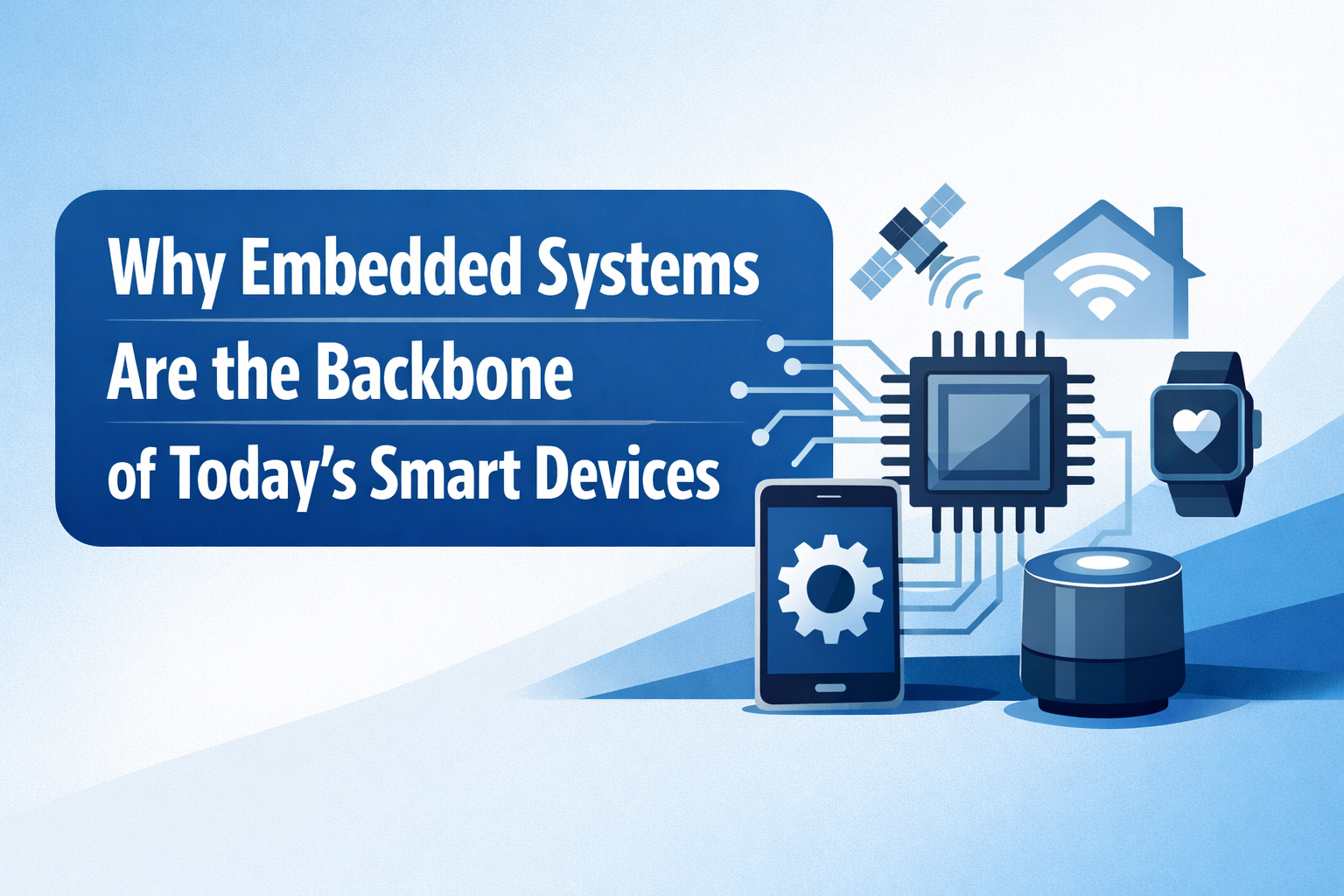
In today’s hyperconnected world, the seamless integration of technology into everyday life is often invisible yet essential. From the smartwatch that tracks your pulse to the smart thermostat that learns your temperature preferences, these devices rely on small, dedicated processors embedded within their hardware. The design and optimization of such processors are driven by specialized embedded software development services that ensure reliability, low power consumption, and rapid response times. By embedding complex logic directly into the device, manufacturers can deliver instant feedback, reduce latency, and maintain a compact form factor that would be impossible with a general‑purpose computer. Moreover, the embedded nature of these systems allows them to operate autonomously, even in environments where connectivity is intermittent or unavailable. This autonomy is critical for applications such as industrial automation, medical monitoring, and autonomous vehicles, where real‑time decision making can directly impact safety and performance.
What Are Embedded Systems?
Embedded systems are specialized computing units designed to perform a specific set of functions within a larger system. Unlike general-purpose computers that run diverse operating systems and applications, embedded systems run tightly coupled firmware or lightweight operating systems tailored to their task. Their architecture typically prioritizes deterministic behavior, minimal memory footprint, and efficient power usage. These constraints drive developers to choose optimized hardware, real-time operating systems, and streamlined software stacks that can meet stringent timing and reliability requirements. As a result, embedded systems are often the critical components that enable complex products to function smoothly and safely.
The Ubiquity of Smart Devices
The proliferation of smart devices has turned embedded systems into the invisible backbone of modern life. Smartphones, smart speakers, wearable health monitors, and connected appliances all rely on embedded processors to interpret sensor data, execute control algorithms, and communicate with cloud services. In automotive ecosystems, the shift toward electric and autonomous vehicles has amplified the role of embedded systems, with hundreds of microcontrollers managing everything from battery management to lane‑keeping assistance. Even large‑scale infrastructures, such as smart grids and industrial Internet of Things (IIoT) deployments, depend on embedded gateways and edge nodes to process telemetry locally, reducing latency and bandwidth consumption. These embedded solutions empower devices to make split‑second decisions, such as adjusting lighting levels in a room or triggering an alarm when a sensor detects a hazardous condition.
Key Features That Make Embedded Systems Ideal
Low power consumption is one of the defining attributes of embedded systems. Designers must balance performance with energy efficiency, especially for battery‑powered wearables and remote sensors that may need to operate for months without maintenance. To achieve this, engineers often employ power‑gating techniques, dynamic voltage scaling, and specialized low‑power microcontrollers that can enter deep sleep modes during idle periods. Additionally, many embedded platforms integrate dedicated hardware accelerators for tasks like cryptography, audio processing, or image recognition, further reducing the CPU load and extending operational life. The modularity of embedded firmware also allows developers to replace or upgrade individual components without redesigning the entire system, ensuring longevity and adaptability in rapidly evolving markets. This design philosophy is especially crucial for safety‑critical applications.
Key Features That Make Embedded Systems Ideal (Continued)
Real‑time performance is another cornerstone that distinguishes embedded systems from conventional computing platforms. Many applications demand deterministic responses within strict time windows, such as braking systems in vehicles or medical infusion pumps. To meet these constraints, embedded developers often rely on real‑time operating systems (RTOS) that provide task scheduling, interrupt handling, and priority inversion mitigation. Coupled with deterministic hardware timers and precise clock sources, these systems guarantee that critical operations execute at predictable intervals, thereby ensuring safety and reliability. By integrating automation watchdog timers and fault‑tolerant design patterns, developers can also recover from unexpected software glitches, preventing catastrophic failures in mission‑critical environments. Furthermore, the use of hardware‑accelerated cryptographic modules ensures secure communication even over unsecured networks.
Challenges and Solutions in Embedded Development
Despite their strengths, embedded systems face a unique set of challenges that can impede development and deployment. One major hurdle is the scarcity of resources; memory, processing power, and input/output bandwidth are often limited, forcing developers to write highly efficient code. Another obstacle is the diversity of hardware platforms, each with its own peripheral interfaces and vendor‑specific drivers, which can complicate portability. Additionally, security vulnerabilities in embedded firmware can expose devices to malicious attacks, especially as IoT adoption expands. To mitigate these issues, teams adopt modular architectures, leverage open‑source toolchains, and implement rigorous testing pipelines that include static analysis, fuzz testing, and continuous integration. By embedding secure boot mechanisms and regular over‑the‑air updates, manufacturers can patch vulnerabilities post‑deployment, extending device longevity and trust.
Case Studies: From Wearables to Industrial Automation
Consider the smartwatch, which integrates sensors, a low-power MCU, and a wireless radio into a single chip package. Engineers must optimize firmware to manage heart-rate monitoring, step counting, and notification handling while keeping battery life above 48 hours. In contrast, an industrial robot arm uses multiple embedded controllers to coordinate precise motor movements, sensor fusion, and safety interlocks. Each controller runs a lightweight RTOS and communicates over a fieldbus, ensuring that the arm reacts instantly to operator commands or collision detection. These examples illustrate how embedded systems enable devices to perform complex tasks reliably, safely, and efficiently. With advanced SDS services, organizations can design, deploy, and maintain robust embedded solutions across industries. In the automotive domain, a single embedded module can manage both entertainment and safety functions, reducing the overall system complexity and cost seamlessly.
Future Trends: AI, IoT, and Beyond
The next wave of embedded innovation will be driven by the convergence of artificial intelligence and edge computing. On‑device inference engines powered by lightweight neural networks enable devices to recognize patterns, predict failures, and adapt behavior without routing data to distant servers. Coupled with 5G connectivity, these smart systems will support real‑time collaboration across vast networks, opening doors to autonomous logistics, remote surgery, and dynamic
