

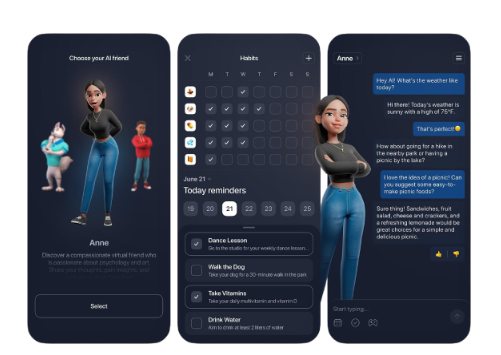
The concept of an AI companion has moved from being a novelty chatbot to a complex system that is intended for long-term and substantial interaction. The users today demand conversations that are attentive, adaptive, and emotionally intelligent. Consequently, AI Companion App Development has become a complex process that combines language modeling, system design, and behavioral knowledge into a unified experience. Interaction is no longer measured by how intelligent-sounding the AI is but by how well it integrates into a user’s digital life.
Designing Conversations That Feel Continuous
Conversational continuity is the heart of an engaging AI companion. Users do not respond in a vacuum; they come back with expectations informed by their previous conversations. The developer’s interest is in creating a conversation flow that is progressive rather than repetitive.
This requires designing a conversation system that refers to the previous context in a natural way. The aim is not to achieve perfect recall but to achieve a degree of continuity that makes the AI seem attentive without drowning the conversation. In an ai companion platform like candy ai, this degree of ongoing awareness can make all the difference between an engaging and a mechanical AI.
Context Beyond Single Sessions
True engagement depends on how well the system manages context across sessions. Developers design memory layers that distinguish between short-term conversational cues and longer-term preferences. This allows the AI to adapt over time while remaining relevant in the present moment.
Emotional Alignment in Interaction Design
Interactive AI companions not only react to what is being said, but also to how it is being said. Emotional congruence is achieved by a sophisticated orchestration of tone, rhythm, and structure of responses. Instead of trying to replicate emotions, the goal is to direct the system to reflect the intent of the conversation in a suitable manner.
It is necessary to modulate responses to a conversation by combining sentiment analysis with response modulation. For instance, reflective conversations can be slower and more deliberate, while casual conversations can be more fleeting and dynamic. This is a crucial aspect that a seasoned ai development company would focus on.
Personalization Without Overreach
Personalization is a key part of engagement, but it has to be one that feels earned rather than oppressive. The developer builds systems that personalize based on observed behavior rather than explicit profiling. This enables the AI companion to feel responsive without making assumptions that will shatter trust.
Personalization logic can be deeply embedded in response generation systems. Rather than having a recommendation layer, the conversational AI can personalize the dialogue itself.
Adaptive Interaction Patterns
Over time, AI companions learn which interaction styles resonate with individual users. Some users prefer concise exchanges, while others engage in longer dialogues. Adaptive interaction patterns help maintain engagement by aligning conversational depth with user behavior.
Technical Foundations That Support Engagement
However, beneath every interesting AI companion lies a solid technical infrastructure. The ability to respond quickly, stay up and running, and synchronize data seamlessly all add up to the illusion of intelligence. Even the most sophisticated language models can become disengaging if the system itself is not performing well.
The development community is very focused on backend system orchestration to make the system responsive regardless of the load. This technical capability often makes or breaks whether the users stay engaged in the conversation or disengage due to friction.
In platforms that are early-stage and aligned with AI MVP app development, these technical capabilities are thoroughly tested to see how actual users will interact with the system over time.
Collaboration Across Development Approaches
The creation of interesting AI companions can be a process that involves a variety of skill sets. There are machine learning engineers, conversational designers, and product architects who collaborate on this process. In other instances, no-code developers can also be involved in the process by designing conversational flows or testing interaction scenarios using visual interfaces. To ensure consistency, development teams use shared standards and interfaces.
Iteration Through Observation
Engagement is not optimized at launch but is instead honed through observation. The development team is constantly analyzing anonymized patterns of engagement to see where the flow of conversation is natural and where it tends to falter. These observations inform changes to logic, memory, and tone alignment.
Most development teams choose not to retrain models on a regular basis but instead opt for controlled update cycles.
Conclusion
Creating a highly engaging AI companion app involves more than the use of highly advanced language models. The field of AI Companion App Development can be described based on the extent to which systems are able to support conversational continuity, emotional alignment, responsible personalization, and reliability. Candy AI is one of the ai companion platforms that show how engagement is a result of careful system design and iteration. As the expectations of users continue to escalate, engagement will continue to be grounded in the nuances of how AI companions listen, remember, and respond.
