

The best ai advertising campaigns share patterns that have nothing to do with luck or massive budgets. They share structure. The companies behind them made specific decisions about data, speed, and automation that anyone can replicate — if you know what to look for.
Why Good Campaigns Fail and Great Ones Scale
Most campaigns start strong and fade. The creative was fresh, the audience was tight, and the first week looked promising. Then fatigue sets in. CPAs creep up. The team is too busy to refresh creative, so they let it run. By week four, the campaign is bleeding money and nobody noticed until the monthly report.
Great campaigns do not rely on a strong launch. They rely on systems that adapt continuously. The creative rotates before fatigue hits. The bids adjust before costs spike. The budget shifts before a channel goes cold.
The difference between a good campaign and a great one is not the starting point. It is what happens in week three when nobody is watching.
Manual management cannot sustain that level of attention. AI-driven systems can. That is the structural advantage behind every top-performing campaign today.
The Building Blocks of Campaigns That Win
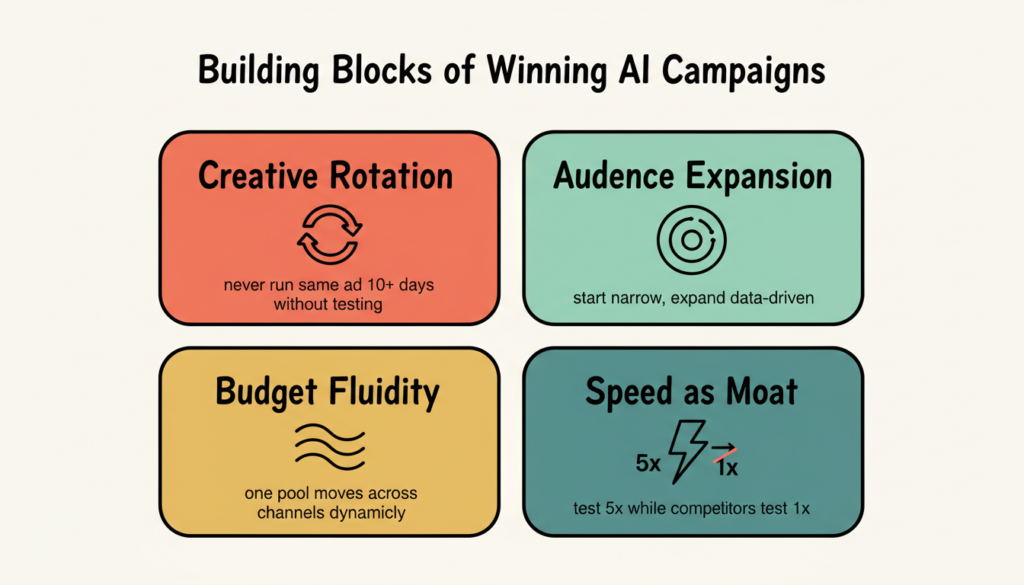
Autonomous Creative Rotation
The best campaigns never run a single ad for more than 10 days without testing a variant. AI systems generate and test creative at a pace humans cannot match. They identify fatigue signals — declining CTR, rising frequency, dropping conversion rate — and rotate before performance degrades. This is ai powered advertising at its most practical. No guessing when to refresh. The system handles it.
Real-Time Audience Expansion
Top campaigns do not start with a massive audience and hope for the best. They start narrow, find what converts, and expand methodically. AI models analyze conversion data to build lookalike audiences that mirror your best customers. The expansion is data-driven, not gut-driven.
Cross-Channel Budget Fluidity
Winning campaigns treat their budget as one pool, not separate allocations per channel. If Google converts better on Tuesday and Meta converts better on Thursday, the budget moves accordingly. Multi-platform expertise built into the system means no channel gets starved and no channel gets overfed.
Speed as a Competitive Moat
The campaigns that outperform do not have better strategies on paper. They execute faster. They test five creatives while competitors test one. They shift budget daily while competitors shift monthly. Speed of execution is the single most underrated factor in campaign performance.
What You Can Steal for Your Own Campaigns
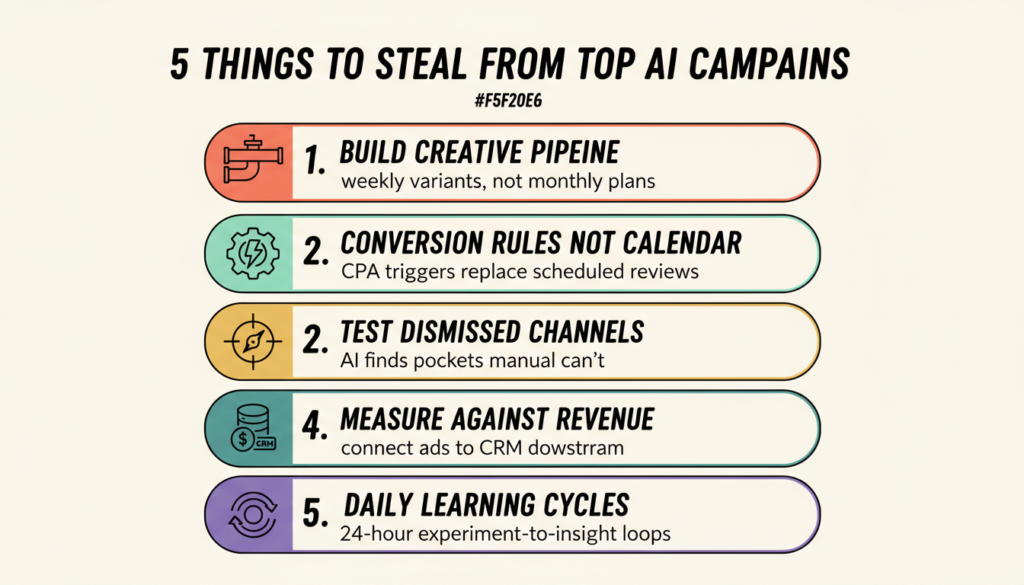
Build a creative pipeline, not a creative calendar. Stop planning one set of ads per month. Build a system that produces new variants weekly. Feed them into your AI platform and let it pick winners. The more raw material you give the system, the faster it learns what resonates.
Set conversion-based rules, not time-based rules. Replace scheduled reviews with trigger-based rules. If CPA exceeds target by 20%, the system pauses. If ROAS hits 3x, the system scales. Remove the calendar from your optimization loop.
Use ai powered advertising tools to test channels you dismissed. Many teams write off channels after one failed manual test. The best campaigns succeed on channels that others abandoned — because AI-driven targeting and creative optimization produce completely different results than manual approaches. LinkedIn, Pinterest, and programmatic display all have pockets of high-intent traffic that manual campaigns cannot find efficiently.
Measure against revenue, not platform metrics. Connect your ad data to your CRM. Track which campaigns produce customers who actually pay and retain. Optimize for downstream revenue, not upstream clicks.
Compress your learning cycles. The best campaigns learn something new every day. They run experiments, collect data, and apply insights within 24 hours. If your learning cycle is weekly or monthly, you are running 7-30x slower than teams that compress it to daily. That speed gap is where competitive advantage lives.
The Window Is Closing
The playbook behind the best AI advertising campaigns is not secret. It is public, documented, and available to any team that adopts it. But adoption takes time. Building the infrastructure, training the team, and tuning the system takes weeks, not days.
Every week you wait is a week your competitors use to refine their systems further. Their models get smarter with more data. Their cost advantages compound.
Companies already running these campaigns report CAC reductions of 30-40% and conversion improvements in the same range. Those are structural advantages that grow over time as the AI accumulates more data.
The best time to adopt this approach was six months ago. The second-best time is now.
https://atechvibe.com/what-the-vaneck-and-grayscale-etf-race-means-for-bnb-holders/
