

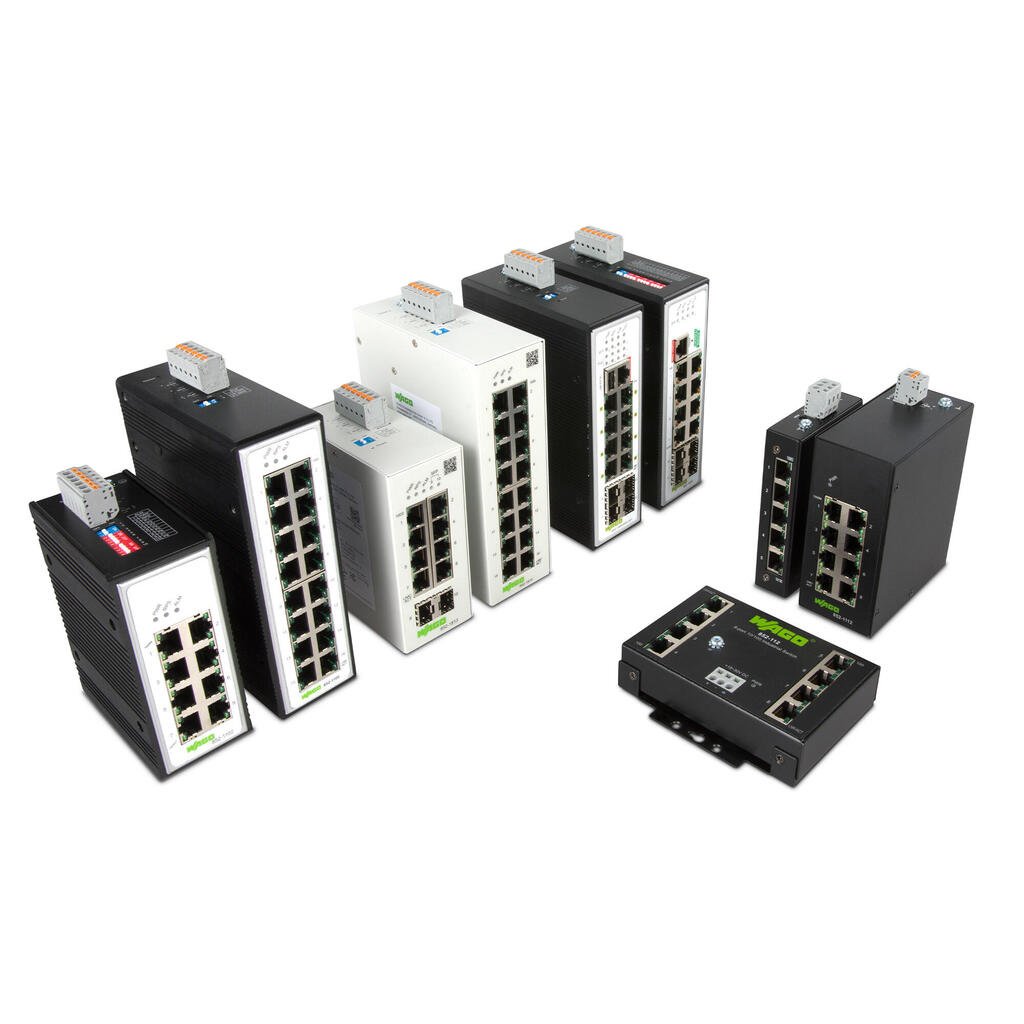
Introduction: The Growing Role of Ethernet in Industrial Networks
Industrial automation has rapidly evolved from isolated systems to highly connected environments. Today, Ethernet-based communication has become the backbone of modern industrial networks, gradually replacing traditional fieldbus systems. This shift is driven by the need for faster data exchange, real-time monitoring, and seamless integration across operations.
In a typical industrial setup, controllers, remote I/O modules, HMIs, sensors, and monitoring platforms constantly exchange operational data. Whether it’s a production line adjusting speeds or an energy system optimizing output, reliable Ethernet communication ensures that every component stays synchronized.
At the center of this communication lies the network switch a critical device that connects all automation components and directs data traffic efficiently. Without it, data collisions, delays, and communication breakdowns would disrupt operations.
However, industrial environments are far from ideal. Challenges such as network congestion, electromagnetic interference, extreme temperatures, and mechanical vibrations can significantly impact communication reliability. This is where industrial-grade network switches prove their value not just by connecting devices, but by ensuring stable, uninterrupted, and optimized data flow.
What Is an Industrial Network Switch?
A network switch is a Layer-2 device that forwards Ethernet frames between connected devices using MAC address tables. In simple terms, it ensures that data reaches the correct destination without unnecessary traffic flooding the network.
In industrial settings, switches manage communication between PLCs, industrial PCs, sensors, and distributed I/O systems. This coordination enables real-time control, accurate data logging, and smooth machine-to-machine interaction.
There are two main types of switches:
- Unmanaged switches:
These are plug-and-play devices ideal for simple networks. They require no configuration and are cost-effective for small setups where advanced features like redundancy or monitoring are not critical. - Managed switches:
These provide advanced configuration, diagnostics, and monitoring capabilities. With features like VLANs, QoS, and SNMP, they allow operators to control traffic, detect faults, and optimize performance.
Unlike commercial office switches, industrial network switches are built for durability and reliability. They operate in harsh conditions, with features such as:
- Extended temperature ranges (–40°C to +70°C)
- Rugged metal housing and DIN-rail mounting
- Resistance to vibration, shock, and electrical noise
Outcome: Businesses benefit from reduced downtime, longer equipment lifespan, and consistent network performance—even in extreme environments.
How Network Switches Manage Industrial Data Traffic?
Efficient data handling is essential in industrial systems where delays can impact production and safety. Network switches use several mechanisms to ensure smooth communication:
- MAC address learning & frame forwarding: Switches identify connected devices and send data only to the intended recipient, reducing unnecessary traffic and improving speed.
- Packet buffering: During high traffic, switches temporarily store data packets, preventing loss and ensuring reliable transmission.
- Quality of Service (QoS): QoS prioritizes critical automation traffic—such as control signals over less important data.
Benefit: Ensures real-time responsiveness in mission-critical processes.
- VLAN segmentation: VLANs divide a network into smaller logical segments.
- Outcome: Improved security, reduced congestion, and better network organization.
- IGMP Snooping: This feature manages multicast traffic efficiently, ensuring data is sent only to devices that need it.
Benefit: Optimized bandwidth usage and improved network efficiency.
Together, these capabilities ensure that industrial networks remain fast, organized, and resilient under heavy workloads.
Redundancy and Reliability in Industrial Ethernet Networks
In industrial environments, even a brief communication failure can halt production or compromise safety. Network switches address this risk through advanced redundancy features.
- Ring topology protocols (ERPS, RSTP, Xpress Ring): These protocols create backup communication paths. If one connection fails, data is automatically rerouted.
- Fast recovery times: Modern switches can restore communication in less than 20 milliseconds.
- Redundant power supply inputs: Dual power inputs ensure the switch continues operating even if one power source fails.
- Alarm contacts and diagnostics: Switches can trigger alerts for power failures, port issues, or network faults.
These features collectively enhance operational reliability, ensuring that critical systems remain online even under failure conditions.
Applications of Network Switches in Industrial Systems
Network switches are essential across a wide range of industrial applications:
- PLC networks
Connecting controllers, HMIs, and remote I/O modules for synchronized operations. - Energy systems
Supporting real-time monitoring and control in power plants and renewable energy setups. - Transportation infrastructure
Enabling communication in traffic systems, rail networks, and smart logistics. - Industrial automation plants
Facilitating seamless communication between machines, sensors, and control systems.
Future Trends in Industrial Network Infrastructure
Industrial networking continues to evolve, with network switches playing a central role in future-ready infrastructure.
- Fiber-optic expansion: Increasing adoption for high-speed, low-latency, and interference-free communication.
- Power over Ethernet (PoE): Enables both power and data transmission through a single cable.
- Advanced security features: Including authentication (IEEE 802.1X), encryption, and traffic monitoring.
- Converged IT-OT networks: Industrial switches are bridging operational technology (OT) and information technology (IT), enabling unified data systems and smarter decision-making.
Conclusion
Industrial network switches are far more than simple connectivity devices—they are the backbone of reliable Ethernet communication in modern automation systems. By managing data traffic efficiently, ensuring redundancy, and supporting advanced features like QoS, VLANs, and PoE, they enable seamless, real-time operations across industries.
The result is clear: improved uptime, enhanced productivity, reduced operational risks, and scalable network infrastructure. As industrial environments become more connected and data-driven, the role of network switches will only grow more critical in ensuring consistent, secure, and high-performance communication.
