

Artificial intelligence has made remarkable progress in recent years, but one challenge remains: enabling machines to interact with the physical world as naturally as humans do. From autonomous robots to smart prosthetics and advanced industrial systems, the next wave of AI depends on improving how machines perceive, interpret, and respond to real-world environments.
One emerging area of research is the connection between brain waves and physical AI. Scientists are exploring whether signals generated by the human brain can help train intelligent systems, improve human-machine interaction, and even control robots directly. While the technology is still developing, early breakthroughs suggest that brain-computer interfaces could play an important role in shaping the future of physical AI.
What Is Physical AI?
Physical AI refers to artificial intelligence that operates in the real world through physical devices such as robots, autonomous vehicles, drones, and wearable technologies. Unlike traditional AI that analyzes text or images, physical AI must understand its surroundings, make decisions in real time, and perform precise physical actions.
For example, a warehouse robot must recognize objects, avoid obstacles, and safely transport goods. These tasks require continuous learning and rapid decision-making, making physical AI far more complex than software-based AI applications.
Understanding Brain Waves
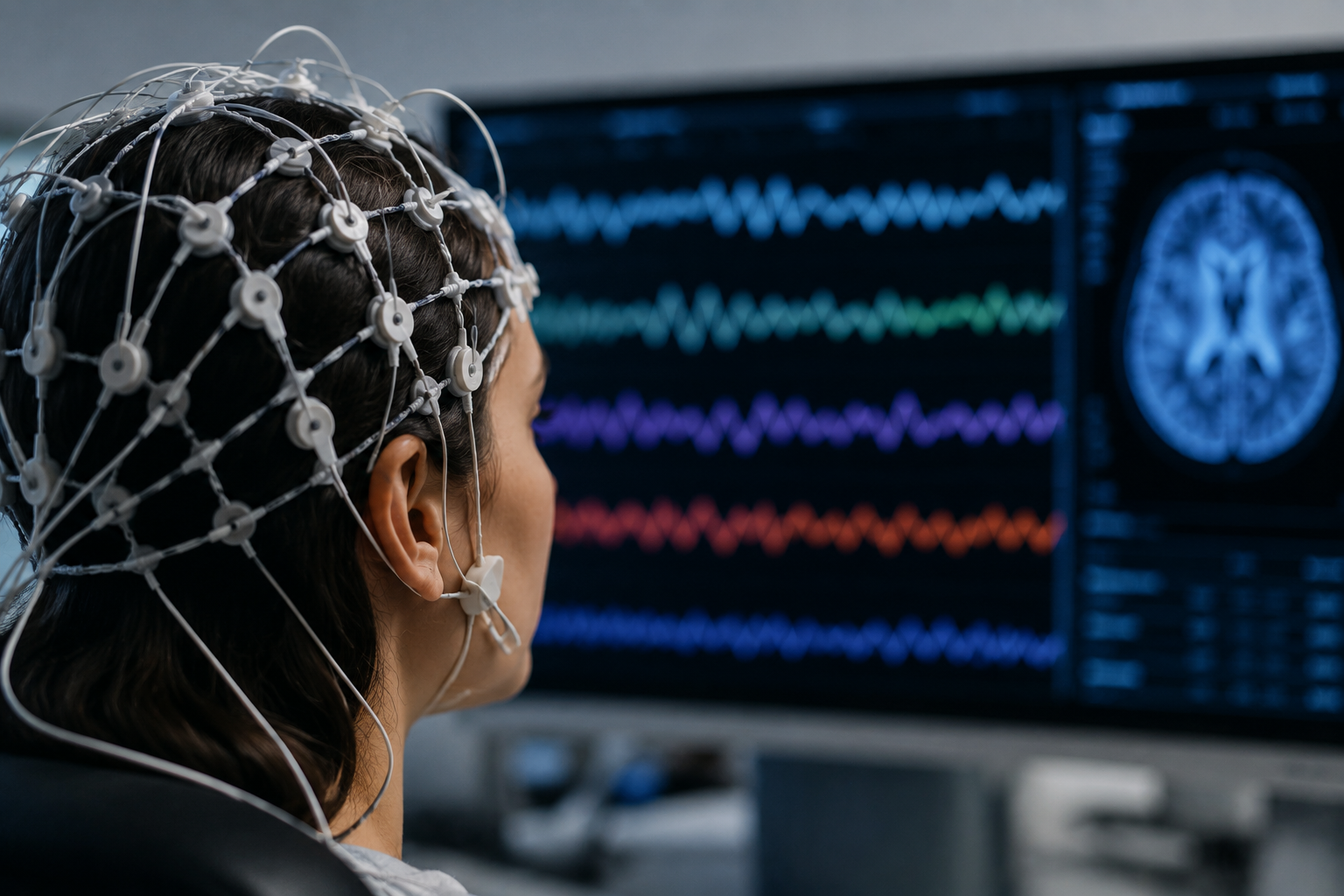
Brain waves are electrical signals produced by neurons communicating within the brain. These signals can be measured using technologies like electroencephalography (EEG), which records patterns of brain activity through sensors placed on the scalp.
Different brain wave frequencies are associated with various mental states, including concentration, relaxation, sleep, and problem-solving. Researchers are learning how to decode these patterns to understand a person’s intentions, attention, or emotional state.
This growing understanding has opened new possibilities for connecting the human brain directly with intelligent machines.
How Brain Waves Could Improve Physical AI
Brain-computer interfaces (BCIs) create a communication pathway between the human brain and external devices. Instead of relying solely on voice commands or physical controls, a user could guide a machine using neural signals.
Imagine a robotic arm responding to a person’s intention before they even move. A wheelchair could change direction based on the user’s thoughts, or an industrial robot could adapt its movements based on the operator’s focus and decision-making.
Such systems could make human-machine collaboration faster, safer, and more intuitive.
Real-World Applications
Healthcare
Medical technology is one of the biggest beneficiaries of brain-wave research. Patients with paralysis have already demonstrated the ability to control robotic arms and computer cursors using neural signals. Future prosthetic limbs could respond almost as naturally as biological ones, significantly improving quality of life.
Robotics
Robots equipped with AI could work alongside humans more effectively by interpreting cognitive signals. In manufacturing or hazardous environments, this could reduce delays and improve workplace safety.
Autonomous Systems
Brain-inspired learning may also help autonomous vehicles and drones make smarter decisions in unpredictable situations. While they won’t literally “read minds,” understanding human intent could improve cooperation between people and intelligent machines.
Education and Training
Brain-wave monitoring may help identify when learners lose focus or become mentally overloaded. AI-powered educational systems could then adjust lessons in real time to improve learning outcomes.
Current Challenges
Although the concept is exciting, several obstacles remain before brain-wave-powered physical AI becomes common.
The first challenge is accuracy. Brain signals are extremely complex and can vary significantly between individuals. Decoding these signals consistently remains a difficult scientific problem.
Hardware also needs improvement. Current EEG devices often require specialized equipment and controlled environments. Future consumer-friendly systems must become smaller, more comfortable, and more reliable.
Privacy presents another major concern. Brain activity contains highly personal information, raising important questions about data ownership, consent, and cybersecurity. Strong ethical guidelines and regulations will be essential as the technology advances.
The Role of AI in Understanding the Brain
Modern AI algorithms are already helping researchers analyze enormous amounts of neural data. Machine learning models can identify patterns that would be difficult for humans to detect manually.
As these models become more sophisticated, they may improve the speed and accuracy of decoding brain signals. In turn, better neural data can help train smarter physical AI systems, creating a cycle where AI and neuroscience continue to advance together.
What the Future May Hold
The long-term vision extends beyond controlling individual devices. Researchers imagine intelligent environments where humans and AI collaborate seamlessly through natural communication, including gestures, speech, and even neural signals.
While fully thought-controlled robots remain years away, incremental progress is already transforming healthcare, rehabilitation, and robotics. Advances in sensors, AI models, and neuroscience could eventually enable physical AI systems that understand human intentions with greater precision than ever before.
However, success will depend not only on technological breakthroughs but also on responsible development that protects user privacy and builds public trust.
Conclusion
Brain waves may not be the sole key to the future of physical AI, but they represent one of the most promising frontiers in artificial intelligence research. By combining neuroscience with advanced machine learning, researchers are creating new ways for humans and machines to interact naturally.
Although significant technical and ethical challenges remain, ongoing innovations suggest that brain-computer interfaces could reshape industries ranging from healthcare to robotics. As research continues, brain-wave technology has the potential to unlock smarter, safer, and more responsive physical AI systems that work alongside humans rather than simply replacing them.
Frequently Asked Questions
1. What are brain waves?
Brain waves are electrical signals produced by neurons in the brain. They reflect different mental activities such as focus, relaxation, and sleep.
2. What is physical AI?
Physical AI refers to artificial intelligence used in robots, autonomous vehicles, smart machines, and other systems that interact directly with the physical world.
3. Can brain waves control robots?
Yes. Through brain-computer interfaces, researchers have demonstrated that neural signals can control robotic arms, wheelchairs, and computer systems, although the technology is still evolving.
4. Is brain-wave technology safe?
Most non-invasive methods, such as EEG, are considered safe. However, researchers continue to study privacy, security, and ethical concerns related to neural data.
5. Will brain-wave-powered AI become common?
While widespread adoption may take several years, ongoing research in neuroscience and AI is making brain-computer interaction increasingly practical for healthcare, robotics, and assistive technologies.
