

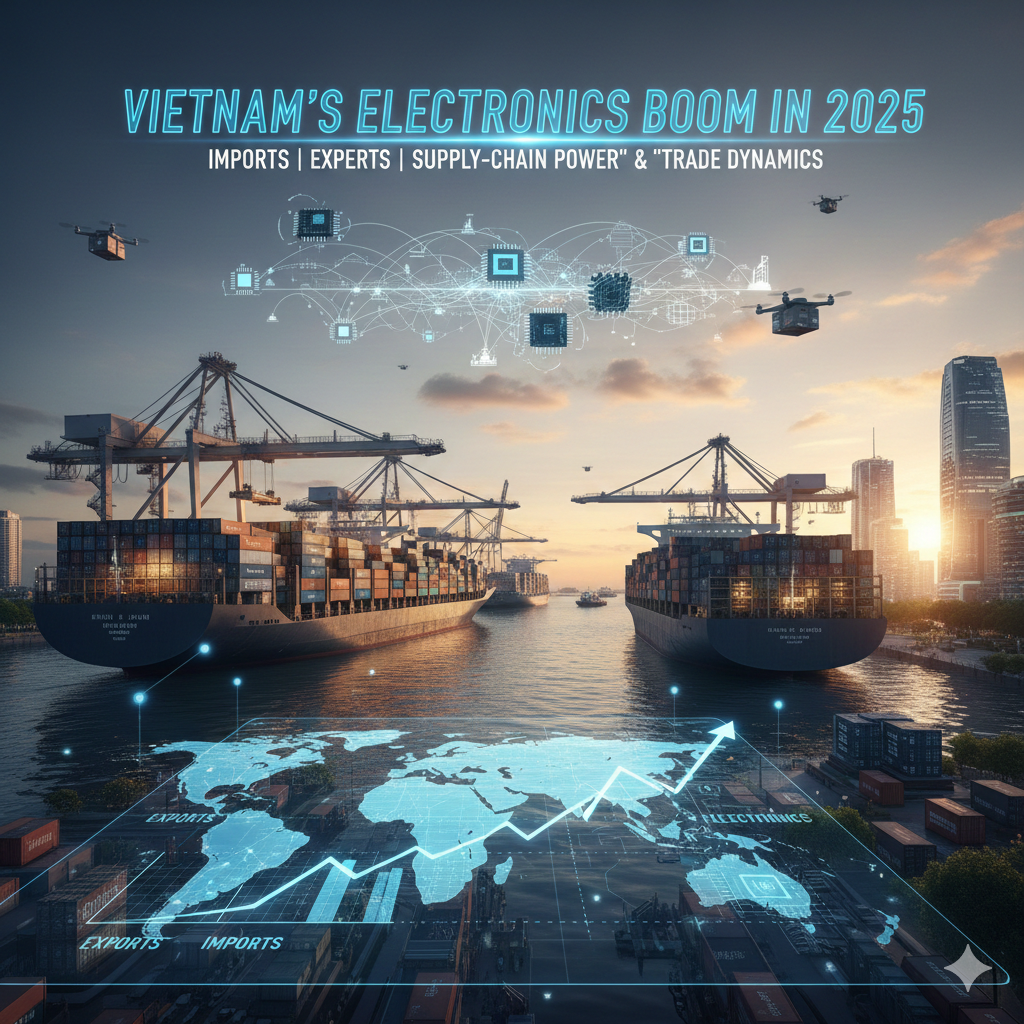
Vietnam’s trade landscape in 2025 is undergoing one of its biggest transformations in decades, and at the center of this shift is the high-growth electronics sector. Computers, electronic components, and advanced hardware have not only become major contributors to national trade but also the engine driving record-breaking expansion. Backed by strong foreign investment, rising global demand, and deepening supply-chain ties—particularly the China Vietnam electronics supply link—Vietnam has emerged as a top global manufacturing and trade hub.
This detailed guest post explores how the electronics industry reshaped Vietnam’s economy, the evolution of vietnam electronics imports, the structure of Vietnam’s export markets, the impact of major FDI inflows, and what the future holds for Vietnam electronics trade. It also uses insights from vietnam shipment data to provide a data-driven understanding of the fast-growing sector.
Electronics: The Heart of Vietnam’s Trade Expansion
By 2025, electronics are no longer just a strong sector—they have become the core of Vietnam’s trade momentum. According to the latest customs figures, the total value of Vietnam’s electronics imports in 2024 reached $136.04 billion, up 21% from the previous year. On the export side, vietnam exports of electronics hit $143.33 billion, marking an 8% increase and positioning the country among the world’s most competitive electronics producers.
The combined import-export figure for electronics touched $279.37 billion in 2024–25, a record-breaking milestone. This rapid expansion reflects not just strong manufacturing capability, but Vietnam’s deeper integration into global supply chains—and a significant portion of that momentum can be traced back to the China Vietnam electronics supply relationship.
Vietnam: A Global Electronics Powerhouse
Vietnam is now the 8th largest electronics exporter and the 6th largest electronics importer globally. This ascent didn’t happen overnight. Over the past decade, Vietnam has consistently expanded both its production capacity and import capability, doubling down on upstream and downstream electronics activities.
Looking at data from 2014–2025, Vietnam’s electronics trade grew from $70.57 billion to nearly $280 billion, with compound annual growth driven by rising demand for smartphones, circuits, and electronic components. Insights from vietnam shipment data confirm that the country has become a global hub for assembling devices for brands worldwide.
The Role of Electronics in Vietnam’s 2025 Macro Trade Boom
In 2025, electronics accounted for nearly one-third of Vietnam’s total import value and about 22% of total exports. The volume is staggering:
- Electronics imports in August 2025: US$14.13 billion
- First eight months of imports: Nearly US$96 billion (up 38.2% YoY)
- Electronics exports in August 2025: US$10.2 billion
- First eight months of exports: Nearly US$67 billion (up 43.1% YoY)
Behind this surge is a network of global Vietnam electronics suppliers providing parts, components, and assembly support.
Vietnam Electronics Imports: A Backbone of Tech Manufacturing
The engine of Vietnam’s electronics success is its import structure. Vietnam electronics imports reached unprecedented levels in 2024–25 due to soaring demand for integrated circuits, panels, chips, and advanced components used for assembly.
Top 5 Sources of Vietnam Electronics Imports
According to the latest data:
- China – $58.62 billion (43.1%)
- South Korea – $34.92 billion (25.7%)
- Taiwan – $14.17 billion (10.4%)
- Japan – $7.95 billion (5.9%)
- USA – $4.54 billion (3.3%)
China stands as the dominant supplier. Its proximity, scale, and cost advantages solidify the China Vietnam electronics supply link as the most critical supply-chain relationship in Vietnam’s electronics ecosystem. This connection supports Vietnam’s role as an assembly hub where imported components are processed and exported as finished electronic goods.
Vietnam Electronics Exports: A Global Reach
On the export side, Vietnam serves dozens of international markets. The top export destinations include:
- USA – $41.65 billion (29.1%)
- China – $30.13 billion (21%)
- South Korea – $9.53 billion
- Hong Kong – $6.58 billion
- Japan – $6.34 billion
The U.S. remains the largest buyer of Vietnamese electronics, especially smartphones and computer hardware. Japan, the Netherlands, India, the UAE, the UK, and Thailand also contribute significantly. These export patterns reinforce the importance of vietnam exports as a key driver of economic resilience.
What Makes China Vietnam Electronics Supply So Critical?
China’s role is not incidental—it is deeply structural. China’s ecosystem of factories, suppliers, and logistics chains supports Vietnam’s rapidly expanding manufacturing sector.
Key advantages include:
- Proximity → Lower lead times and shipping costs
- Scale → Ability to meet Vietnam’s massive demand for components
- Specialization → Advanced integrated circuits, chipsets, screens, and semiconductors
- Cost-efficiency → Essential for price-sensitive consumer electronics
However, this tight interdependence presents strategic risks. Any disruption in China—whether geopolitical, economic, or logistical—can directly impact Vietnam’s production capacity, underlining the need for more diversified Vietnam electronics suppliers.
Top Electronics Products Shaping Vietnam Electronics Trade
Vietnam’s imports and exports are dominated by electronics under HS Code 85.
Top Imports
- Integrated circuits (HS 8542): $62.91B
- Flat display modules (HS 8524): $16.49B
- Smartphones & telephone sets (HS 8517): $11.13B
- Printed circuits (HS 8534): $5.56B
- Semiconductor devices (HS 8541): $5.05B
Top Exports
- Smartphones/telephone sets (HS 8517): $57.80B
- Display modules (HS 8524): $19.30B
- Integrated circuits (HS 8542): $13.24B
- Wires & cables (HS 8544): $7.31B
- Transmission apparatus (HS 8525): $6.75B
This breakdown from vietnam shipment data shows that the country has mastered the assembly of high-demand categories like smartphones and semiconductors.
FDI as the Supercharger: The Lite-On Example
Vietnam attracts billions in foreign investment, especially from tech manufacturers. A powerful illustration is Lite-On Technology Corp (Taiwan).
Major Highlights:
- $690 million plant in Quang Ninh (2025)
- Covers 30 hectares—two factories + office
- Produces computer parts, optical devices, communication equipment
- Capacity: 124 million units per year by 2030
- Additional $200 million investment in Hai Phong facility
- Total investment in Vietnam: $1 billion+
These commitments from Lite-On signal immense confidence in Vietnam, further accelerating Vietnam electronics trade and boosting its capabilities beyond basic assembly.
Key Risks for Vietnam’s Electronics Sector
Despite the strong growth, Vietnam faces several strategic vulnerabilities:
1. Overdependence on China
The China Vietnam electronics supply link is extremely useful—but risky. Any disruption could slow production across Vietnam.
2. Limited Value Capture
Much of Vietnam’s electronics output is assembly-based.
Without stronger R&D, chip design, and upstream manufacturing, domestic value capture remains limited.
3. Policy Vulnerabilities
Changes in U.S. or EU import rules, stricter rules of origin, and global tariff changes could impact vietnam exports.
4. Sustainability Challenges
Growing manufacturing raises challenges around labor standards, e-waste, energy use, and environmental compliance.
Opportunities for Vietnam: Moving Up the Electronics Value Chain
Despite risks, Vietnam has immense growth potential.
1. Develop Upstream Capabilities
Semiconductor testing, packaging, advanced PCB manufacturing, and chip R&D can reduce import dependence.
2. Diversify Electronics Suppliers
Increasing component imports from Taiwan, Korea, Japan, and Southeast Asia can lessen reliance on China.
3. Strengthen Trade Diplomacy
By reinforcing ties with the U.S., EU, and ASEAN, Vietnam can secure stable export markets.
4. Human Capital Development
Investing in engineering skills and vocational training is vital for higher value-added manufacturing.
5. Green Electronics Manufacturing
Vietnam can position itself as a sustainable electronics production hub—attracting ESG-focused investors.
What’s Next? Vietnam Electronics Trade Outlook (2026–2030)
Forecast Trends
- Electronics may account for 35–40% of Vietnam’s total imports by 2030.
- Exports expected to grow 10–15% annually.
- More FDI could expand domestic assembly and high-tech manufacturing.
Strategic Scenarios
- Upstream Breakthrough → Vietnam boosts chip testing and packaging.
- Supplier Diversification → Reduces risks from China dependency.
- Green Electronics Hub → Vietnam leads in sustainable manufacturing.
- Trade Disruption → China-related risks could force emergency supply-chain shifts.
Conclusion
Vietnam’s electronics boom is reshaping its economic identity. Driven by strong vietnam electronics imports, rising exports, large-scale FDI, and a complex network of Vietnam electronics suppliers, the country has emerged as a global tech manufacturing powerhouse. Yet the heavy reliance on the China Vietnam electronics supply ecosystem remains both a strength and a vulnerability.
Whether Vietnam evolves into a high-tech, high-value electronics hub or remains an assembly-driven economy depends on how effectively it invests in innovation, diversification, and upstream capacity. One thing is certain—the world is watching Vietnam’s rise, and its trajectory in the electronics sector will define the next decade of its economic story.
For deeper insights, real-time trade intelligence, and verified vietnam shipment data, businesses can explore platforms like VietnamExportData or contact TradeImeX for detailed market reports, import-export dashboards, and custom analytics.
