

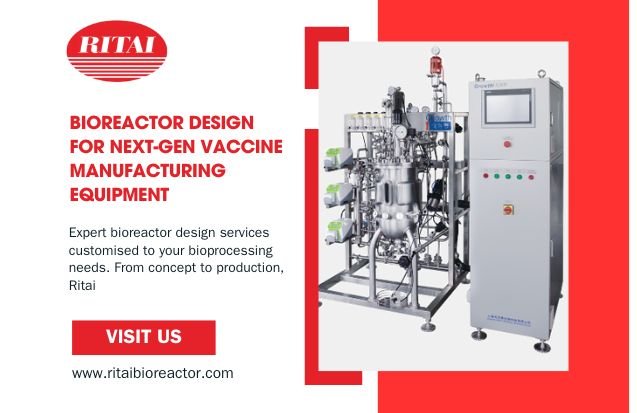
If you’ve spent any time around upstream teams in the past few years, you’ve probably noticed a shift in the conversations. Instead of talking only about batch size or feed ratios, people are now comparing control strategies, debating single-use versus stainless configurations, and questioning whether their current setup can keep pace with new vaccine platforms. It’s clear that Bioreactor Design is no longer a supporting detail—it sits at the centre of modern Vaccine Manufacturing Equipment planning.
Why Bioreactor Design Is Getting a Second Look
Traditional bioreactors were built for predictable, slower-moving production cycles. Today’s landscape is very different. mRNA, viral vectors, recombinant proteins, and cell-based vaccines all have their own quirks. A design that works smoothly for CHO cells may struggle with HEK293 or insect lines. And when you’re aiming for rapid scale-up with minimal downtime, these mismatches become real bottlenecks.
Many facilities are revisiting their reactor setups not because they enjoy capital expenditure meetings, but because the biology itself forces them to. A good example: several teams I’ve spoken with recently had to retrofit impeller designs simply to maintain cell viability in vector-based workflows. The cells could handle the nutrient environment, but not the shear conditions.
Single-Use Systems Are Becoming Standard, Not an Experiment
It wasn’t long ago that single-use bioreactors were treated like a novelty. Now, they’re becoming the default choice—especially for next-gen vaccine programs. Speed matters, and single-use systems cut out cleaning cycles and validation work that often drag down timelines.
But speed isn’t the only reason. Modern single-use bags have much better gas-transfer performance than earlier versions. We used to struggle with oxygen transfer limits in high-density cultures; now, with improved spargers and membrane materials, those issues are far less common.
This is where brands like Ritai Bioreactor have gained attention. Their systems lean heavily into flexible designs and updated mixing capabilities that support quick platform shifts—something upstream teams appreciate when juggling multiple vaccine candidates at once.
Better Sensors = Better Control
Next-gen vaccines demand tighter monitoring. In the early days, you basically watched pH, DO, and maybe temperature fluctuations. Now, inline sensors give you near-real-time data on metabolites, cell density, and even product expression.
This matters because newer vaccine platforms don’t behave as generously as traditional protein cultures. Viral vector production, for instance, has a narrow performance window. Drift too far from the culture’s sweet spot and your yield tanks.
Advanced bioreactors integrate soft sensors, perfusion-ready probes, and adaptive control loops. Teams can spot unexpected trends before they become production-stopping issues. From a practical standpoint, this reduces batch-to-batch variability and supports smoother tech transfers between facilities.
Scaling Up Without Losing Your Sanity
Scaling remains one of the biggest pain points. A 50-L run may behave perfectly, only for a 500-L run to develop mixing blind spots or oxygen starvation zones. That’s why thoughtful Bioreactor Design has become almost as important as the cell line itself.
Good design considers:
- Impeller shape and torque under varying loads
- Gas transfer efficiency in denser cultures
- Heat removal in high-productivity modes
- Baffle placement to avoid dead zones
- Automation interfaces that simplify multi-step feeding
One upstream lead told me they spent months fixing scale-up issues caused by nothing more than a poor impeller-to-volume ratio. These are the kinds of headaches modern design tries to avoid.
Modularity Helps Teams Adapt Faster
Because vaccine programs move fast, modular equipment is becoming the norm. Facilities want reactor systems that can run adherent cells today and suspension cultures tomorrow, without forcing weeks of downtime for reconfiguration.
Manufacturers are responding with:
- interchangeable headplates
- quick-swap feed port assemblies
- standardized digital controls
- scalable footprints that fit both R&D and GMP rooms
This flexibility isn’t about trends—it’s about survival in an industry where product lines shift quickly.
The Push Toward Fully Connected Facilities
Bioreactors don’t operate in a vacuum. Their performance depends heavily on upstream and downstream compatibility. This has led to an emphasis on integrated, data-driven infrastructure.
A well-designed bioreactor should connect seamlessly with:
- perfusion systems
- media preparation units
- downstream clarification units
- facility-wide monitoring platforms
And since regulators now expect tighter process documentation, having a unified digital backbone isn’t optional anymore.
Manufacturers such as Ritai Bioreactor have leaned into this with systems built around open communication protocols. Teams can plug reactors into their existing historian platforms without wrestling with proprietary communication layers.
Final Thoughts
Next-gen vaccine production is changing the way facilities think about bioreactors. What used to be a straightforward equipment choice is now a strategic decision shaping an entire production workflow. With smarter sensors, flexible configurations, stronger single-use materials, and automation that actually helps instead of hindering, bioreactors have become the backbone of modern Vaccine Manufacturing Equipment.
If anything, the biggest shift isn’t the hardware—it’s the recognition that good Bioreactor Design directly affects timelines, yields, and long-term scalability. And in a vaccine world where speed and consistency matter more than ever, those details are worth getting right.
