

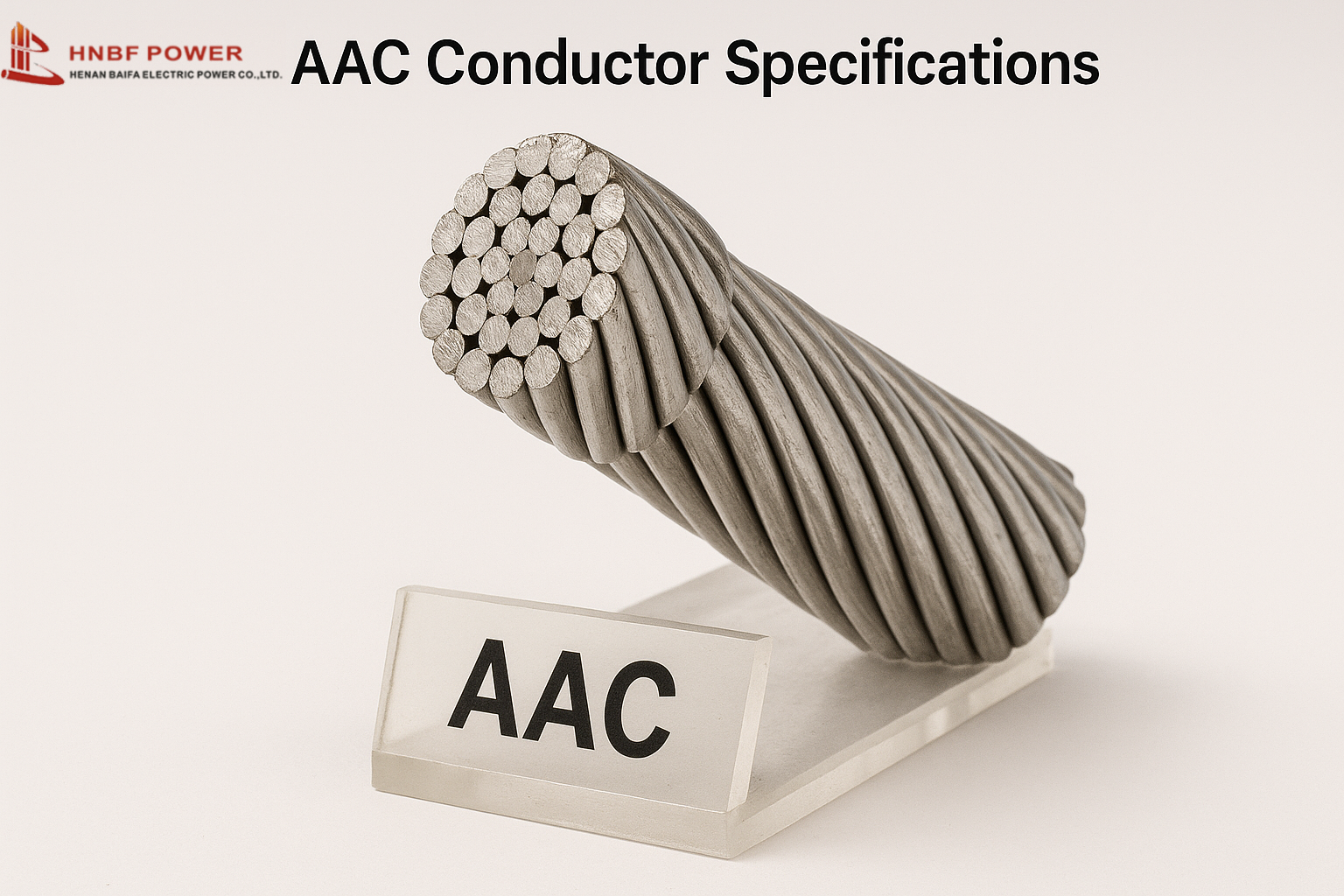
In modern power transmission and distribution networks, selecting the right overhead conductor is essential for ensuring reliability, efficiency, and cost control. Among the commonly used conductors in utility infrastructure, the AAC conductor (All Aluminum Conductor) stands out for its excellent electrical conductivity, lightweight structure, and corrosion resistance.
For engineers, EPC contractors, and procurement teams, understanding the technical features and applications of AAC conductors can help optimize overhead line projects. In this guide, we explore the structure, advantages, applications, and key selection factors of AAC conductors and how HNBF Power delivers high-quality solutions for global power utilities.
What is an AAC Conductor?
An AAC conductor (All Aluminum Conductor) is an overhead electrical conductor made entirely of high-purity aluminum strands. These strands are concentrically stranded together to form a flexible and efficient conductor used mainly in short-span distribution lines and urban power networks.
AAC conductors are manufactured using EC-grade aluminum with a purity of about 99.7%, which provides high electrical conductivity and excellent corrosion resistance.
Key Characteristics of AAC Conductor
- High electrical conductivity
- Lightweight compared to copper conductors
- Excellent corrosion resistance
- Good flexibility for installation
- Cost-effective solution for distribution networks
Due to these properties, AAC conductors are widely used in urban distribution lines, substations, and coastal regions where corrosion resistance is essential.
Structure and Manufacturing of AAC Conductors
AAC conductors consist of multiple aluminum wires stranded in layers around a central wire. The number of strands depends on the conductor size and current-carrying requirements.
Typical Construction
AAC conductors are produced in several stranding configurations such as:
- 7 strands
- 19 strands
- 37 strands
- 61 strands
Each layer increases the conductor’s mechanical strength while maintaining flexibility and conductivity.
Manufacturing Process
The production of AAC conductors involves several precise manufacturing steps:
- Aluminum Rod Production – High-purity aluminum rods are produced using EC-grade aluminum.
- Wire Drawing – Aluminum rods are drawn into smaller diameter wires.
- Stranding Process – Multiple aluminum wires are stranded concentrically using high-speed stranding machines.
- Quality Testing – Conductors are tested for tensile strength, conductivity, diameter tolerance, and resistance.
At HNBF Power, advanced manufacturing lines and strict quality control ensure every conductor meets international standards such as IEC, ASTM, BS, and DIN.
Key Advantages of AAC Conductors
1. Excellent Electrical Conductivity
AAC conductors provide very high conductivity due to the use of pure aluminum. This allows efficient power transmission with minimal energy losses.
2. Superior Corrosion Resistance
Aluminum naturally forms a protective oxide layer, making AAC conductors highly resistant to corrosion. This is especially beneficial in coastal and humid environments.
3. Lightweight Design
Compared with copper conductors, AAC is significantly lighter. This reduces installation complexity and lowers support structure requirements.
4. Cost Efficiency
AAC conductors are more economical than copper conductors while still providing reliable electrical performance.
5. Easy Installation
The flexible structure allows easier handling during installation, which helps reduce labor time and project costs.
Common Applications of AAC Conductors
AAC conductors are widely used in power distribution systems and utility infrastructure where mechanical strength requirements are moderate.
Urban Distribution Networks
AAC conductors are ideal for short-span distribution lines in cities, where high conductivity and lightweight properties are advantageous.
Substation Connections
They are commonly used for busbars and substation jumpers, where excellent conductivity is required.
Coastal Power Systems
Because of their corrosion resistance, AAC conductors perform well in coastal and marine environments.
Low and Medium Voltage Overhead Lines
AAC is frequently used in LV and MV overhead distribution lines for residential and commercial power supply.
AAC vs ACSR vs AAAC: Key Differences
When designing overhead transmission lines, engineers often compare AAC conductors with other aluminum conductor types.
| Conductor Type | Core Material | Strength | Conductivity | Typical Application |
|---|---|---|---|---|
| AAC | Aluminum | Moderate | Very High | Urban distribution |
| AAAC | Aluminum Alloy | High | High | Medium span transmission |
| ACSR | Steel Reinforced | Very High | Moderate | Long span transmission |
AAC conductors are best suited for shorter spans and distribution systems, while ACSR and AAAC conductors are used for longer spans requiring higher tensile strength.
Why Choose HNBF Power for AAC Conductors?
Selecting the right manufacturer is as important as choosing the right conductor type. HNBF Power is a global manufacturer specializing in overhead conductors and power cables, including:
- AAC conductors
- AAAC conductors
- ACSR conductors
- Aerial bundled cables (ABC)
- LV power cables
- Concentric cables
Key Advantages of HNBF Power
- Advanced conductor manufacturing technology
- Compliance with international standards (IEC, ASTM, BS)
- Reliable quality control and testing procedures
- Custom conductor sizes and specifications
- Global supply for utilities, EPC contractors, and infrastructure projects
By working with HNBF Power, utilities and procurement teams gain access to high-performance conductor solutions designed for modern power grids.
Key Factors When Selecting an AAC Conductor
Before purchasing AAC conductors, engineers and procurement teams should evaluate several important parameters:
Electrical Requirements
The conductor must support the required current capacity and voltage level.
Span Length
AAC conductors are best suited for short to medium span applications.
Environmental Conditions
Corrosion resistance is critical for coastal or industrial areas.
Standards Compliance
Ensure the conductor meets recognized standards such as IEC or ASTM.
Frequently Asked Questions (FAQs)
1. What does AAC conductor stand for?
AAC stands for All Aluminum Conductor, a type of overhead conductor made entirely from aluminum strands designed for power distribution networks.
2. Where are AAC conductors commonly used?
AAC conductors are mainly used in urban power distribution systems, substations, and coastal transmission environments.
3. What is the main advantage of AAC conductors?
The primary advantage is high electrical conductivity combined with lightweight construction and corrosion resistance.
4. How is AAC different from ACSR conductors?
AAC conductors contain only aluminum strands, while ACSR conductors include a steel core for higher mechanical strength.
5. Are AAC conductors suitable for long transmission lines?
AAC conductors are typically used for shorter spans and distribution networks, while long transmission lines often require ACSR or AAAC conductors.
Conclusion
AAC conductors play a crucial role in modern power distribution infrastructure, offering high conductivity, corrosion resistance, and cost-effective performance. For utilities, EPC contractors, and procurement teams, selecting high-quality AAC conductors ensures reliable electricity delivery and long-term operational efficiency.
As a trusted global manufacturer of overhead conductors and power cables, HNBF Power provides reliable AAC conductor solutions designed to meet international standards and project requirements.
Contact HNBF Power Today
If you are planning a power transmission or distribution project and need customized AAC conductor solutions, contact HNBF Power today. Our engineering team is ready to help you select the right conductor specifications for your grid infrastructure and ensure reliable performance for years to come.
