

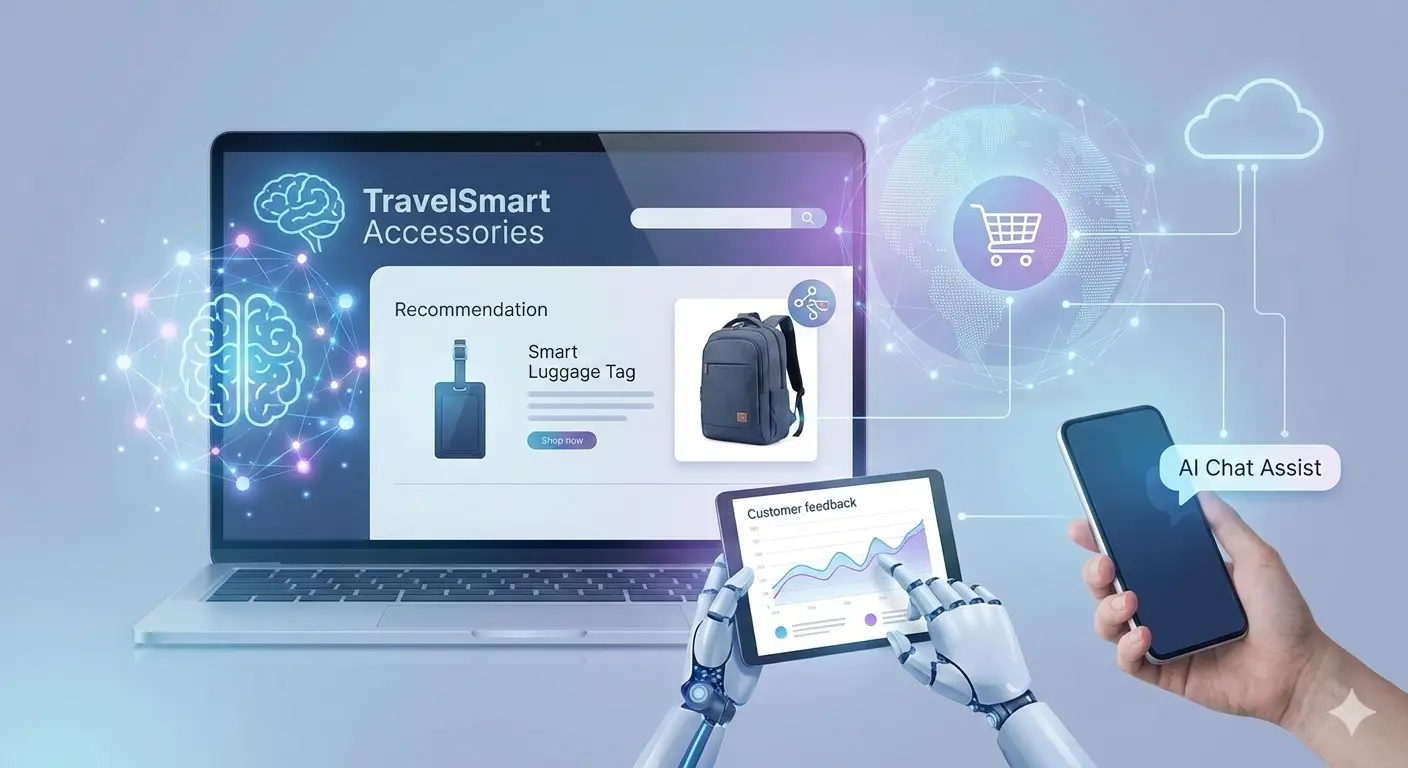
In online shopping, travel accessory brands are now using smart technology to work better and connect with customers. As more people shop online, AI (Artificial Intelligence) is not just a trend—it has become an important tool. Brands use it to understand customers, manage their work easily, and sell more products.
If you own a brand, do marketing, or create content, knowing these AI trends will help you stay ahead. In this article, we explain the important AI tools that travel accessory brands are using—from smarter search to predicting what customers want, and more.
1. Personalized Shopping Experiences
Customers today expect personalization, not generic recommendations.
AI helps travel accessories brands tailor their online stores to each customer’s unique preferences.
How personalization works
AI collects data from:
- Browsing history
- Past purchases
- Search behavior
- Time spent on pages
This data is used to show product suggestions that feel hyper-relevant.
Benefits for travel accessories brands
Brands that use personalization see:
✔ Higher engagement
✔ More add-to-cart actions
✔ Increased conversion rates
For example, if someone looks at backpacks and travel organizers, AI will suggest related items like packing cubes or travel wallets.
For example, some travel accessories stores use AI-driven product recommendations to simplify the buying journey. Stuff My Bags applies this approach by organizing product suggestions around user browsing behavior, helping shoppers discover relevant items more efficiently.
2. Smart Search and Navigation
One of the fastest ways to lose a customer is a poor search experience.
Traditional search is rigid. Misspell a word? No results. Don’t know exact product name? Frustration.
AI-Driven Search
AI makes search smarter by understanding:
- Intent
- Synonyms
- Misspelled words
- Context
So a search for “carry-on with charger pocket” returns exactly what the shopper wants.
Key advantages
✔ Reduces search friction
✔ Increases product discovery
✔ Improves customer satisfaction
AI search can even suggest products before a shopper finishes typing — just like Google’s autocomplete.
3. Chatbots and Virtual Shopping Assistants
AI chatbots are no longer basic FAQs. Modern bots can:
- Answer detailed product questions
- Recommend products
- Collect customer feedback
- Assist with returns and tracking
Why travel brands love chatbots
Travel accessories often involve questions like:
“Will this suitcase fit in overhead bins?”
“Is the charger compatible with Indian sockets?”
“Which size backpack is best for long flights?”
Bots can instantly answer these, helping shoppers make decisions faster.
Benefits in action
✔ 24/7 customer support
✔ Lower support costs
✔ Faster response times
✔ Better user experience
And when bots can hand off to a human agent, customers feel supported — not stuck.
4. Visual Search Technology
Imagine taking a photo of a bag you like and instantly finding it online.
That’s visual search.
AI analyzes the image and matches it with products in the store.
Why visual search matters
- Customers don’t need words to describe products
- Visual inspiration leads directly to purchases
- Browsing becomes more intuitive
Travel accessories brands can use this to let users shop what they see — a powerful edge in ecommerce.
5. Predictive Analytics for Inventory & Demand
One of the hidden challenges in ecommerce is inventory management.
Stock too much = dead inventory
Stock too little = lost sales
AI solves this with predictive analytics — forecasting demand before it happens.
How predictive analytics helps
AI uses data like:
- Seasonal trends
- Historical sales
- Search patterns
- Market behavior
This helps brands prepare products ahead of time — especially for travel seasons like summer or holidays.
Impact on travel accessories brands
✔ Less unsold inventory
✔ Better stock allocation
✔ Fewer supply chain issues
✔ Faster delivery times
Smart inventory means happier customers and healthier profit margins.
6. Dynamic Pricing That Works
Gone are the days of static price tags.
AI enables dynamic pricing — adjusting prices in real-time based on:
- Demand
- Competitor pricing
- Stock levels
- Seasonal trends
Benefits of dynamic pricing
✔ Maximizes profit
✔ Keeps prices competitive
✔ Helps clear slow-moving stock
For travel accessories, price sensitivity matters a lot. Shoppers want value, and AI pricing helps brands stay strategic without manual effort.
7. AI-Powered Content & SEO Recommendations
SEO isn’t just keywords anymore — it’s about delivering value that matches user intent.
AI can help brands:
- Find trending keywords
- Optimize product pages
- Improve meta descriptions
- Identify content gaps
This results in better search rankings and more organic traffic.
Example
Instead of optimizing only for “travel backpack,” AI might recommend:
- “Best backpacks for India travel”
- “Anti-theft travel backpacks under $100”
- “Best travel gear for international flights”
These long-tail keywords attract high-intent buyers.
8. Email Marketing with AI Automation
Emails are still one of the highest-ROI marketing channels.
But generic newsletters don’t perform well anymore.
AI elevates email marketing by:
- Personalizing subject lines
- Predicting best send times
- Segmenting audiences
- Tailoring product picks per subscriber
So instead of sending the same email to everyone, AI sends relevant content at the right time.
Typical AI email triggers
- Abandoned cart reminders
- Recommended products based on browsing
- Re-engagement campaigns
- Post-purchase follow-ups
This creates a more natural customer journey that actually converts.
9. Fraud Detection and Secure Payments
AI isn’t just for sales and marketing — it’s also protecting your store.
Ecommerce is increasingly targeted by fraudsters. AI strengthens your security by:
✔ Detecting suspicious transactions
✔ Blocking fake accounts
✔ Monitoring payment risks
✔ Securing customer data
For travel brands handling international customers, this is especially important. AI helps minimize loss and protect trust — which is priceless.
10. Personalized Packaging & Fulfillment Optimization
AI can even extend into fulfillment — predicting:
- Best shipping partners
- Optimal packaging
- Fastest delivery routes
- Cost-efficient handling
Some brands use AI to tailor packaging based on customer preferences or product type.
Imagine receiving a travel accessory with custom packing instructions or curated extras — that’s personalization at scale.
11. Voice Commerce Integration
Voice assistants like Alexa and Siri are growing in ecommerce.
AI voice search lets users:
- Search products by voice
- Add to cart without typing
- Check order status verbally
For travel accessories — especially on mobile devices — voice commerce simplifies shopping on the go.
12. Emotion AI & Customer Sentiment Analysis
Emotion AI analyzes customer reactions using:
- Reviews
- Social media mentions
- Chat interactions
- Surveys
This helps brands understand:
✔ What customers love
✔ What annoys them
✔ What’s missing in products
Brands can then improve product design, content, and service — making decisions based on real emotional feedback.
13. AI-Generated Product Descriptions (Done Right)
AI tools can help write product descriptions faster, but it must be humanized and value-driven.
Good AI descriptions:
- Capture real benefits
- Answer shopper questions
- Reduce confusion
- Boost SEO with keywords
Bad AI descriptions = robotic text that doesn’t help the customer.
So brands use AI with editorial oversight to ensure quality.
14. Real-Time Analytics Dashboards
AI can power dashboards that track:
- Sales performance
- Customer behavior
- Traffic sources
- Engagement metrics
This gives business owners a clear picture of what’s working and what’s not — in real time.
Instead of waiting weeks for reports, teams can act instantly.
15. Combining AI With Human Creativity
The most successful brands blend AI + human insight.
AI can identify patterns, automate tasks, and optimize processes — but humans provide:
✨ Storytelling
✨ Creative strategy
✨ Emotional connection
✨ Brand vision
Travel accessories are emotional products — they help people explore, discover, and feel confident on their journeys. No algorithm can replace that human spark.
Conclusion: AI Is Not Optional — It’s Essential
In 2026 and beyond, AI will keep changing how online shopping works—especially for travel accessory brands. From smart search to personal marketing, stock predictions, and safe payments, AI helps brands:
✔ Improve customer experience
✔ Boost conversions
✔ Save operational costs
✔ Grow sustainably
If your brand hasn’t started using AI yet, now is the time.
If you’re looking for good travel gear made for today’s travelers, check out Stuff My Bags—where smart online shopping meets real travel needs.
