

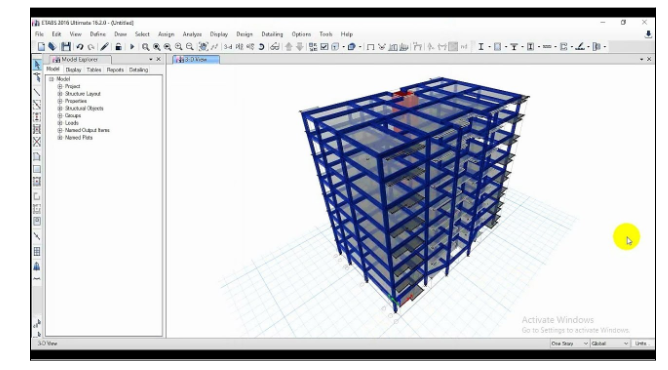
Structural engineers are expected to deliver faster, more accurate, and code-compliant designs; often under significant time constraints. To meet these expectations, many professionals turn to structured digital programs that make advanced tools accessible without heavy financial commitments. Yet, even the most well-designed learning resource cannot deliver meaningful results unless learners approach it with clarity, discipline, and professional intention. This is especially true when participating in a free ETABS course, where self-direction plays a significant role in the learning outcome.
Below are the five most critical mistakes that engineers should consciously avoid when learning this powerful structural analysis and design software.
1. Skipping Fundamental Engineering Principles Before Using the Software
One of the foundational mistakes learners make is diving into the software without reinforcing essential engineering concepts. Structural design software simplifies calculations, but it does not replace engineering judgment. Engineers who rely too heavily on automation often misunderstand load behavior, member interactions, stiffness considerations, and failure mechanisms.
This gap becomes evident when modelling real structures. Without clarity on why certain parameters matter or how different elements respond under various loads, learners often create inaccurate models or interpret results incorrectly. Software proficiency must be built upon a solid conceptual base.
Understanding core topics, such as load combinations, ductility, material behavior, and code design philosophy, ensures that every model reflects realistic structural behavior. Engineers who strengthen their fundamentals before modelling develop the confidence to troubleshoot issues, validate software outputs, and ensure their designs meet safety and performance standards. For this reason, even those following an ETABS course must prioritize conceptual clarity before mastering commands.
2. Treating Interface Familiarity as Professional Expertise
Another common error is assuming that knowing the software interface is equivalent to mastering structural analysis. Many learners spend too much time memorizing menus and tools instead of understanding the engineering logic behind each modelling step. This creates a superficial skillset that works only for routine tasks and fails when confronted with complex design challenges.
ETABS is a powerful analytical tool, but the value it provides depends on how intelligently it is used. Professionals must think beyond “which button to click” and instead understand the structural implications of constraints, meshing strategies, load assignments, and boundary conditions.
True expertise comes from connecting engineering theory with software functionality. Mastery is achieved when engineers can make informed decisions about modelling strategy, correctly interpret analysis results, and adjust parameters to better reflect site conditions, geometry, and load paths. Treating ETABS as a decision-support system, rather than a calculator, sets successful learners apart in professional practice.
3. Limiting Learning to Theoretical Examples Instead of Practicing on Real Projects
An often-overlooked mistake is restricting practice to preloaded examples or guided demonstrations. While these are useful for understanding features, they rarely reflect the complexities of real structural systems. Engineers must experience real project scenarios to build the ability to navigate irregular geometries, multidirectional load paths, and mixed material systems.
Practical exposure deepens understanding by revealing how design choices affect performance and constructability. Case studies, model replications, and hands-on practice with real project data provide insights into error patterns, workflow optimization, and code-compliant modelling techniques.
Working on actual projects also strengthens analytical reasoning. Engineers learn to justify design decisions, identify inefficient structural forms, and recognize discrepancies in analysis results. These skills are crucial for developing engineering intuition, an ability that distinguishes seasoned professionals from beginners.
Completing an ETABS course is one step, but applying its lessons to real-world challenges is what transforms knowledge into practical expertise.
4. Failing to Verify and Validate Analysis Outputs
ETABS provides powerful analytical capabilities, but its outputs are only as reliable as the inputs provided. Many learners assume that once the software runs, the results are automatically correct. This misconception leads to unsafe or noncompliant designs.
Every model must be checked rigorously. Verification ensures the model is built correctly, with accurate geometry, loads, and constraints. Validation confirms that the results make sense and conform to established engineering principles. When working on building design in ETABS, these checks become even more critical, as even minor parameter errors can compromise safety, serviceability, or code compliance.
The absence of thorough verification often results in unnoticed modelling errors such as misassigned loads, unintentional releases, or unrealistic stiffness assumptions. Design codes exist to guide safe, economical, and structurally sound decisions. Without checking models against local code provisions, engineers risk producing outputs that are technically incorrect or legally noncompliant.
Professionals who consistently verify and validate their models develop stronger engineering judgment, prevent structural failures, and uphold ethical responsibility in their work. Engineers must treat software output as part of a larger decision-making process rather than a substitute for engineering reasoning.
5. Learning Without Seeking Expert Feedback or Peer Review
Self-paced learning offers flexibility, but isolation can slow progress and reinforce incorrect methods. Engineering is inherently collaborative, and meaningful growth often stems from interacting with mentors, peers, and experienced professionals.
Learning alone deprives students of valuable insights, such as industry best practices, common modelling pitfalls, and efficient workflow techniques. Expert guidance accelerates learning by clarifying doubts, offering alternative approaches, and highlighting techniques that improve accuracy and speed.
Whether through formal coaching, interactive sessions, or community forums, learners benefit immensely from structured engagement. By combining self-study with expert feedback, participants transform theoretical knowledge into practical, confident, and industry-ready skills.
Conclusion:
Mastering ETABS requires more than completing a learning module; it demands a disciplined, structured, and professionally guided approach. Avoiding common mistakes such as skipping engineering fundamentals, relying solely on interface familiarity, or neglecting verification ensures that learners build a strong technical foundation.
When approached with intention and clarity, an ETABS course becomes far more than an introductory resource. It serves as a stepping stone toward advanced modelling confidence, better design decisions, and stronger career readiness. Strengthening related competencies, such as understanding the basics of Staad Pro, further enhances an engineer’s ability to analyse, compare, and validate structural behaviour across different platforms.
For learners seeking structured guidance, industry-relevant training, and long-term skill development, Civilera provides trusted, practical, and results-driven learning support, helping professionals grow confidently in the field of structural design.
