

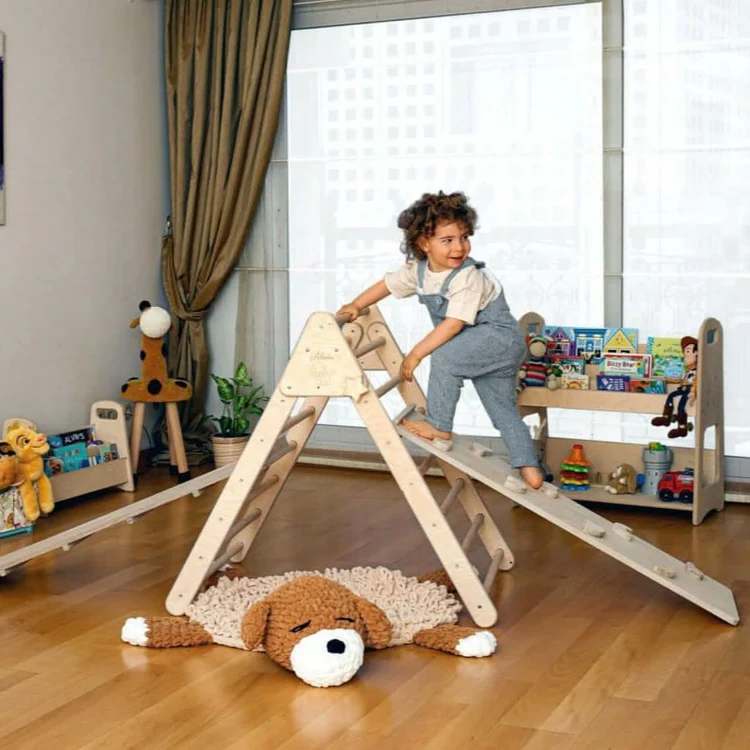
Parenting in the present time is highly regulated by the need to bring up kids who are self-assured, skilled, and emotionally stable. Among the various tools that are gaining fame, Pikler Triangles are considered a heterogeneous climbing structure. Based on respectful parenting and child-led movement, they offer little ones a secure avenue to test their physical skills at their own time. What appears to be a basic wooden frame is, in fact, a remarkable ally in development that sustains and enhances growth, even beyond the very first unsteady steps.
The craze is not only about the simplistic design that blends beautifully with the modern nursery, but it is also based on a deep knowledge of children’s physiology and the psychology of needing to be independent. These triangles create risk-free areas for children to play and thus, provide them the opportunity to develop and test their limits, be in control of their bodies, and gain confidence that will last even outside the playroom walls.
Pikler Triangles: Develops More Than Muscles
This climbing structure, unlike usual play equipment, which often determines the way children are supposed to play, welcomes them to explore without any guidance. It is up to the children to decide when they are going to climb, how high they are going to go, and when they need a break. They learn their limits by testing them, which reduces fear and builds a healthy relationship with physical challenges.
- Strength with awareness: the kids are gradually and imperceptibly gaining muscle while at the same time mastering their control.
- Balance through experience: the stability is coming up naturally, without any artificial ways of propping it up.
- Confidence without pressure: no loud supporters, no pushing, only the child’s own belief.
Independence, the Silent Superhero
A child is not picked up, moved, or helped into a position that is beyond their reach. A child who climbs up by themselves feels that the success is rightly theirs, while the failure is just another lesson on the way to success. The child’s independence helps emotional toughness and, at the same time, reduces the dependency on adults’ instructions.
Movement, Focus, Patience, and Problem-Solving
Climbing is not just a physical challenge, but it is also a cognitive one. Each and every movement includes planning, coordination, and decision-making. Even without the bright lights and electronic sounds, kids are still very much in the zone as far as the activity is concerned.
Mental Skills Gained During Play:
- Concentration: kids can stay with the activity for longer periods of time if they are interested.
- Problem-Solving: discovery of one’s own body movement to swing from bar to bar
- Patience: the child will have to learn that a little step at a time is the only way to get there, and that success won’t be instant
A Safer Way to Take Risks
The modern parent often finds it hard to give the child freedom and still keep him or her safe. The climbing apparatus offers both aspects by introducing risk in a very controlled manner. Kids will discover how to fall correctly and learn how to hold on tighter or climb down instead of up.
- Child-operated movements at a low height
- No forced poses or set time for challenges
- If the child falls, it will be a minor and manageable fall, if at all.
Design That Grows With the Child
Another reason parents love this climbing structure is its longevity. It evolves with the child rather than being outgrown quickly. Its open-ended design invites imagination. One day it’s a mountain, the next a bridge, and later a quiet reading nook with a blanket draped over it.
How it adapts over time:
- Early crawling and pulling up.
- Confident climbing and hanging
- Creative play like forts, tunnels, or obstacle courses
Minimalist, Intentional, and Home-Friendly
The non-obtrusive effect of clean lines, natural materials, and a neutral tone is so strong that they even make the toy look like it belongs in the living area rather than a noisy one. The whole situation also favors the idea that kids don’t necessarily need lots of toys, just a few good-quality ones that acknowledge their potential.
The reason why parents like the design:
- Integrates flawlessly with home décor
- Promotes controlled, intensive play
- Represents deliberate, non-messy parenting
Conclusion
To sum up, what attracts parents is more than the product itself; it is the mentality that goes along with it. Pikler Triangles are not merely a passing craze but rather a philosophy, signifying a transformation in modern parents’ perception of play. It is not about hastening the milestones or revealing the achievements; it is about giving the child time at their own pace. These triangles help in supporting, fortifying, and nurturing the child’s self-confidence, concentration, independence, and hardiness, the very qualities that are retained even after the climbing years.
read more blogs like this at atechvibe.com
