

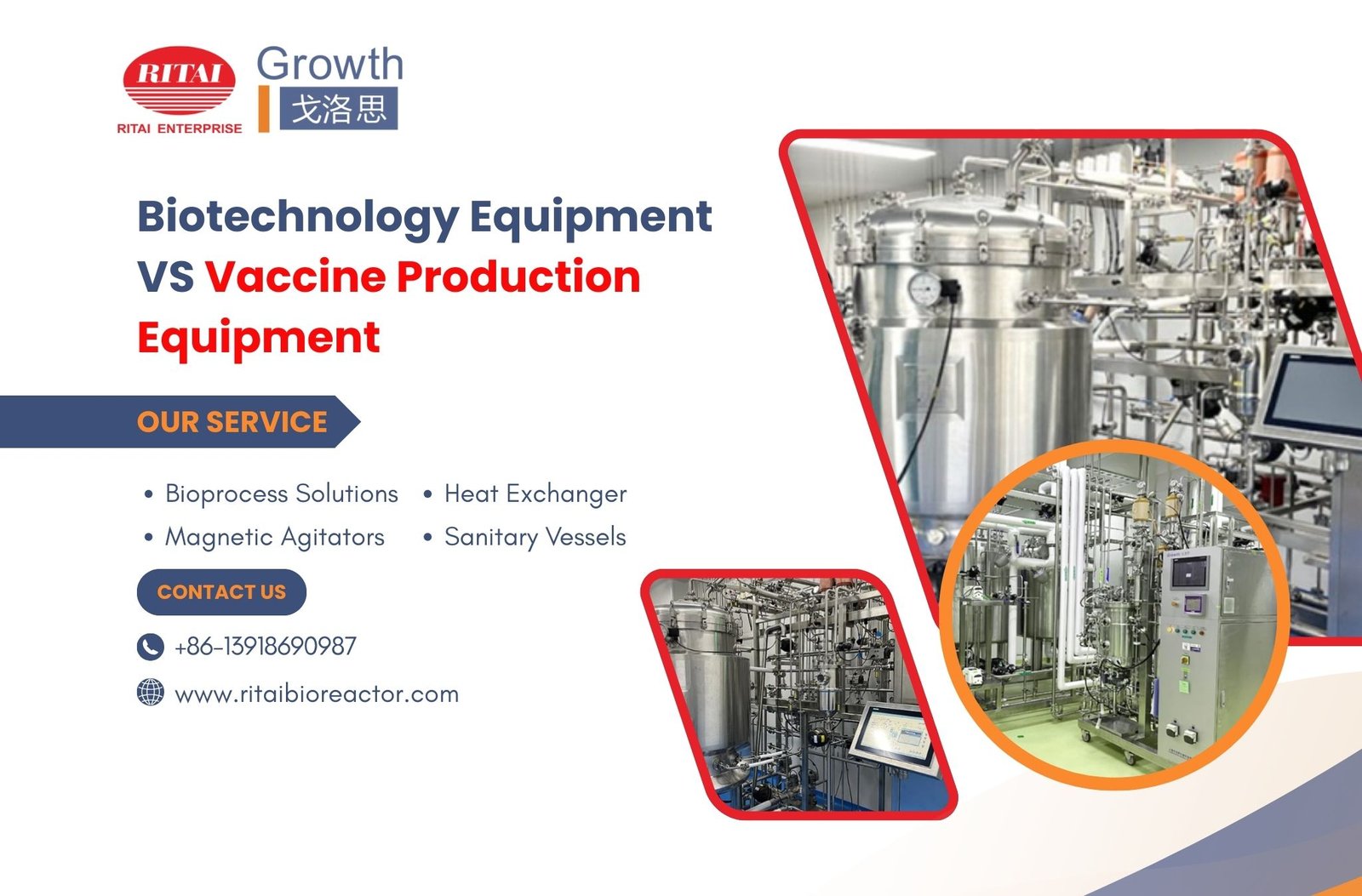
Most scale-ups don’t slip because the biology is hard. They slip because Biotechnology Equipment can’t hold setpoints under load, can’t be cleaned the way QA expects, or produces batch data that no one trusts. In vaccines, that pressure hits faster: one missing document from your Vaccine Production Equipment supplier can stop validation lots cold.
This guest post is a colleague-to-colleague guide to selecting Biotechnology Equipment and Vaccine Production Equipment with fewer surprises—what belongs on the critical path, what to ask vendors, and how to keep purchasing tied to process risk. I’ll use Ritai Bioreactor as a practical example of how to assess a core unit operation without getting trapped in marketing language.
What counts as Biotechnology Equipment once you’re in a GMP facility?
If it touches product, product-contact utilities, or batch records, it’s Biotechnology Equipment. Typical groups include:
- Upstream Biotechnology Equipment: media/buffer prep, hold tanks, seed train systems, bioreactors, gassing and gas control
- Downstream process equipment: depth filtration, tangential flow filtration, chromatography skids, formulation systems
- Fill-finish as Vaccine Production Equipment: sterile filtration, filling, isolators/RABS, lyophilizers, inspection
And don’t ignore interfaces: if your Biotechnology Equipment depends on clean steam, WFI, gases, or environmental monitoring, those connections need clear ownership and qualification planning.
Why does Vaccine Production Equipment selection decide your timeline?
Vaccine Production Equipment delays programs in three predictable ways.
Lead times beat your plan. A key piece of Vaccine Production Equipment like an isolator or lyophilizer can take many months. Order it late and you’ll finish development with nowhere to run PPQ.
Documentation becomes the hidden workstream. Regulators expect traceability, drawings, software specs, alarms, and audit trails. Vaccine Production Equipment without a complete documentation package forces you into backfilling while the clock keeps running.
Scale exposes control gaps. Vaccines often run in narrow windows: mixing, shear, temperature, gas transfer, hold times. Vaccine Production Equipment that looked fine in a demo can drift during real loads and real campaign conditions.
How do you match Biotechnology Equipment to your platform?
Start with the biology, then translate it into control needs and contamination risks. The “right” Biotechnology Equipment for microbes is not the same as for mammalian cells or virus work.
Are you running microbes?
Microbial processes need Biotechnology Equipment that supports robust agitation, high oxygen transfer, foam control, and repeatable sterilization. Probe durability matters because sensors see harsher conditions and faster fouling.
Are you running mammalian cells or virus-based vaccines?
Cell-based processes demand low-shear handling, stable gassing, and tight pH control. Closed processing and aseptic connections are part of the Vaccine Production Equipment story, not a nice-to-have. Virus programs also stress consistent timing and disciplined downstream clearance, so your Biotechnology Equipment choices must support repeatability across campaigns.
What should you demand from Vaccine Production Equipment suppliers before you sign?
Treat this like qualification, not shopping.
Do they provide GMP-ready documentation—up front?
For Vaccine Production Equipment, ask early for:
- Material traceability (316L certs, polymer compliance, extractables/leachables where relevant)
- Design packages (URS mapping, P&IDs, GA drawings, wiring/I-O lists)
- Software packages (functional specs, audit trail behavior, user access control, backup/restore)
- Validation support (IQ/OQ templates, calibration certificates, FAT/SAT protocols)
If a vendor says later, assume later means during a crisis. Hold Biotechnology Equipment vendors to the same standard.
Can the system support data integrity and sensible automation?
Modern Biotechnology Equipment should integrate with PLC/SCADA, produce time-stamped records, and make alarms and interventions reviewable. Vaccine Production Equipment that relies on local files or unprotected exports is a compliance risk you don’t need.
What happens after installation?
Ask who does commissioning, typical response times, spare-part availability, and whether remote diagnostics exist. In vaccine campaigns, downtime is expensive. Vaccine Production Equipment without a service plan can erase the advantage you thought you bought.
Where do teams overspend or underinvest in Biotechnology Equipment?
Three patterns show up repeatedly:
- Buying “max spec” before CPPs are stable—Biotechnology Equipment becomes complex without improving outcomes.
- Underbudgeting utilities and qualification—clean steam, WFI, HVAC fit, and IQ/OQ/PQ take time and money.
- Ignoring consumables and second sources—single-use Vaccine Production Equipment only works if supply is reliable.
Spend where it reduces risk: sterility, control, documentation, and maintainability. That rule holds for Biotechnology Equipment and Vaccine Production Equipment alike.
How should you evaluate a Ritai Bioreactor as core Biotechnology Equipment?
A bioreactor is often the first truth test of a vendor’s GMP maturity. When you evaluate a Ritai Bioreactor, focus on what shows up in deviations:
- Control under real load: can the Ritai Bioreactor hold pH and DO during feeding and viscosity changes?
- Cleanability/sterility design: stainless drainability and dead-legs, or single-use integrity testing and connections
- Sensors and calibration workflow: quick swaps, documented calibration, clear SOP fit
- Records QA can use: traceable batch data, alarm history, and user actions
- Change control: version tracking and patch handling
If your core Biotechnology Equipment is disciplined on documentation and service, the rest of your Vaccine Production Equipment program usually follows.
What procurement checklist keeps Vaccine Production Equipment decisions sane?
Tie procurement to risk:
- Define CQAs/CPPs your process equipment must control.
- Identify critical-path Vaccine Production Equipment (long lead, high aseptic risk, complex validation).
- For each item of Biotechnology Equipment and Vaccine Production Equipment, define ranges, accuracy, materials, cleaning approach, and automation needs.
- Require documentation packs in the quote and score completeness.
- Plan FAT/SAT, IQ/OQ/PQ, and training inside the purchase.
- Validate supply chain: consumables, spare parts, second sources.
- Confirm facility fit: WFI, clean steam, gases, power, floor loading, HVAC.
Final thoughts: What’s the simplest way to de-risk Biotechnology Equipment?
Choose Biotechnology Equipment that behaves predictably, documents everything, and is supported by people who answer hard questions without hand-waving. Vaccine Production Equipment raises the stakes because aseptic risk and regulatory expectations are higher, so “we’ll fix it next run” usually isn’t acceptable.
If you’re evaluating a Ritai Bioreactor or any comparable system, ask for comparable process references, review the validation package early, and speak with the service team—not only sales. Do that, and your Biotechnology Equipment and Vaccine Production Equipment decisions look less like guesswork and more like engineering.
