

Introduction
The Micro800 PLC family from Allen-Bradley is widely used in small to mid-sized automation systems where flexibility, compact design, and cost efficiency are important. These controllers are commonly found in machines, skids, and standalone processes that need reliable control without unnecessary complexity. As automation projects grow, built-in I/O is often not enough to handle all field signals. This is where expansion modules become essential. The Allen Bradley 2085-IA8 is one such module, designed to expand AC input capability for Micro800 controllers. This blog explains how the 2085-IA8 works with Micro800 PLCs in a simple, practical way that connects theory with real-world applications.
What Is the Allen Bradley 2085-IA8 Module?
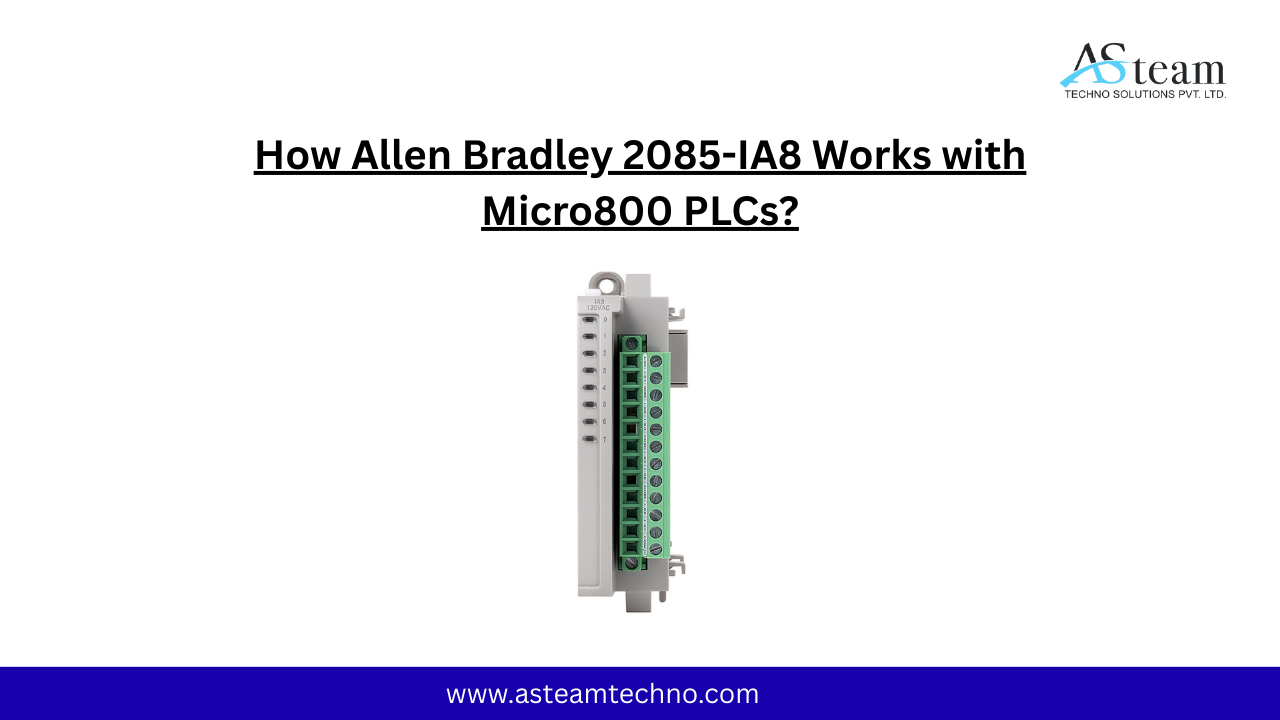
The Allen Bradley 2085-IA8 is a digital input expansion module designed specifically for the Micro800 PLC platform. It provides eight AC input channels, allowing the PLC to read 120V AC signals from field devices. Instead of replacing the controller when more inputs are needed, this module lets users expand input capacity easily. The 2085-IA8 is compatible with Micro850 and Micro870 controllers and is commonly used in systems where sensors, switches, or devices operate on AC voltage. Typical applications include machine control panels, packaging equipment, and process automation setups that rely on AC signals rather than low-voltage DC inputs.
Understanding Micro800 PLC Compatibility
The Micro800 platform is designed as a modular control system, meaning controllers can be expanded using plug-in I/O modules. The 2085-IA8 is engineered specifically for this platform, ensuring seamless electrical and logical compatibility. Communication between the PLC and expansion modules happens through the I/O expansion bus, which transfers power and data internally without external wiring. To keep this communication stable, the expansion chain must end with a bus terminator or end cap. Without it, the PLC may report faults or fail to recognize installed modules, making the terminator a critical but often overlooked component.
How the 2085-IA8 Processes AC Input Signals
The 2085-IA8 receives AC signals from field devices such as push buttons, limit switches, proximity sensors, or relay contacts. When an AC voltage is applied to an input channel, the module detects it and converts that electrical signal into a digital logic state that the PLC can understand. Each input updates its status whenever it changes from OFF to ON or ON to OFF. Built-in input filtering plays a key role here by smoothing out short voltage spikes and electrical noise, preventing false triggering and ensuring stable, reliable signal detection in industrial environments.
Key Technical Specifications (Simplified Explanation)
The 2085-IA8 operates within a wide AC voltage range suitable for industrial power systems, making it reliable even when voltage fluctuates slightly. When an input is ON, it draws a small current to confirm signal presence; when OFF, leakage current is kept very low to avoid false readings. Input impedance helps limit current flow, protecting both the module and field devices. Inrush current is managed internally to handle sudden voltage application safely. The input filter timing meets international IEC standards, ensuring consistent and noise-resistant signal processing across different applications.
Best AI Tools for Students in 2026
Physical Installation of the 2085-IA8
Installation of the 2085-IA8 is straightforward. The module can be mounted on a DIN rail or secured directly to a panel. Proper spacing around the module is important to allow airflow and prevent heat buildup. The module connects directly to the side of the Micro800 controller or another expansion module using built-in latches. At the end of the expansion chain, an end cap or bus terminator must be installed to complete the system and prevent communication errors.
Wiring the 2085-IA8 Module
Each input channel has clearly labeled terminals, with shared common connections grouped for convenience. AC wiring typically connects one side of the supply to the field device and the other side to the input terminal. Recommended wire sizes ensure secure connections and reliable signal transmission. Proper grounding through the panel or DIN rail is essential for safety and noise reduction. Always remove power before wiring or disconnecting terminals to prevent electrical hazards and protect the module from damage.
Programming and Integration with Micro800 PLCs
Programming the 2085-IA8 is done using Connected Components Workbench (CCW) software. Once added to the project, the module’s input points automatically appear in the PLC’s tag database. These inputs can be used directly in ladder logic, just like built-in I/O. No additional add-on profiles or special configuration files are required, making integration quick and user-friendly.
Common Applications and Use Cases
The 2085-IA8 is widely used for monitoring limit switches, push buttons, and AC sensors. It is ideal for reading relay outputs from external devices and expanding input capacity in control panels. Common industries include packaging, material handling, machine automation, and small process control systems where AC field signals are standard.
Best Practices for Reliable Operation
Reliable performance starts with good grounding and clean wiring practices. Always verify that input voltage levels match module ratings and avoid connecting overloaded or damaged devices. Periodic inspection of terminals and wiring helps prevent loose connections and signal issues over time.
Conclusion
The Allen Bradley 2085-IA8 works seamlessly with Micro800 PLCs by providing a simple and reliable way to expand AC input capability. From signal detection to PLC integration, the module is designed for ease of use and industrial reliability. For systems that rely on AC field devices, the 2085-IA8 offers a practical, scalable solution without added complexity.
FAQs
Q1. Which Micro800 PLCs support the 2085-IA8 module?
The 2085-IA8 is supported by Micro850 and Micro870 controllers.
Q2. What type of signals does the 2085-IA8 accept?
It accepts 120V AC digital input signals from field devices.
Q3. Do I need additional software or profiles to use the 2085-IA8?
No, it is natively supported in Connected Components Workbench.
Q4. What happens if the bus terminator is not installed?
The PLC may show faults or fail to recognize the expansion modules.
Q5. Is the 2085-IA8 suitable for noisy industrial environments?
Yes, built-in input filtering helps prevent noise-related false signals.
Reach Us
Asteam Techno Solutions Pvt. Ltd. is AVEVA (Formerly Wonderware) Registered System Integrator providing sale/service/support and executing the HMI/SCADA, Historian/MES Solutions to End-user & OEM/System Integrator community for their diverse needs.
Leading single-source supplier & solution provider for industrial automation hardware and software solutions needed.
