

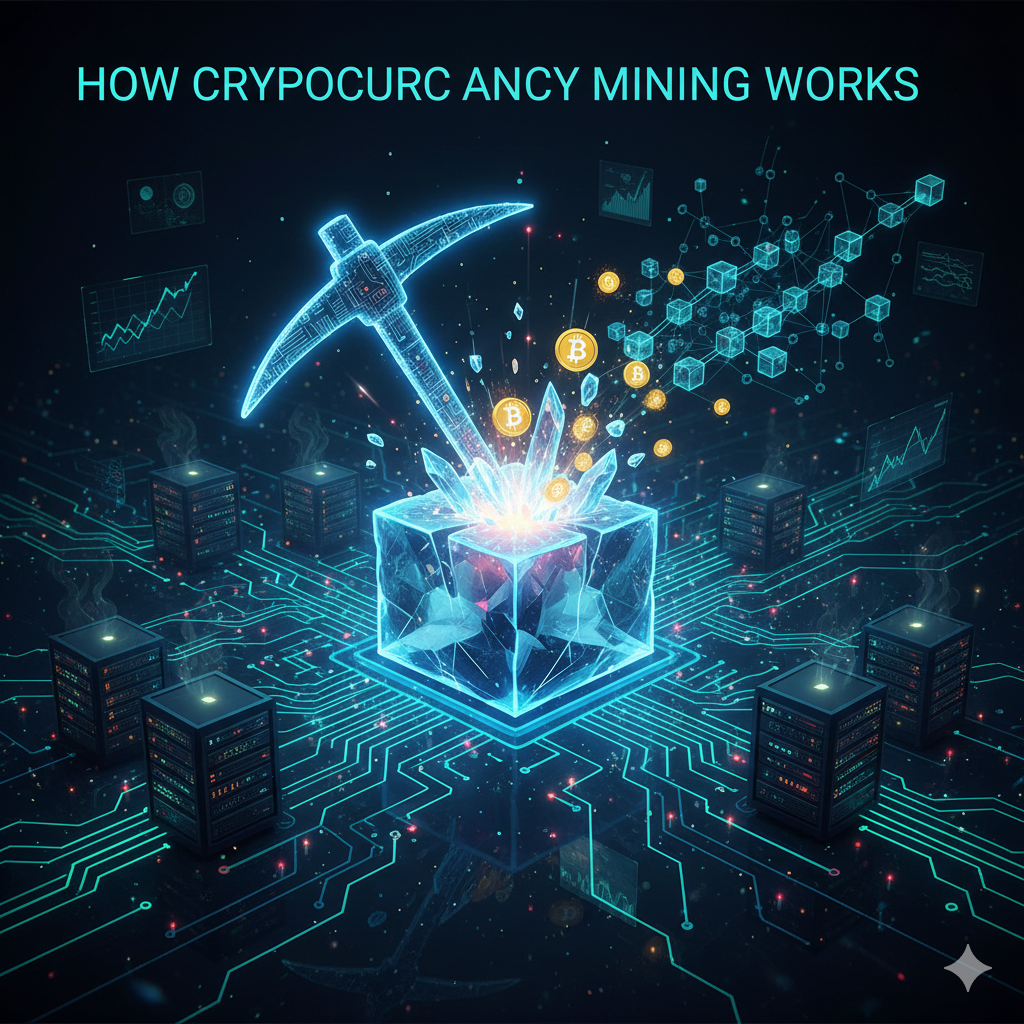
During my 11 years in the blockchain industry, from building mining operations to advising cryptocurrency exchanges, I’ve witnessed mining evolve from a hobby anyone could do on their laptop to a sophisticated industrial enterprise. Mining remains one of the most fascinating and essential processes in cryptocurrency.
Many people hear about mining and imagine physical extraction like gold mining. The reality is quite different it’s a computational process that secures networks and creates new cryptocurrency.
Understanding how mining works is crucial whether you’re considering mining yourself or simply want to grasp how cryptocurrencies maintain security and trust without central authorities.
What Is Cryptocurrency Mining in Simple Terms?
Cryptocurrency mining is the process of using computational power to validate transactions, secure the blockchain network, and create new coins by solving complex mathematical puzzles. Miners compete to find solutions to these puzzles, and the first to succeed gets rewarded with newly minted cryptocurrency and transaction fees.
Think of miners as both auditors and lottery players simultaneously. They verify that transactions are legitimate, bundle them into blocks, and compete to add those blocks to the permanent blockchain record.
The “mining” metaphor comes from the similarity to precious metal extraction it requires effort and resources, becomes progressively harder, and has a finite supply. Just as gold miners expend energy to extract value from the earth, crypto miners expend computational energy to extract value from the network.
From my experience consulting for mining operations across three continents, I’ve learned that mining serves multiple critical functions beyond just creating new coins. It’s the backbone of blockchain security.
How Does the Mining Process Actually Work?
The mining process involves miners collecting pending transactions, bundling them into a candidate block, and repeatedly computing hash functions until they find a value that meets the network’s difficulty requirements. Once found, this block is broadcast to the network for verification and added to the blockchain, rewarding the successful miner.
Here’s the step-by-step process I’ve observed and optimized in countless mining operations. First, miners gather unconfirmed transactions from the mempool (transaction waiting area) and verify their validity.
Next, they create a block header containing a reference to the previous block, a timestamp, the transactions’ Merkle root, and a nonce (a random number). Miners then compute the cryptographic hash of this block header.
If the hash meets the difficulty target (typically requiring a certain number of leading zeros), they’ve solved the puzzle. If not, they change the nonce and try again. This process happens billions of times per second across the network.
The first miner to find a valid hash broadcasts their block to the network. Other nodes verify the solution, and if valid, add the block to their blockchain copy. The successful miner receives the block reward plus transaction fees.
What Equipment Do You Need for Cryptocurrency Mining?
Mining requirements depend on the cryptocurrency and consensus mechanism, but Bitcoin mining requires specialized ASIC hardware costing thousands of dollars, while some altcoins can still be mined profitably with high-end GPUs. The minimum viable setup includes mining hardware, reliable internet, cooling systems, and access to cheap electricity.
In my years evaluating mining operations from hobbyist to industrial scale, I’ve seen the equipment landscape transform dramatically. When Bitcoin launched in 2009, you could mine on a regular CPU and actually win blocks.
By 2011, miners shifted to GPUs (graphics cards) which offered 50-100 times more hashing power. By 2013, ASIC (Application-Specific Integrated Circuit) miners emerged specialized chips designed solely for mining specific algorithms.
Today’s Bitcoin ASIC miners like the Antminer S19 XP cost $5,000-$15,000 each and consume 3,000-5,000 watts. Professional operations deploy thousands of these machines in warehouse facilities.
For Ethereum (before its transition to Proof of Stake) and other GPU-minable coins, high-end graphics cards from NVIDIA or AMD remain viable. A competitive GPU mining rig might cost $3,000-$10,000 with 6-12 graphics cards.
Why Does Mining Difficulty Constantly Increase?
Mining difficulty adjusts automatically to maintain consistent block production times as more miners join the network or computing power increases. Bitcoin adjusts difficulty every 2,016 blocks (approximately two weeks) to ensure blocks are found roughly every 10 minutes regardless of total network hash rate.
This self-regulating mechanism is brilliant design that I’ve studied extensively. If miners collectively become more powerful and start finding blocks faster than the target time, the network increases difficulty by requiring more leading zeros in the hash.
Conversely, if miners drop off and blocks slow down, difficulty decreases to maintain the schedule. This ensures predictable coin issuance and consistent network security regardless of participation levels.
Throughout my career, I’ve watched Bitcoin’s difficulty increase exponentially. In 2010, you could mine blocks on a laptop. Today, even a warehouse full of latest-generation ASICs has only a tiny chance of finding a block solo.
This ever-increasing difficulty is why most individual miners join mining pools to combine their power and share rewards proportionally.
Is Cryptocurrency Mining Still Profitable?
Mining profitability depends on multiple factors including electricity costs, hardware efficiency, cryptocurrency prices, and network difficulty with electricity costs being the single most important variable. Miners in regions with electricity below $0.05 per kWh can often profit, while those paying $0.10+ per kWh struggle to break even.
From my experience analyzing mining economics for investors and operators, I use a simple framework. Calculate your daily revenue based on hash rate and current block rewards, then subtract your daily electricity cost and amortize hardware costs.
Bitcoin mining currently generates approximately $15-30 per day per latest-generation ASIC, assuming $0.06/kWh electricity. However, that machine costs $8,000, meaning you need 9-12 months just to recover the hardware investment.
Price volatility dramatically impacts profitability. During bull markets, mining becomes incredibly lucrative as coin prices soar while costs remain relatively fixed. During bear markets or when evaluating expenses like white label exchange pricing for platforms considering mining integration, margins compress or turn negative.
Many large operations negotiate special electricity rates, utilize renewable energy, or operate in cold climates to reduce cooling costs. Some even capture waste heat for other purposes, improving overall economics.
What Are Mining Pools and Why Do Miners Use Them?
Mining pools are groups of miners who combine their computational power and share block rewards proportionally based on contributed hash rate. Individual miners join pools because solo mining has become impractically difficult for most cryptocurrencies, with chances of finding a block alone being extremely low for average participants.
I always recommend pools for anyone starting mining today. Consider Bitcoin: the total network hash rate exceeds 400 EH/s (exahashes per second). A single S19 XP miner contributes about 140 TH/s (terahashes).
Your chance of finding a block solo is roughly 140 TH/s ÷ 400,000,000 TH/s = 0.000035%. You might wait years or decades to find a single block, making income completely unpredictable.
Mining pools solve this by combining thousands of miners’ power. When the pool finds a block, rewards are distributed based on each miner’s contributed work. This provides consistent, predictable income albeit smaller per payout.
Pools charge fees (typically 1-3%) but the reliability is worth it. Major pools like Foundry USA, AntPool, and F2Pool control significant portions of Bitcoin’s hash rate. Some platforms, including those offering white label dex exchange solutions, integrate mining pool connectivity for users interested in diversified crypto income strategies.
What Environmental Concerns Exist Around Mining?
Cryptocurrency mining, particularly Bitcoin, consumes enormous amounts of electricity currently using more energy annually than some entire countries. Environmental concerns center on carbon emissions when electricity comes from fossil fuels, though estimates of mining’s carbon footprint vary widely and the industry increasingly utilizes renewable energy sources.
This is perhaps the most controversial aspect of mining that I’m constantly asked about. Bitcoin’s annual electricity consumption is estimated at 100-150 TWh, comparable to countries like Argentina or Norway.
However, context matters. The banking system globally consumes far more energy when you account for bank branches, ATMs, data centers, and employee infrastructure. Gold mining also requires massive energy for extraction and processing.
Increasingly, miners gravitate toward renewable energy because it’s often the cheapest. Iceland, Norway, and parts of China (before the ban) attracted miners with abundant hydroelectric power. Texas miners use excess wind and solar energy.
Some operations even provide grid stabilization services, consuming surplus renewable energy that would otherwise go to waste and shutting down during peak demand to help balance the grid.
Can You Mine Cryptocurrency on Your Phone or Regular Computer?
Mining cryptocurrency on phones or regular computers is technically possible but economically impractical and potentially harmful to devices due to insufficient processing power, high electricity costs relative to earnings, and hardware wear. Mobile mining apps are often scams or yield negligible returns while draining batteries and reducing device lifespan.
I’ve tested numerous mining setups over the years, and the math simply doesn’t work for consumer devices anymore. A high-end laptop might generate $0.10-0.50 per day mining certain altcoins while consuming $0.50-2.00 in electricity and accelerating hardware degradation.
Mobile mining is even worse. Smartphones lack the processing power for meaningful contribution, and the battery wear from constant operation far exceeds any potential earnings.
Beware of mobile apps promising easy mining profits many are scams collecting personal data or running malware. Legitimate cryptocurrency mining requires dedicated hardware, proper infrastructure, and careful economic analysis.
Conclusion
Cryptocurrency mining is a sophisticated process that secures blockchain networks through computational work while distributing new coins to participants. While it started as an activity accessible to anyone with a computer, it has evolved into a competitive industry requiring significant capital investment and operational expertise.
For most individuals, the days of profitable home mining have passed unless you have access to exceptionally cheap electricity and can invest in proper equipment. However, understanding mining helps you appreciate how cryptocurrencies maintain security and trust without central authorities.
Whether you’re considering mining as an investment or simply want to understand blockchain technology better, remember that successful mining requires careful economic analysis, ongoing optimization, and realistic expectations about returns in an increasingly competitive landscape.
