

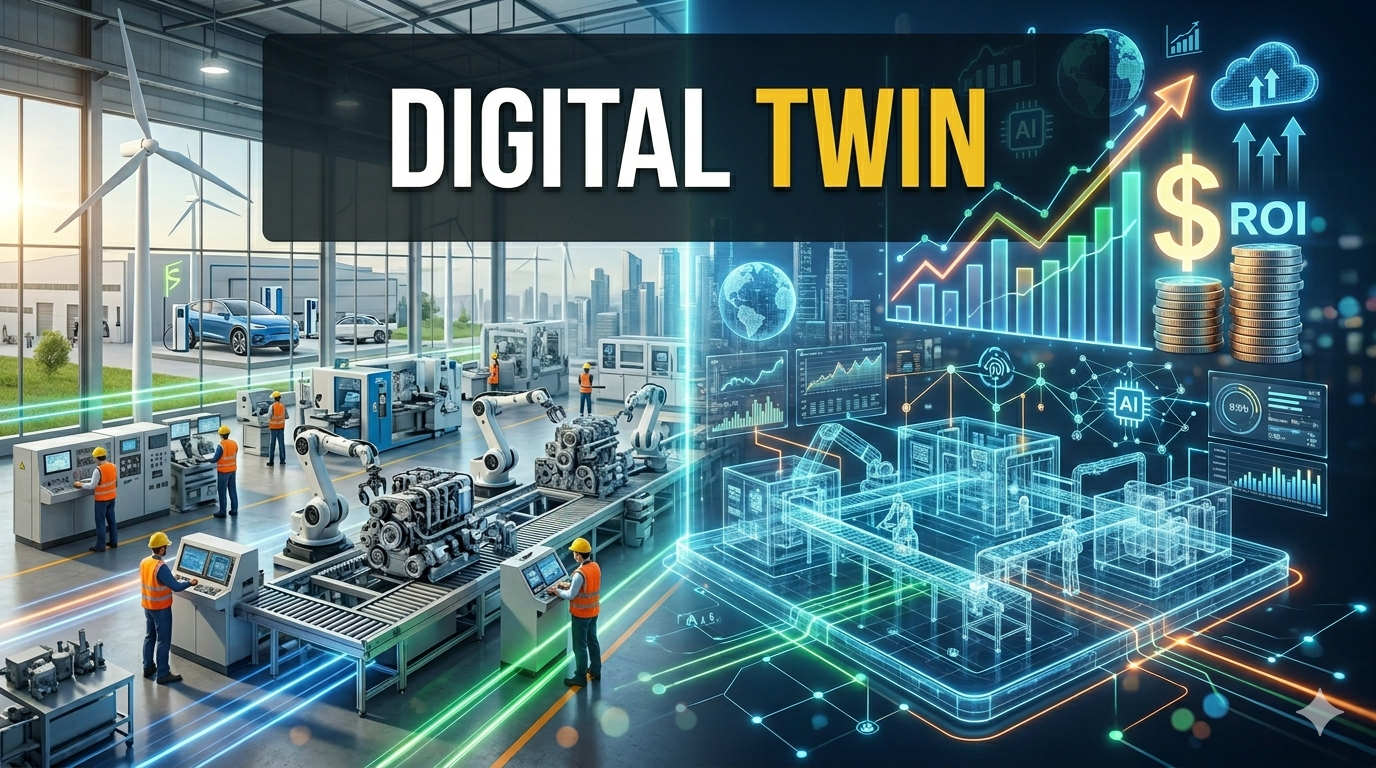
Every CFO has been in that meeting where a major technology investment gets greenlit based on projected efficiency gains that never quite materialize. Digital twin technology is different, and the numbers are starting to prove it.
According to our curated digital twin statistics, the global digital twin market is projected to surpass $110 billion by 2028, with adoption accelerating fastest in manufacturing, healthcare, and energy precisely the sectors where operational margins are tightest and the stakes of poor decision-making are highest.
But market size projections don’t pay your quarterly P&L. What matters to a CTO, COO, or CDO sitting across from a board asking hard ROI questions is this: do digital twins actually move the needle, and how quickly?
This blog answers that directly with specific examples, real use cases, and the financial logic behind why enterprise leaders across industries are treating digital twin solutions not as a technology experiment, but as a core operational investment.
What Is a Digital Twin, and Why Does It Matter for Business Outcomes?
A digital twin is a real-time virtual replica of a physical asset, process, or system built using IoT sensor data, AI modeling, cloud computing, and simulation engines.
It mirrors the behavior of its physical counterpart so accurately that teams can test scenarios, predict failures, and optimize operations without touching the real-world system.
That last part is where the ROI lives.
Before digital twins, the only way to understand how a production line would respond to a new configuration was to test it at full cost, full risk, and full disruption.
With a digital twin, a manufacturing operations team can run 500 simulated variants overnight and arrive the next morning knowing which configuration to deploy. The cost of experimentation drops from hundreds of thousands of dollars to a fraction of that.
This isn’t theoretical. It’s the core value loop that makes digital twin solutions worth the investment: reduce the cost of knowing, and you reduce the cost of deciding.
The Direct ROI Drivers: Where Digital Twins Pay for Themselves
1. Predictive Maintenance That Actually Predicts
Unplanned equipment downtime costs industrial manufacturers an estimated $50 billion annually in the US alone, according to Deloitte.
The standard response has been either reactive maintenance (fix it when it breaks) or time-based preventive maintenance (service it every 90 days regardless of actual condition). Both are expensive.
Digital twins change the model. By continuously monitoring sensor data from physical assets and cross-referencing it against a behavioral model of how that equipment should perform, a digital twin can identify degradation patterns weeks before a failure occurs.
Maintenance teams receive an alert, schedule a targeted intervention, and avoid both the downtime and the cost of over-servicing equipment that didn’t need it.
A 400-turbine wind farm operator that deployed digital twin monitoring across its fleet reduced unplanned downtime by 36% within 18 months translating directly to increased generation capacity and lower maintenance labor costs. The digital twin paid for itself within the first year.
This is the pattern enterprise leaders should look for: not “what does this technology cost,” but “what is the cost of operating without it.”
2. Faster, Lower-Risk Product Development
Product development cycles carry enormous sunk cost risk. A pharmaceutical company that spends 18 months developing a drug delivery device only to discover a design flaw in late-stage physical testing has lost not just money it’s lost time it can never recover.
Digital twins collapse this risk by moving experimentation into the virtual space earlier. Engineers can stress-test a medical device design against thousands of edge-case simulations before a single physical prototype is built.
They can model patient physiological variability, identify design tolerances that would fail in real-world conditions, and iterate at a speed that physical prototyping simply cannot match.
The result: development cycles that shrink by 20–30% are increasingly common in industries that have adopted digital twin methodology at scale. For a product with a $200M revenue opportunity, shaving six months off time-to-market has a quantifiable value that dwarfs the cost of the technology investment.
3. Supply Chain Visibility and Resilience
COVID-19 exposed a painful truth: most enterprise supply chains were operating with significant blind spots. Decisions were made on historical data, vendor relationships, and educated assumptions not real-time visibility into supplier capacity, logistics bottlenecks, or demand signals.
A supply chain digital twin creates an end-to-end virtual model of the supply network — from raw material sourcing through production, warehousing, logistics, and last-mile delivery.
When a disruption occurs anywhere in the chain (a port closure, a supplier quality issue, an unexpected demand spike), the digital twin can instantly model the downstream impact across the entire network and simulate response options.
For a large consumer goods company managing 3,000+ SKUs across a global distribution network, the ability to make confident supply chain decisions in hours rather than days isn’t just operationally valuable it’s a measurable competitive advantage. Inventory carrying costs drop. Stockouts decrease. Customer service levels improve. All three show up directly on the P&L.
4. Energy Efficiency and Sustainability Targets
This ROI driver is underrated, but it’s becoming increasingly material for enterprise decision-makers.
A commercial real estate firm managing 15 million square feet of office, retail, and industrial space faces two converging pressures: rising energy costs and ESG reporting obligations that are increasingly tied to investor and tenant requirements. Both problems have the same solution: better control over building performance.
Digital twins of buildings and campuses allow facilities teams to model HVAC performance, lighting loads, and energy consumption patterns against real-time occupancy data, weather forecasts, and utility pricing signals. Systems can be continuously optimized not just scheduled resulting in energy reductions of 15–25% that compound year over year.
At scale, those percentages represent millions of dollars in avoided energy costs annually, plus measurable progress toward carbon reduction commitments that are increasingly affecting access to capital, insurance pricing, and tenant retention.
Industry-Specific ROI: Where Digital Twins Are Delivering the Most Impact
Manufacturing and Industrial Operations
Manufacturing was the first industry to adopt digital twin technology at scale, and for good reason. Physical assets are expensive. Downtime is expensive. Process inefficiency is expensive. Digital twins address all three simultaneously.
Beyond predictive maintenance, manufacturers use digital twins for production line optimization modeling throughput, bottlenecks, and resource allocation to find configurations that maximize output without additional capital investment.
A mid-sized automotive parts supplier that ran this exercise across three of its facilities identified $8M in annual efficiency gains without adding a single piece of equipment.
Quality control is another high-ROI application. Digital twins can model defect patterns in real time, identifying process variables (temperature, pressure, material batch variability) that are contributing to quality failures before those failures work their way into finished product.
Healthcare and Life Sciences
Healthcare has perhaps the most diverse digital twin ROI landscape of any sector and also the highest stakes.
Hospital operations teams use digital twin models of their facilities to optimize patient flow, bed allocation, staffing levels, and procedure scheduling.
A 600-bed academic medical center that deployed an operational digital twin reduced average patient wait times by 28% and improved surgical suite utilization from 68% to 81% recovering millions in revenue capacity that was previously left idle.
In pharmaceutical manufacturing, digital twins of production environments enable what the FDA calls “Quality by Design” building quality control into the process itself rather than testing for it after the fact. This dramatically reduces batch rejection rates and regulatory compliance risk.
For life sciences companies investing in digital twin services for clinical trial simulation, the ROI case is even more compelling. Synthetic patient models can identify trial design flaws early, reducing the risk of late-stage trial failures that can cost $100M or more.
Energy and Utilities
Grid operators, renewable energy companies, and traditional utilities are deploying digital twins at asset, network, and system levels to solve problems that simply didn’t have good solutions before.
Asset-level twins of transmission infrastructure allow utilities to assess structural health in real time, prioritize inspection resources, and extend asset life through targeted maintenance instead of running fixed-interval maintenance programs that often service assets that don’t need it while missing ones that do.
At the grid level, digital twins enable scenario modeling for integrating variable renewable energy sources (solar, wind) into grid operations without destabilizing supply.
As the energy transition accelerates, this modeling capability becomes directly tied to a utility’s ability to meet regulatory mandates and avoid grid events that carry enormous financial and reputational consequences.
Real Estate and Smart Infrastructure
Commercial real estate operators and smart city developers are using digital twins to bridge the gap between physical infrastructure management and data-driven decision-making.
For real estate developers, digital twins of buildings-in-design allow construction cost optimization before a foundation is poured. Changes that would cost $500K to address during construction can be identified and resolved during the design phase for a fraction of that cost.
For city infrastructure managers, digital twin models of transportation networks, water systems, and public safety infrastructure enable proactive management instead of reactive crisis response with direct implications for operational budgets and citizen service levels.
The Implementation Reality: What Drives Success (and What Doesn’t)
Not every digital twin deployment delivers its projected ROI. Understanding why some succeed and others stall is as important as understanding the opportunity.
Start With a High-Value, Well-Defined Problem
Digital twin projects that begin with a vague mandate (“we need to digitize our operations”) consistently underperform compared to projects anchored in a specific, measurable problem (“we need to reduce our equipment downtime rate from 12% to under 6%”). The technology is the means, not the end.
The most successful implementations start with the business question and work backward to the technical architecture not the other way around.
Data Quality Is Non-Negotiable
A digital twin is only as accurate as the data that feeds it. Organizations that discover mid-project that their sensor coverage is incomplete, their IoT data is inconsistent, or their historical maintenance records are poorly structured face significant delays and cost overruns. Data readiness assessment isn’t optional it’s the foundation of a realistic implementation plan.
Integration With Existing Systems Determines Adoption
A digital twin that operates in isolation from the ERP, CMMS, or analytics platforms that operational teams use daily will be treated as a parallel system rather than a core tool. Integration is what drives adoption, and adoption is what drives ROI.
The organizations getting the most from digital twin investments are those that embed the technology into existing operational workflows making it the system of record for asset performance and scenario planning, not a separate dashboard that someone has to remember to check.
Phased Deployment Beats Big-Bang Rollouts
The digital twin projects that deliver the fastest time-to-value are almost always phased — starting with a single asset, facility, or process, proving value, and then expanding. This approach reduces implementation risk, builds internal expertise, and creates the business case evidence needed to justify broader investment.
How to Evaluate Your Digital Twin ROI Before You Invest
A legitimate ROI case for a digital twin project should quantify value across at least three of the following dimensions:
Downtime reduction value: What is your current unplanned downtime rate, and what is the per-hour cost of that downtime? A 30% reduction in downtime events often yields the single largest near-term ROI figure.
Labor productivity improvement: How much time do your maintenance, operations, or planning teams spend on manual data collection, analysis, and decision-making that a digital twin could automate or accelerate? Multiply by fully-loaded labor cost.
Defect and waste reduction: What percentage of your production output fails quality standards, and what is the cost of rework, scrap, or warranty claims? Digital twin-enabled quality control typically targets this figure directly.
Capital expenditure avoidance: What capital investments would you need to make to achieve your operational targets without digital twin optimization? Extending asset life by 15% or optimizing production without adding capacity are legitimate CapEx avoidance figures.
Risk mitigation value: What is the expected cost of a product recall, regulatory penalty, grid event, or supply chain disruption and how does a digital twin meaningfully reduce that probability? Risk reduction has quantifiable value that rarely appears in ROI models but is significant for enterprise decision-makers.
Frequently Asked Questions About Digital Twin ROI
What is the typical ROI timeline for a digital twin implementation?
Most enterprise digital twin deployments begin showing measurable ROI within 12–18 months of go-live, with the fastest returns typically coming from predictive maintenance applications where downtime reduction can be quantified immediately. Full ROI realization across all value dimensions generally occurs within 2–3 years.
How much does it cost to build a digital twin solution for an enterprise?
Digital twin implementation costs vary significantly based on scope, data infrastructure maturity, and integration complexity. A focused single-asset or single-process digital twin typically ranges from $250K–$750K for development and integration. Enterprise-scale multi-asset deployments run considerably higher. The relevant benchmark is always the ROI multiple, not the absolute cost.
What industries benefit most from digital twin technology?
Manufacturing, healthcare and life sciences, energy and utilities, and commercial real estate consistently report the highest ROI from digital twin investments — driven by the high cost of downtime, quality failures, and operational inefficiency in these sectors.
What data do you need to build an effective digital twin?
At minimum: real-time sensor or IoT data from the physical asset or process, historical operational data (at least 12–24 months for accurate model training), and integration access to relevant enterprise systems (ERP, CMMS, or similar). Data quality and coverage directly determine model accuracy and, ultimately, ROI.
How do digital twins differ from traditional simulation models?
Traditional simulation models are static — they represent a system as it was configured at a point in time. A digital twin is dynamic and continuously updated with real-world data, meaning it always reflects the current state of the physical system. This real-time synchronization is what enables predictive (rather than reactive) decision-making.
Can small and mid-sized enterprises benefit from digital twins, or is this only for large corporations?
Digital twins are increasingly accessible to mid-market enterprises, particularly as cloud-based deployment models reduce the infrastructure investment required. The key is scoping the initial implementation to a high-value, well-defined problem rather than attempting enterprise-wide deployment from day one.
