

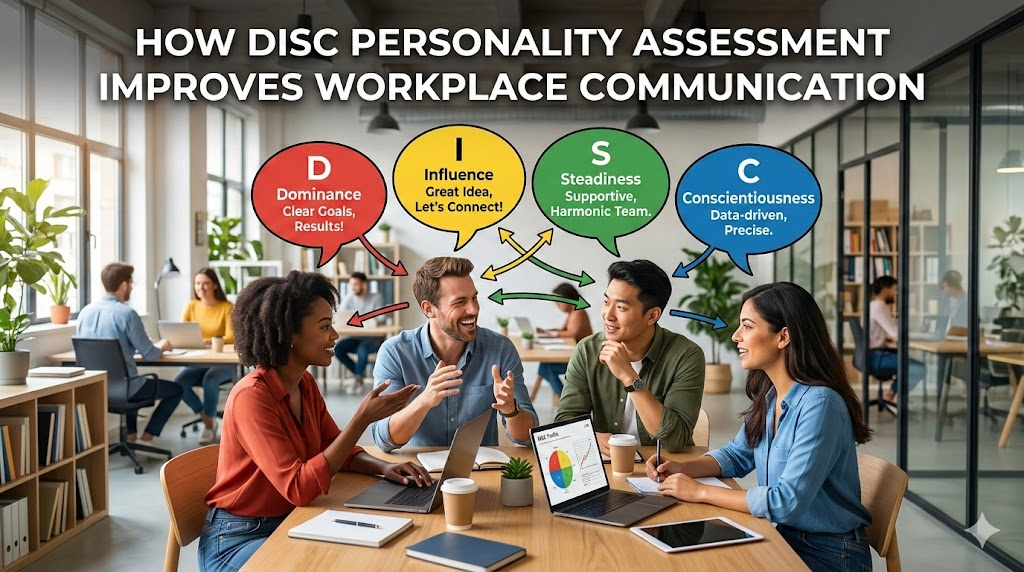
Strong communication is the foundation of every successful organization. Yet even in high-performing teams, misunderstandings, personality clashes, and unclear expectations can slow progress. Many companies are addressing these challenges by using the DISC personality assessment to better understand behavioral differences and improve how employees interact with one another.
Rather than focusing on labels, DISC provides a practical framework for recognizing communication styles and adapting to them. When people understand why others behave the way they do, conversations become more productive and far less personal.
What Does DISC Stand For?
The DISC abbreviation breaks down into four areas:
- D – Decisive: Results-driven, decisive, sometimes forceful.
- I – Interactive: Social, enthusiastic, motivated by recognition.
- S – Stabilizing: Patient, reliable, supportive.
- C – Cautious: Precise, analytical, detail-focused.
We are all a blend of these four. The DISC test categories highlight which tendencies show up most strongly for each individual. Instead of putting people into rigid boxes, DISC reveals dominant behavioral patterns that influence communication, decision-making, and workplace relationships.
Why Workplace Communication Often Fails
Communication problems rarely stem from bad intentions. More often, they arise from different behavioral preferences:
- Fast-paced vs. methodical decision-making
- Direct vs. relationship-focused messaging
- Big-picture thinking vs. detail-driven analysis
- Risk-taking vs. cautious planning
For example, a Decisive (D) manager may prioritize speed and results, while a Cautious (C) employee prefers careful review and data. Without awareness, both may feel frustrated — one perceiving delay, the other perceiving recklessness.
The DISC framework reframes these differences as style variations, not personality flaws.
5 Ways DISC Improves Workplace Communication
1. Creates Self-Awareness
Effective communication starts with understanding yourself. When employees recognize their dominant DISC tendencies, they gain insight into:
- How they respond under pressure
- How they give and receive feedback
- How they handle conflict
- What motivates them
Self-awareness reduces reactive communication and increases emotional intelligence.
2. Builds Empathy Across Teams
DISC helps team members understand that colleagues aren’t being “difficult” — they’re operating from a different behavioral style.
- Decisive individuals value efficiency and clear outcomes.
- Interactive team members thrive on collaboration and recognition.
- Stabilizing employees prioritize harmony and consistency.
- Cautious professionals focus on accuracy and structure.
Recognizing these motivations reduces misinterpretation and builds mutual respect.
3. Encourages Adaptive Communication
One of the most practical benefits of the DISC personality assessment is adaptability. Employees learn how to adjust their communication style based on who they’re speaking with.
For example:
- When communicating with a D, keep messages brief and outcome-focused.
- With an I, allow room for enthusiasm and discussion.
- With an S, provide reassurance and clarity about expectations.
- With a C, present facts, data, and logical reasoning.
Small adjustments can dramatically improve collaboration and reduce friction.
4. Reduces Workplace Conflict
Many conflicts are rooted in style differences rather than real disagreements. DISC provides a neutral language to address tension constructively.
Instead of saying:
“You’re too controlling.”
A team member might say:
“I notice you prefer a Decisive approach — can we balance speed with some additional input?”
This shift turns criticism into collaboration.
5. Improves Feedback and Performance Conversations
Feedback is often uncomfortable because it’s delivered in a way that clashes with someone’s communication style.
DISC helps managers tailor feedback:
- D: Be direct and focus on results.
- I: Keep it positive and engaging.
- S: Be supportive and steady.
- C: Provide specific examples and logical explanations.
When feedback aligns with behavioral preferences, it’s more likely to be accepted and acted upon.
Strengthening Team Dynamics
Every team benefits from behavioral diversity:
- Decisive members push projects forward.
- Interactive personalities energize morale.
- Stabilizing employees maintains cohesion.
- Cautious professionals ensure quality and precision.
When teams understand these complementary strengths, they stop competing and start collaborating.
Long-Term Impact on Organizational Culture
Organizations that consistently apply DISC insights often see:
- Higher engagement
- Improved cross-department collaboration
- Reduced interpersonal tension
- More effective leadership communication
Over time, communication becomes intentional rather than reactive. Employees learn not just to express themselves clearly, but to listen with awareness of style differences.
Final Thoughts
Workplace communication challenges are inevitable — but misunderstandings don’t have to be. By increasing self-awareness and teaching adaptability, the DISC personality assessment provides a practical framework for improving everyday interactions.
When teams understand that everyone is a blend of Decisive, Interactive, Stabilizing, and Cautious tendencies, communication shifts from conflict to clarity. And in today’s fast-moving workplace, that clarity becomes a powerful competitive advantage.
