

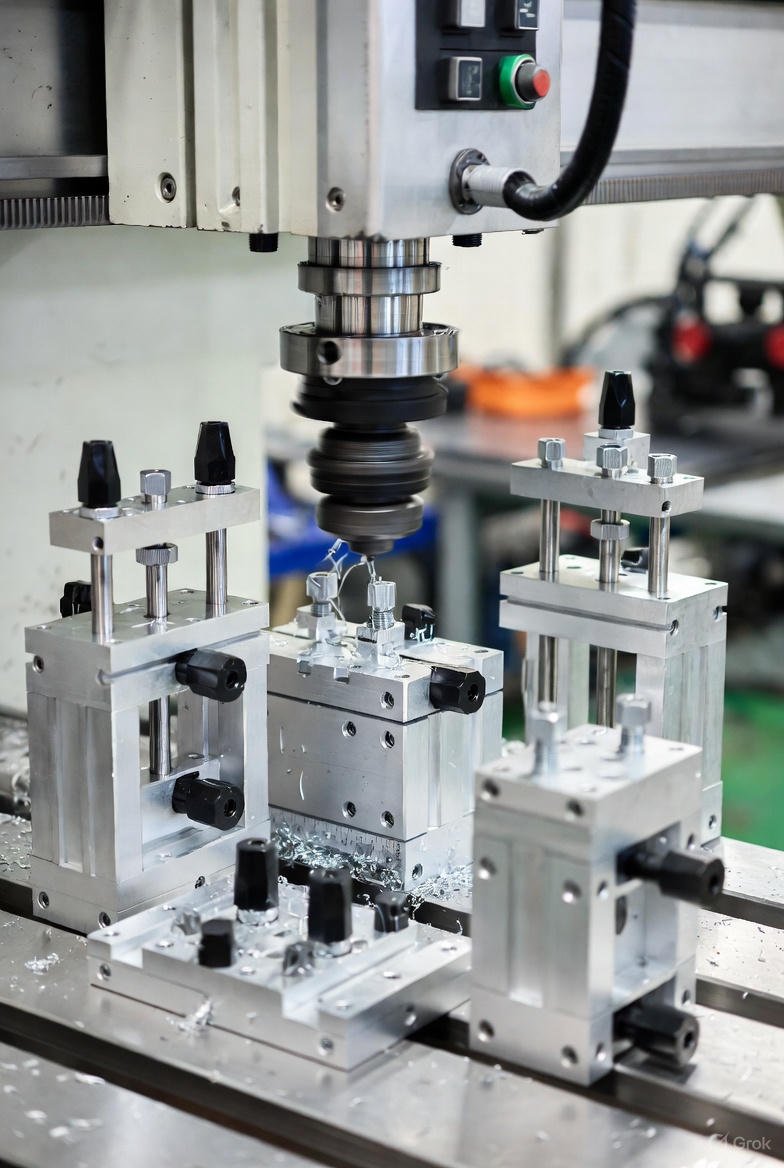
CNC machining is one of the most important manufacturing methods used today to produce accurate, repeatable, and high-quality components. By relying on computer-controlled motion, CNC machines can remove material with exceptional consistency across complex geometries and tight tolerances. Precision matters because modern products demand reliable assembly, predictable performance, and strict dimensional control. Industries such as aerospace, automotive, medical devices, electronics, robotics, and industrial equipment depend on CNC machining to meet these expectations at scale. As component designs grow more intricate and tolerance requirements become stricter, manufacturers must manage not only machine performance but also how each workpiece is positioned and supported during machining, because unstable positioning can undermine accuracy even on the most advanced equipment.
In practical CNC operations, this challenge is addressed through jigs and fixtures tooling which creates a controlled physical interface between the machine and the workpiece, ensuring consistent alignment, secure support, and repeatable machining results across production cycles.
The Importance of Jigs and Fixtures Tooling in CNC Manufacturing
How Tooling Enables Dimensional Accuracy
Jigs and fixtures tooling plays a central role in CNC machining by defining how a part is located, restrained, and supported throughout machining operations. CNC machines follow programmed tool paths with high precision, but the physical accuracy of the finished component depends heavily on stable workholding tooling systems. When cutting forces act on a workpiece, inadequate support can lead to vibration, deflection, or micro-movement, all of which negatively affect dimensional accuracy. Well-designed manufacturing support tooling counteracts these forces by evenly distributing clamping pressure and maintaining firm contact with reference surfaces, allowing programmed accuracy to be realized in the physical part.
Supporting Repeatability and Process Control
Repeatability is essential in CNC machining, especially in serial production where consistent quality is required across large batches. Precision machining aids integrated into tooling systems ensure that every part is loaded in the same position and orientation, regardless of operator or shift. This consistency reduces variation between components, simplifies inspection processes, and supports statistical process control. As a result, manufacturers can maintain stable machining performance over long production runs while reducing the need for frequent adjustments or corrective actions.
Types of Jigs and Fixtures Tooling Used in CNC Operations
Common Tooling Configurations and Applications
Different CNC machining tasks require different tooling configurations based on part geometry, material, and production volume. Plate-style tooling is commonly used for flat or prismatic components because it provides strong support and clear datum referencing. V-block-based tooling is well suited for cylindrical parts, helping maintain concentricity and axial alignment during machining. Modular tooling systems consist of standardized elements that can be rearranged, making them ideal for prototyping and low-volume production where flexibility is important. Hydraulic and pneumatic tooling solutions are often used in high-volume manufacturing environments because they enable rapid, repeatable clamping while maintaining consistent positioning and reducing cycle time.
Standard Tooling Versus Custom Solutions
Standard CNC fixture and jig solutions are cost-effective and readily available for simple components, but they often lack the precision and accessibility required for complex or high-tolerance parts. Custom jigs and fixtures tooling is designed specifically for a given component, taking into account its geometry, material behavior, machining sequence, and tolerance requirements. These tailored solutions optimize clamping force distribution, improve tool access, and reduce setup time. While custom tooling requires more upfront design effort, it frequently delivers long-term benefits through improved part quality, reduced scrap, and higher overall process reliability.
Design Principles Behind Effective Manufacturing Support Tooling
Structural Rigidity and Material Selection
The effectiveness of workholding tooling systems depends largely on their ability to resist deformation under machining loads. Tooling materials must be selected based on stiffness, durability, and thermal stability. Tool steel and cast iron are commonly used because they provide excellent rigidity and vibration damping, while aluminum alloys are chosen when reduced weight and easier handling are priorities. Structural rigidity ensures that tooling maintains its geometry over repeated machining cycles, preventing gradual accuracy loss. Proper material selection also extends tooling service life, making it a dependable asset in long-term CNC production.
Alignment Accuracy and Operator Efficiency
Successful tooling design balances precision with practical usability. Precision machining aids establish accurate datum points that align the workpiece with the machine coordinate system, ensuring consistent feature placement. At the same time, tooling must allow sufficient clearance for cutting tools to access all required surfaces without interference. Ease of loading, unloading, and inspection is equally important, as efficient handling reduces setup errors and supports consistent production performance across operators and shifts. Tooling that simplifies workflow contributes directly to improved productivity and reduced human error.
Impact on Productivity, Quality, and Cost Control
Reducing Setup Time and Production Variation
Well-designed manufacturing support tooling significantly reduces setup time by eliminating the need for repeated manual alignment. Faster setups allow more productive machining time and improve overall equipment utilization. Consistent workpiece positioning also minimizes part-to-part variation, which simplifies downstream processes such as inspection and assembly while supporting predictable production schedules.
- Faster setup and changeover between jobs
- Consistent part positioning across production batches
- Reduced dependence on operator judgment for alignment
Improving Quality and Managing Manufacturing Costs
CNC fixture and jig solutions directly influence quality by stabilizing workpieces during machining. Improved rigidity reduces vibration and tool chatter, resulting in better surface finishes, tighter tolerances, and longer tool life. These improvements lower scrap and rework rates while reducing tooling and inspection costs. Over time, the cost savings achieved through higher quality and efficiency often outweigh the initial investment in tooling development.
- Lower scrap and rework rates
- Improved machining stability and surface quality
- More predictable and controlled production costs
Industry Applications and Best Practices
Use of Jigs and Fixtures Tooling Across Industries
Jigs and fixtures tooling is essential in industries where precision and reliability are critical. Aerospace manufacturing relies on rigid tooling to support complex geometries and strict tolerance requirements for structural components. Medical device manufacturing depends on precise tooling to meet regulatory standards and ensure consistent product performance. Automotive production uses high-volume tooling to maintain uniformity across thousands of parts, while electronics and robotics industries require accurate positioning for small, intricate components. Across these sectors, tooling enables CNC machines to meet industry-specific quality expectations with confidence.
Maintaining Long-Term Tooling Performance
To sustain accuracy and efficiency, tooling must be treated as a long-term production asset rather than a temporary solution. Regular inspection helps identify wear, deformation, or alignment issues before they impact part quality. Clear documentation of setup and usage procedures supports repeatability across machines and operators. Collaboration between design, machining, and quality teams ensures that tooling evolves alongside product changes and process improvements, supporting continuous optimization of CNC manufacturing operations.
Conclusion
CNC machining remains a cornerstone of modern manufacturing because it delivers precision, repeatability, and scalability across diverse industries. However, machine capability alone cannot guarantee consistent results without proper physical support at the workpiece level. Jigs and fixtures tooling provides the foundation that allows CNC machines to convert digital instructions into accurate, repeatable components by improving alignment, reducing setup time, and minimizing variation. A strong understanding of tooling design principles, application strategies, and maintenance practices enables manufacturers to optimize machining performance and achieve reliable long-term outcomes.For readers seeking general technical background, neutral reference material on jigs explains how tools are guided and positioned during machining processes. Additional foundational context can be found in independent resources discussing fixtures, which describe their role in securely locating and supporting workpieces throughout manufacturing operations.
