

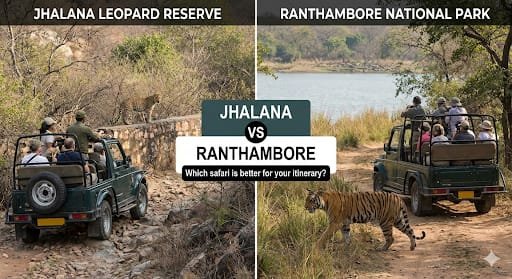
Why Jhalana or Ranthambore Is the Better Safari for Your Rajasthan Itinerary
Choosing between Jhalana and Ranthambore isn’t really a “tiger vs leopard” debate. It’s a planning decision: how much time do you have, how far are you willing to travel, and do you want a quick wildlife hit or a full forest break?
If your Rajasthan trip already includes Jaipur, both options can work, but they fit into an itinerary in completely different ways.
1) Location and travel time from Jaipur
Jhalana Leopard Safari sits right on Jaipur’s doorstep, so it behaves like a half-day activity rather than a separate destination. Many travellers do a fort in the morning, rest at the hotel, and head for an evening safari without changing cities.
Ranthambore, on the other hand, is a proper detour. Jaipur to Ranthambore (Sawai Madhopur side) is commonly quoted at about 180 km, and the drive usually takes 3.5 to 4 hours, depending on traffic and road conditions. That travel time is the difference between “let’s do a safari today” and “we need to build a wildlife leg into the trip.”
What this means in real life:
- If you’re in Jaipur for 2-3 days, Jhalana fits neatly.
- If you have 4+ days and want a deeper wildlife experience, Ranthambore starts making sense (ideally with an overnight stay).
2) Safari timings and flexibility
Jhalana’s safari slots change by season, and the timing details are actually one of its biggest advantages for itinerary planning because you can pick a slot that doesn’t break your Jaipur day.
For example, one widely used timing chart lists:
- 1 Nov–31 Jan: 7:00 am–9:30 am and 3:15 pm–5:45 pm
- 1 Apr–31 May: 5:45 am–8:15 am and 4:15 pm–6:45 pm
The same source notes two practical details travellers often miss: you’re typically expected to report about 25 minutes before departure, and the safari duration is a maximum of 2.5 hours.
Ranthambore also runs morning/evening safaris, but because it’s a bigger travel commitment from Jaipur, “flexibility” matters less than logistics. Once you commit to Ranthambore, your day revolves around safari time plus the travel and hotel check-in/out.
What this means for your itinerary:
- If you want a safari that behaves like an “add-on experience,” Jhalana is easier to schedule.
- If you want your trip to include a dedicated wildlife segment, Ranthambore is the stronger fit.
3) What you’re likely to see (and what you’re really paying for)
This is where expectations matter.
Jhalana is known for leopard safaris close to an urban setting. The terrain is compact, sightings can happen quickly, and the experience often feels action-oriented: you enter, you track, you scan the ridges, you wait, you move again.
Ranthambore is famous for tigers, but the bigger draw is the overall forest atmosphere large landscapes, lakes, and the feeling that you’re in a classic Indian tiger reserve. Even a “quiet” safari can still feel like a proper wilderness morning.
The honest truth: neither park guarantees anything. But you can choose what you want to maximize:
- If your priority is “I want the best chance of seeing a big cat with minimum travel,” Jhalana usually wins on convenience.
- If your priority is “I want the most iconic tiger-reserve experience in Rajasthan,” Ranthambore wins on immersion.
4) Cost and booking: simple vs planned
Jhalana is generally easier for last minute travellers because it’s Jaipur-based and runs like a city activity, especially if you’re already in town and flexible with slots. It’s still smart to book ahead on weekends and peak season, but you’re not building an entire travel leg around it.
Ranthambore typically needs more advance planning in peak months because your costs are not just safari fees. You’re also adding:
- Jaipur Ranthambore transfers (both ways)
- At least one night of accommodation near Sawai Madhopur
- Extra meals and travel buffers
So even if the safari price doesn’t feel wildly different, the overall cost of “doing Ranthambore properly” is usually higher.
5) The vibe: quick thrill vs full escape
If your Rajasthan itinerary is culture heavy forts, bazaars, food walks Jhalana is a clean fit. You can do your Jaipur highlights and still squeeze in a safari without turning your trip into constant packing and driving.
If your trip is built around wildlife (or you’ve dreamed of seeing a tiger in India), Ranthambore earns the extra effort. It feels like a separate chapter of the journey, not a side activity.
Conclusion
If you’re short on time and based in Jaipur, Jhalana is the practical choice: it’s close, easy to slot into a busy schedule, and the safari itself is short enough to keep the rest of your day intact. Just plan around the Jhalana Leopard Safari Jaipur timing for your travel month, and remember the reporting buffer arriving about 25 minutes early saves you last second stress.
If you can spare the travel time and want a more immersive reserve experience, Ranthambore is worth building into your route, especially if your broader plan already resembles a golden triangle tour with Ranthambore, where Delhi-Agra-Jaipur connects naturally to a wildlife stop before you continue onward.
To read such a blog, go to atechvibe.com
