

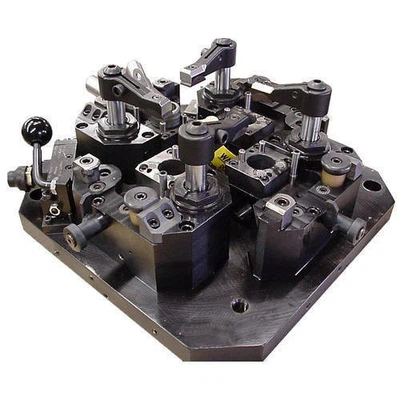
CNC machining depends on control at every stage of the process. Before a spindle rotates or a tool engages material, the workpiece must be positioned with certainty. This is where jigs and fixtures become essential in modern manufacturing environments. They create a stable reference that allows machines to deliver repeatable and accurate results across short and long production runs.
As tolerances become tighter and product complexity increases, manufacturers cannot afford variability in workholding. Proper jigs and fixtures tooling transforms machining into a controlled system rather than a trial-and-error operation. With the right fixture strategy, companies achieve higher throughput, lower scrap rates, and consistent quality that meets demanding industry standards.
The Core Function of Jigs and Fixtures in CNC
Establishing Accurate Workpiece Location
The first responsibility of any fixture is to define where the part sits relative to the machine coordinate system. Accurate location ensures that every machining cycle starts from the same datum reference. When positioning is controlled properly, dimensional variation is minimized and inspection becomes straightforward. Reliable jig and fixture design devices eliminate uncertainty and reduce the need for frequent adjustments during production.
Providing Structural Support During Cutting
CNC cutting forces generate vibration and stress that can shift unsupported components. Proper jigs and fixtures tooling distribute these forces evenly and support the workpiece at critical points. This reduces deflection, protects surface finish, and extends tool life. Stable support also allows for higher cutting speeds without sacrificing accuracy.
Engineering Principles Behind Effective Fixture Solutions
Smart Locating Strategy and Datum Control
A well-designed fixture follows a logical locating approach that aligns with design and inspection datums. Locators restrict unnecessary movement while maintaining simplicity and repeatability. Poorly planned locating systems create cumulative errors that programming alone cannot correct. Strong datum control is the foundation of consistent CNC output.
Balanced Clamping Without Part Distortion
Clamping must secure the part firmly while avoiding deformation. Excessive pressure can introduce stress or alter dimensions, especially in thin or complex components. Skilled fixture designers place clamps strategically to hold the workpiece naturally against locators. This ensures stability without compromising geometry.
Productivity Benefits of Custom Jigs and Fixtures Tooling
Faster Setup and Changeover Efficiency
Custom jigs and fixtures significantly reduce setup time by eliminating manual alignment and repeated test cuts. Operators can load parts quickly with confidence that positioning is accurate. Faster changeovers increase spindle utilization and improve overall production efficiency. Over time, this contributes to lower operational costs.
Consistency Across Production Batches
Engineered fixtures maintain uniform quality across different shifts and operators. Because the fixture controls part positioning, results remain stable regardless of who runs the machine. This consistency reduces scrap, simplifies quality control, and builds customer trust.
Designing for Practical CNC Shop Conditions
Ensuring Tool Access and Clearance
Effective fixture solutions allow full tool access without obstruction. Restricted access forces programming compromises and additional setups. Well-planned jig and fixture design devices provide adequate clearance while maintaining rigidity. This balance supports efficient machining and reduces collision risks.
Managing Chip Flow and Coolant Access
Chip accumulation and poor coolant distribution negatively affect tool performance and surface quality. Fixtures should allow chips to evacuate easily and coolant to reach the cutting zone effectively. Clean chip flow maintains stable cutting conditions and supports long-term process reliability.
Materials and Construction Strategies for Durable Fixtures
Selecting Materials for Strength and Longevity
Fixture materials must withstand repeated mechanical loads and environmental exposure. Hardened steel is often chosen for high-volume production due to its wear resistance. Aluminum may be suitable for lighter applications where weight reduction is beneficial. Material choice directly impacts fixture life and dimensional stability.
Optimizing Cost and Lifecycle Performance
Not every project requires maximum fixture complexity. Effective design balances production volume, tolerance demands, and budget constraints. Overbuilt fixtures increase cost without added benefit, while underbuilt designs lead to maintenance and downtime. The goal is sustainable performance with practical investment.
Situations That Demand Custom Jigs and Fixtures
Recognizing Workholding Limitations
Manufacturers often realize the need for custom solutions when standard workholding fails to meet production requirements. Signs include inconsistent tolerances, extended setup times, and rising rework rates. Custom jigs and fixtures tooling addresses these challenges by stabilizing the machining process at its core.
Applications With High Precision Demands
Certain CNC operations benefit significantly from dedicated fixtures, especially when dealing with complex geometries or multi-stage machining. Key advantages include:
- Improved repeatability for critical dimensions
- Reduced scrap and rework costs
- Enhanced confidence in quality assurance
Integrating Fixture Design With CNC Programming
Collaboration Between Engineering and Machining Teams
Successful fixture development requires cooperation between engineers and machinists. Engineers understand design intent and tolerance requirements, while machinists provide insight into real cutting behavior. This collaboration results in fixture systems that perform reliably under actual production conditions.
Continuous Improvement Through Feedback
Fixtures should evolve as production continues. Monitoring wear points, cycle times, and part quality provides data for refinement. This ongoing improvement ensures that jig and fixture design devices remain effective as machining demands change.
Strategic Impact of Jigs and Fixtures on Manufacturing Growth
Supporting Scalable Production
As production volumes grow, consistency becomes more critical. Reliable jigs and fixtures tooling allows manufacturers to scale output without increasing inspection or correction efforts. Stable workholding supports predictable performance across larger batches.
Strengthening Competitive Advantage
Companies that invest in effective fixture strategies gain a clear operational advantage. Improved accuracy, faster setups, and reduced waste directly enhance profitability. Reliable workholding systems contribute to strong customer relationships and long-term manufacturing success.
Conclusion: Precision Begins With Stable Workholding
CNC precision is not achieved by machines alone. It depends on controlled positioning, balanced clamping, and reliable support. Well-designed jigs and fixtures provide the physical stability required for consistent and efficient production. When jigs and fixtures tooling is treated as a strategic element rather than a simple accessory, manufacturers achieve predictable quality, scalable operations, and lasting competitive strength in demanding CNC markets.
