

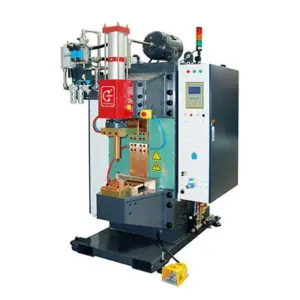
In modern manufacturing, efficiency, precision, and reliability are non-negotiable. For OEMs, automation integrators, and production engineers, selecting the right resistance welder can define the quality and throughput of metal-joining processes. Heron Welder, a global leader in industrial welding and metal-joining solutions, delivers advanced resistance welding machines, clinching systems, self-pierce riveting (FSPR), and fully automated production lines to meet the evolving needs of manufacturers worldwide.
What Is a Resistance Welder?
A resistance welder is a machine designed to join metals through the application of heat generated by electrical resistance. Unlike traditional welding, which often requires filler material or gas, resistance welding relies on pressure and electricity to fuse materials at precise points.
How Resistance Welding Works
The process is straightforward yet highly effective:
- Clamping – Electrodes hold the metal pieces firmly in place.
- Current Application – A high electric current passes through the contact area, creating heat due to the metal’s resistance.
- Fusion – The metal softens and fuses together under pressure.
- Cooling – Pressure is maintained while the welded joint solidifies, creating a strong and consistent bond.
This method enables fast, repeatable welds with minimal operator intervention, making it ideal for high-volume manufacturing environments.
Key Types of Resistance Welders
Heron Welder offers a full spectrum of resistance welding solutions to match different production requirements:
1. Spot Welders
The most common resistance welding method, spot welding, joins overlapping metal sheets at discrete points. Spot welders are widely used in automotive body assembly, electrical enclosures, and metal furniture fabrication.
2. Projection Welders
Projection welding concentrates current on small, pre-formed projections on one of the metal surfaces. This technique reduces electrode wear and is ideal for fasteners, studs, and heavy-duty assembly applications.
3. Seam Welders
For continuous welds along a joint, seam welding machines rotate wheel electrodes to create a leak-proof or airtight weld. Applications include fuel tanks, piping, and HVAC ducts.
4. MFDC & Capacitor Discharge Welders
Advanced machines like MFDC (Medium-Frequency Direct Current) welders and capacitor discharge welders provide precise energy control, enabling welding of thin metals, dissimilar alloys, and delicate components without distortion.
Applications Across Industries
Resistance welding is versatile, serving a wide range of manufacturing sectors:
- Automotive & EVs: Body panels, battery trays, seat frames, and chassis assemblies.
- Electronics & Electrical: Enclosures, connectors, switchgear, and small appliance components.
- Aerospace & Defense: Lightweight assemblies, control panels, and precision metal subcomponents.
- Furniture & HVAC: Sheet metal fabrication, ductwork, and metal furniture components.
Heron Welder’s machines are designed to handle these varied applications efficiently, ensuring repeatable quality and minimal downtime.
Resistance Welding vs. Traditional Welding Methods
Understanding the advantages of resistance welding compared to conventional welding methods helps manufacturers make informed choices:
| Feature | Resistance Welding | Arc/MIG/TIG Welding |
|---|---|---|
| Speed | Extremely fast, suitable for mass production | Slower, requires manual handling |
| Heat Input | Localized, minimal distortion | Higher, may require cooling or fixtures |
| Automation | Highly automatable, compatible with robotic systems | Less automation-friendly |
| Material Types | Works best with thin-to-medium sheets, mild steel, stainless, aluminum | More versatile for thick metals |
| Operator Skill | Lower; machines often automated | Higher; requires trained welders |
For factories aiming to maximize throughput while maintaining quality, resistance welding is often the preferred choice.
Best Practices for Using a Resistance Welder
Maximizing the performance and longevity of resistance welding equipment involves attention to key factors:
- Electrode Maintenance: Regularly inspect and dress electrodes to ensure consistent contact and prevent weld defects.
- Material Preparation: Clean, uniform surfaces reduce resistance variations and improve weld quality.
- Parameter Control: Correct current, pressure, and dwell time settings are critical. Heron’s machines offer precise digital control for repeatable welds.
- Automation Integration: Incorporating robotic handling or conveyor systems minimizes human error and increases throughput.
- Safety Measures: Use protective gear, and follow electrical safety protocols to prevent accidents in high-current environments.
Why Choose Heron Welder?
With decades of experience, Heron Welder is a trusted partner for manufacturers seeking high-quality resistance welding solutions. The company provides:
- Customizable Machines: From compact spot welders to fully automated production lines.
- Advanced Control Systems: Digital controllers, MFDC technology, and real-time monitoring for precision welding.
- Global Support: Installation, training, and maintenance support worldwide.
- Comprehensive Solutions: Alongside resistance welding, Heron offers clinching, self-pierce riveting (FSPR), and welding guns to meet complete production needs.
FAQs About Resistance Welders
1. Can resistance welders join different types of metals?
Yes, especially with MFDC and capacitor discharge welders, you can weld dissimilar metals like steel and aluminum with minimal distortion.
2. How fast can resistance welders operate?
Modern resistance welders can perform hundreds of welds per minute, making them ideal for mass-production environments.
3. What industries benefit most from resistance welding?
Automotive, electronics, aerospace, HVAC, and general sheet metal fabrication industries benefit the most.
4. How do I maintain my resistance welder?
Regular electrode dressing, parameter checks, and preventive maintenance are key to ensuring consistent performance and longevity.
5. Can resistance welding be automated?
Absolutely. Heron Welder machines integrate seamlessly with robotic arms and conveyor systems for fully automated production lines.
Conclusion: Elevate Your Manufacturing with Heron Resistance Welders
For manufacturers looking to improve efficiency, precision, and automation, investing in a resistance welder is a smart choice. Heron Welder combines technical expertise, innovative machine design, and global support to deliver solutions that optimize productivity and ensure high-quality metal joining.
Ready to enhance your production line? Contact Heron Welder today for a customized consultation or request a quote for resistance welding and automated metal-joining solutions tailored to your factory’s needs.
