

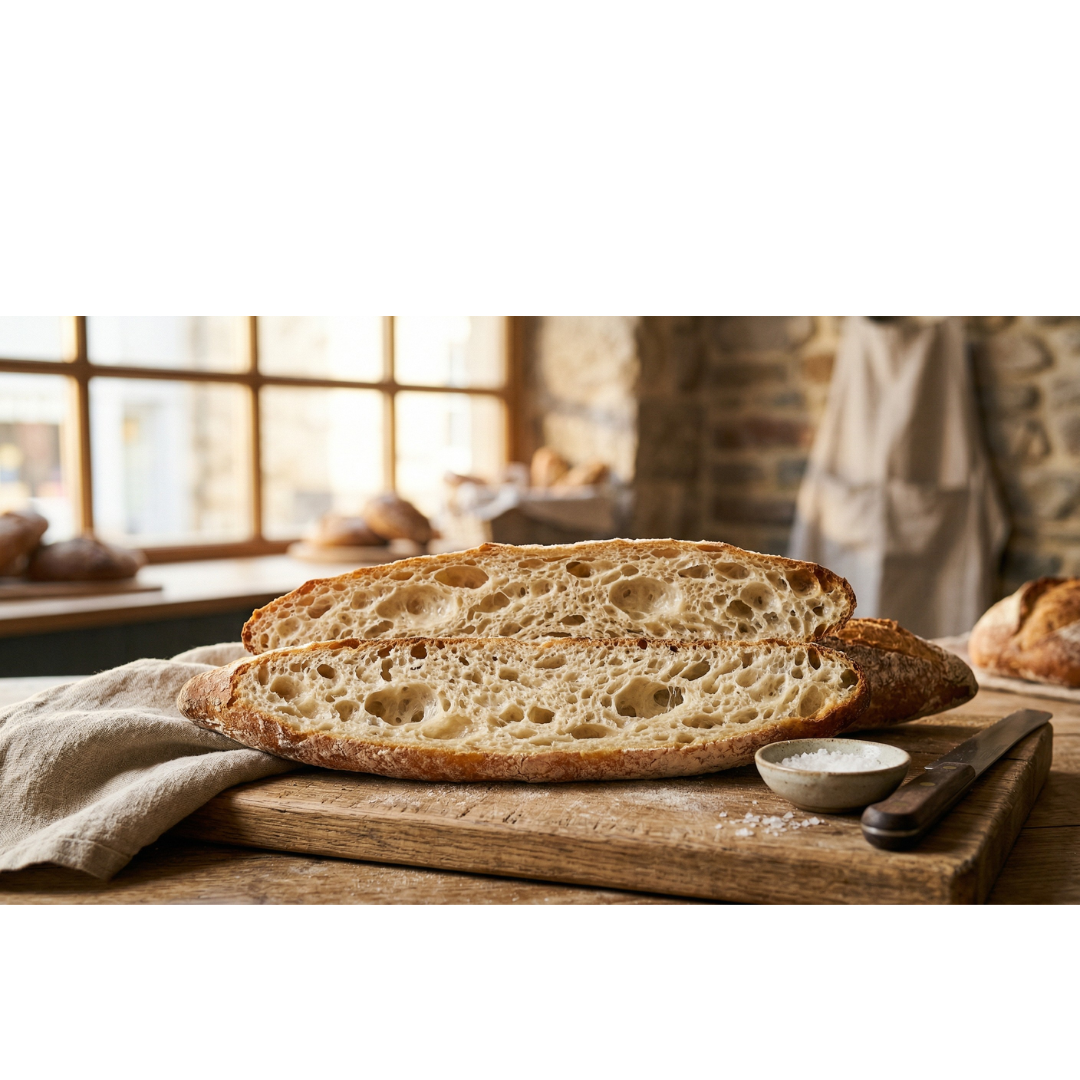
A heavier crumb is not always a sign of quality. In many baked products, it is a sign that the flour is working against the recipe.
Professional bakers working with croissants, baguettes, and laminated pastries know that texture is everything. One of the most common causes of dense, heavy results in commercial production is using flour with more protein than the product actually needs.
This blog explains why T55 flour consistently produces a lighter, more open texture than strong flour, and when each type makes sense in a professional bakery setup.
Understanding the T55 Flour Classification
The “T” system is a French flour grading method based on ash content, which reflects how much of the wheat bran and germ remains after milling. T55 flour sits in the middle range, with an ash content of roughly 0.50% to 0.60%.
What makes this grade distinct:
- Protein content typically falls between 10% and 12%
- Gluten development is moderate, not aggressive
- The flour produces extensible dough rather than elastic, resistant dough
This balance is what gives T55 flour its reputation for producing lighter textures in bread, viennoiserie, and pastry applications.
What Makes Strong Flour Behave Differently
Strong flour, sometimes labeled as bread flour or high gluten flour, usually carries protein levels above 12.5%, often reaching 14% or more.
That extra protein creates a tighter, more rigid gluten network. For products that need structural strength, like sandwich loaves or bagels, this is useful. But for products where lightness and openness matter, it becomes a limitation.
Here is what happens when strong flour is used in the wrong application:
- The dough resists expansion during proofing
- Oven spring is limited because the gluten matrix holds too tightly
- The final crumb is compact and chewy instead of soft and airy
For operations producing French bread, Danish pastry, or puff pastry, strong T55 flour can actively work against the desired result.
How T55 Flour Creates a Lighter Crumb?
The moderate protein in T55 flour allows gluten to form without becoming overly rigid. During fermentation and proofing, gas produced by yeast can expand more freely within the dough. This creates larger, more irregular air pockets and a softer interior.
Several factors contribute to this outcome:
- Extensibility over elasticity: The dough stretches rather than snapping back, supporting open crumb development
- Lower gluten resistance: Gas retention is balanced, not excessive, leading to a tender bite
- Controlled water absorption: T55 absorbs water at a moderate rate, preventing overly dense or gummy textures
In laminated dough production, this matters even more. Butter layers need to expand between soft, pliable dough sheets. A Type 55 Flour that fights back during lamination compresses those layers and reduces flakiness.
Where T55 Flour Works Best in Commercial Production
Professional bakers and pastry chefs choose T55 flour for specific product categories where texture and lightness define quality.
Common applications include:
- Baguettes and French country loaves
- Croissants and pain au chocolat
- Danish pastries
- Brioche
- Tart shells and pâte brisée
- Thin crust flatbreads
In high volume bakeries producing hundreds of croissants per shift, the flour must allow consistent lamination without excessive shrinkback. T55 flour delivers that reliability batch after batch.
Brands such as SwissBake offer T55 grade flour formulated for commercial bakery use, with controlled protein levels and fine milling suited for both artisan bread and viennoiserie production lines.
When Strong Flour Is the Right Choice
Strong flour is not a lesser product. It serves a different purpose.
For products that need to hold shape under weight, maintain chew, or support heavy fillings, higher protein flour performs better. Examples include:
- Pullman loaves
- Burger buns with stacked fillings
- Bagels
- Stuffed bread rolls
The issue is not strong flour itself. The issue is using it where a softer, more extensible dough is required.
Protein Is Not the Only Variable
While protein content is the primary differentiator, milling fineness and ash content also affect texture.
T55 flour typically has a finer particle size than most strong flours, which means smoother dough hydration and more uniform crumb structure. The lower ash content also contributes to a cleaner flavor and lighter crust color both important in pastry and artisan bread presentation.
Conclusion
Flour selection shapes the final texture of every baked product. For items where lightness, softness, and open crumb are the goal, T55 flour outperforms strong flour because of its moderate protein, balanced extensibility, and controlled gluten behavior.
Professional bakers who match flour type to product type achieve more consistent results, reduce waste, and maintain product quality across batches. Understanding what your flour is designed to do is one of the most practical and impactful decisions in any commercial baking operation.
FAQs
Q.1 What is the main difference between T55 flour and T65 flour?
Ans: T55 flour has a lower ash content and slightly less bran, producing a lighter, whiter crumb. T65 retains more of the wheat’s outer layers, giving a slightly more rustic flavor and denser texture. T55 flour is preferred for croissants and white bread, while T65 flour suits country-style loaves.
Q.2 Can T55 flour be used for pizza dough?
Ans: It can work for thin crust and Roman-style pizza where a crisp, light base is needed. However, for authentic pizza bases with longer fermentation, a 00 pizza flour with slightly higher protein is a better match.
Q.3 Why does strong flour make bread denser?
Ans: Strong flour has higher protein, which forms a tighter gluten network. This resists gas expansion during proofing and results in a more compact crumb. For products that need an airy, open texture, this level of gluten strength can be counterproductive.
Q.4 Is T55 flour suitable for laminated dough production?
Ans: Yes. T55 flour is one of the most widely used flour grades for laminated dough. Its moderate gluten and good extensibility allow butter layers to separate cleanly during baking, producing flaky, layered results.
Q.5 How should T55 flour be stored in a commercial bakery?
Ans: Store in a cool, dry area away from direct sunlight and strong odors. Keep bags sealed or in airtight bins. Maintain proper stock rotation to use older batches first and preserve consistent quality over time.
