

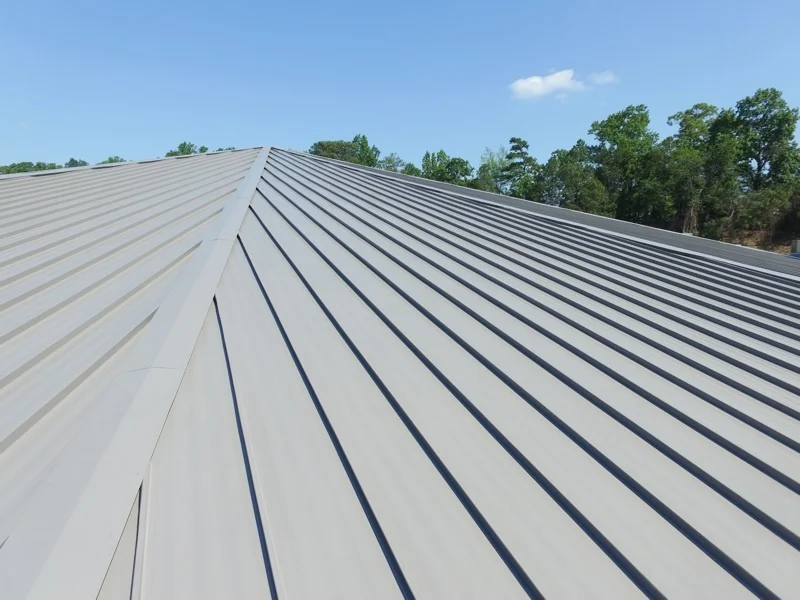
Standing seam metal roofs are often installed on commercial and industrial properties because they are highly waterproof, durable, and resistant to mechanical impacts. They require minimal maintenance, reducing costs.
Industrial standing seam roofing is used on pitched and flat roofs and can withstand high wind loads. In this article, we’ll cover the features of standing seam metal roofing, why it’s so popular for industrial buildings, and how to install and maintain this type of roofing.
Features and Benefits
Standing seam roofing is a type of roofing consisting of metal sheets with raised vertical supports on both sides. The sheets are joined together using concealed fasteners, eliminating holes and visible fasteners. The result is a smooth metal surface with raised locking seams—the seams. This type of roofing is aesthetically pleasing, but it is installed in industrial facilities for other reasons.
What are the advantages of an industrial fold:
- high degree of protection against leaks;
- resistance to snow and wind loads;
- With proper installation and maintenance, the service life of the roofing material is more than 50 years;
- no harmful impact on the environment;
- can be used on an exploited roof with a slope of 3 degrees;
- due to the lightness of the material, there is low load on supporting structures;
- minimal maintenance, which reduces operating costs.
Along with its advantages, industrial roofing also has its disadvantages. Installation requires professional equipment and roofing skills, which increases installation costs. Metal roofing can create noise during rain. While this isn’t critical for industrial buildings, it can impact the productivity of office workers. Condensation can form in attics due to the metal heating. Therefore, it’s important to carefully consider the roofing structure and ventilation system.
Looking for the Best Gutter Cleaning in Ben Lomond CA? Get professional, affordable, and reliable gutter cleaning services to protect your home. Call today!
Basic materials
Standing seam roofing sheets are made of aluminum, galvanized steel, copper, and titanium-zinc alloy. A polymer coating can be used for additional moisture resistance and corrosion resistance. Key requirements for the material include corrosion resistance, lightweight construction, high strength, and resistance to temperature fluctuations and external influences.
Unlike corrugated sheets and metal tiles, standing seam roofing has a smoother surface. The locking system, which eliminates the need to drill holes for fasteners, ensures a more reliable seal. Corrugated sheets and metal tiles are easier to install and can be installed by even non-professionals. Concealed fastening systems, however, require proper installation procedures and specialized tools.
The choice of standing seam roofing material depends on budget, facility type, and operating conditions. For example, galvanized steel or aluminum are more commonly used for large industrial buildings, while copper and titanium-zinc alloys are preferred for buildings with higher aesthetic requirements.
How to install a standing seam roof correctly?
When installing a metal roof with flanges, it’s important to follow the installation procedures and make precise calculations. Otherwise, the fastenings will be weak, the sheets will begin to lift from the surface in strong winds, and the roof will leak.
At the initial stage, roofers prepare the base, which must be strong, level, and load-bearing. For a standing seam flat roof, it’s important to calculate the correct pitch to ensure water doesn’t stagnate on the surface but flows through the gutter system. A waterproofing and vapor barrier layer are laid on the base, and thermal insulation is installed, which is especially important for roofs that are in use.
For a standing seam roof, a continuous deck is laid on a flat roof. For slopes of 20 ° or more, battens are used. The sheets are cut and laid according to the design and secured with clamps. Seams are rolled manually or with a power seaming tool, which speeds up the process and improves the quality of the fastening.
For longitudinal joints, a standing seam is used, which provides high watertightness and resistance to wind loads. If transverse fastening is used, a flat seam can be used. This is less watertight, but easier to install and is used in areas with light loads.
What to consider when choosing a standing seam roof for industrial buildings?
When choosing standing seam sheets, it’s important to consider the building structure, roof geometry, climatic conditions, and installation and maintenance costs. Industrial standing seam roofing (industrial standing seam) features a reinforced structure, increased sheet width, and greater load-bearing capacity.
Get reliable Residential Metal Roofing Services in Carbondale KS for expert installation, repair, and maintenance. Durable, affordable roofing solutions—call today!
Which sheets are suitable for roofing industrial facilities:
- made of galvanized steel with a polymer coating for protection against corrosion;
- thickness from 0.6 mm, which increases the strength of the structure;
- with a double standing seam, providing greater tightness and load resistance.
Standing seam roofing is popular for industrial buildings due to its high water resistance, durability, and attractive appearance. The material is suitable for both flat and pitched roofs, provides reliable leak protection, and requires minimal maintenance.
You can order a standing seam roof installation in the Ben Lomond region from our company. Our roofers will perform the work in accordance with technical requirements and using professional tools. Contact us for a consultation and cost estimate.
Read Other: Roofing Technology Guide: Roof Types, Construction Elements, and Installation Steps
