
The generative AI market is no longer a future prediction — it is a present-day gold rush. Businesses across industries are racing to embed AI-powered creative tools into their product offerings, and the window to enter early is still open. Among the most lucrative opportunities right now is launching an AI Image Generator Software under your own brand. The question is not whether the market is ready. The question is whether your business has the right strategy to enter it without burning through capital.
This is exactly where White Label AI Image Generator Software changes the game entirely.
What Is White Label AI Image Generator Software?
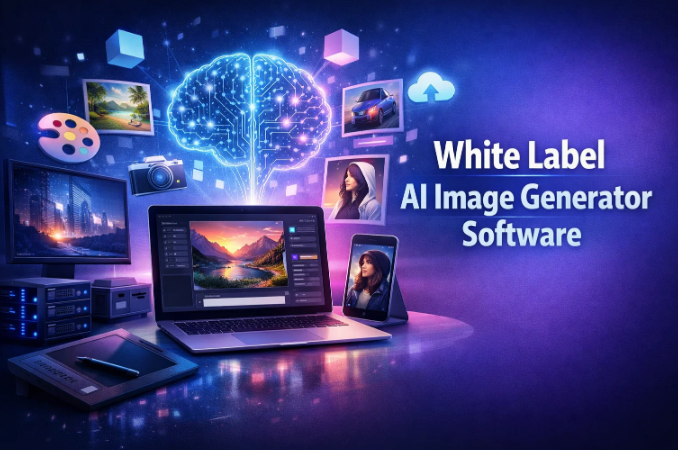
Before diving into the opportunity, it helps to understand what the technology actually is. White Label AI Image Generator Software is a pre-built, fully functional AI-powered image generation platform that a business can rebrand and resell as its own product. Instead of building the underlying AI models, training data pipelines, and generation infrastructure from scratch, you license a ready-made solution and present it to your customers under your own logo, domain, and brand identity.
Think of it like buying a finished product from a manufacturer and selling it under your store brand. The core technology is already proven and functional. Your role is to position it, market it, and deliver it to your target audience. This model has worked for decades in traditional software — and now it is transforming the AI industry at a remarkable pace.
The $1B Market Opportunity You Cannot Afford to Ignore
The generative AI market was valued at over $43 billion in 2023 and is projected to grow at a compound annual growth rate exceeding 35% through 2030. Within that broader market, AI image generation tools represent one of the fastest-growing segments. Platforms like Midjourney, DALL·E, and Stable Diffusion have already demonstrated massive consumer and enterprise demand for AI-driven visual content creation.
However, the real business opportunity does not lie in competing with these giants head-on. It lies in serving the niche markets and industry-specific audiences that generic platforms are too broad to address effectively. A White Label AI Image Generator Software solution lets you build a product tailored to e-commerce brands, marketing agencies, game developers, interior designers, or fashion houses — audiences that need AI image generation but want a tool that fits their specific workflow. That specificity is your competitive advantage.
Why Businesses Are Choosing White Label Over Custom Development
The most common alternative to white labeling is building a custom AI Image Generator App from the ground up. On paper, this sounds appealing — complete control, unique architecture, and a fully proprietary product. In practice, it is one of the most expensive and time-consuming technology investments a company can make.
Training a competitive image generation model requires access to massive GPU clusters, petabytes of training data, and teams of machine learning engineers who command six-figure salaries. Even with unlimited budget, the development timeline stretches into years. By the time your custom product launches, the market landscape could look entirely different. White Label AI Image Generator Software eliminates this risk by giving you a production-ready platform in weeks, not years.
Cost Efficiency That Makes Financial Sense
Custom AI development costs can range from $500,000 to well over $5 million depending on the complexity of the model and the features required. White Label AI App Solutions, by contrast, operate on licensing or revenue-share models that are a fraction of that cost. For startups, SMEs, and even enterprise businesses exploring new revenue streams, this cost structure dramatically lowers the barrier to entry.
Beyond the initial investment, white label solutions also reduce ongoing operational costs. Maintenance, model updates, infrastructure scaling, and security patches are typically handled by the software provider. Your internal team can focus entirely on product experience, customer acquisition, and revenue growth rather than backend infrastructure management.
Key Features to Look for in White Label AI Image Generator Software
Not all White Label AI Image Generator Software platforms are built equally. When evaluating your options, there are several core capabilities that separate a strong foundation from a limiting one.
Text-to-Image Generation Quality is the most fundamental feature. The underlying AI model should be capable of producing high-resolution, photorealistic, and stylistically versatile images from natural language prompts. The quality of output directly determines your product’s perceived value in the market.
Customization Depth matters significantly for differentiation. You should be able to fully rebrand the interface — logo, color scheme, typography, domain — while also being able to configure which styles, aspect ratios, and generation parameters are available to your end users. A rigid white label product limits your ability to create a unique brand experience.
API Access and Integration Capability is critical for businesses that want to embed the image generation feature into an existing platform rather than launching a standalone app. Strong API documentation and flexible integration options allow you to connect the tool with your CRM, e-commerce platform, content management system, or mobile application.
Scalable Infrastructure is non-negotiable. AI image generation is computationally intensive, and a platform that performs well with 100 users may collapse under 10,000. Ensure the underlying architecture supports horizontal scaling, distributed processing, and cloud-agnostic deployment before committing to any provider.
Who Should Consider Launching a White Label AI Image Generator App?
The range of businesses that can profitably launch an AI Image Generator App through white labeling is broader than most people realize. It is not limited to technology companies or AI startups.
Marketing and Creative Agencies are among the most natural fits. Agencies already serve clients who need high-volume visual content. Offering a branded AI image generation tool as part of a service package or as a standalone product creates a new revenue stream while deepening client relationships. It also reduces the agency’s own production costs for content creation.
E-commerce Platforms and Marketplaces have a compelling use case in enabling sellers to generate product images, lifestyle photography mockups, and advertising creatives without hiring photographers. A white-labeled AI image tool embedded into a seller dashboard becomes a platform stickiness feature as much as a productivity tool.
SaaS Companies looking to expand their product surface can add AI image generation as a feature module without diverting engineering resources from their core product. A project management tool, a social media scheduling platform, or a website builder can all meaningfully improve their value proposition by integrating a branded image generation capability.
Education Technology Companies can use white label AI Image Generator Software to help students, educators, and instructional designers create visual learning materials, presentations, and course assets on demand. This opens monetization through institutional licensing rather than consumer subscriptions.
The Role of AI App Development Companies in This Ecosystem
While White Label AI App Solutions provide the foundation, the process of customizing, deploying, and scaling a product still requires technical expertise. This is where AI App Development Companies play an important role in the ecosystem.
These companies specialize in taking white label AI platforms and adapting them to meet the specific technical and business requirements of their clients. They handle tasks like UI/UX redesign, third-party integrations, backend customization, compliance configuration for specific industries, and performance optimization for high-traffic scenarios. Partnering with the right development firm can dramatically accelerate your time to market while ensuring the product you launch is genuinely polished and competitive.
When evaluating AI App Development Companies, look for teams that have demonstrated experience specifically with generative AI products rather than general mobile or web development. The architecture of AI-powered applications — particularly around model serving, prompt engineering, output moderation, and latency optimization — is distinct enough that domain expertise matters significantly. A team that has built and launched AI image tools before will navigate technical decisions far more efficiently than one adapting to the technology for the first time.
On Demand App Development: Matching Speed to Market Opportunity
The generative AI market is moving fast, and timing matters. Businesses that launched AI image tools in 2023 and early 2024 captured early adopter audiences and built brand recognition before the market became crowded. The window has not closed, but it is narrowing.
This is why many businesses are turning to on demand app development companies to accelerate their launch timeline. On-demand development teams operate with flexible engagement models — project-based, sprint-based, or dedicated team structures — that allow companies to move faster than traditional hire-and-build processes permit. When combined with a white label foundation, an on-demand development engagement can take a business from concept to launched product in as little as four to eight weeks.
The combination of White Label AI Image Generator Software as the core and an on-demand development team for customization and deployment is becoming a standard go-to-market playbook for AI product launches. It offers speed without sacrificing quality, and flexibility without sacrificing control.
Monetization Models for Your White Label AI Image Generator App
Launching the product is only the first step. How you monetize it determines whether the venture generates sustainable revenue. There are several proven business models worth considering.
Subscription-Based Pricing is the most common model for AI SaaS products. Users pay a monthly or annual fee for access to a set number of image generations, specific features, or usage tiers. This model provides predictable recurring revenue and aligns well with how most businesses budget for software tools.
Credit-Based or Pay-Per-Use Pricing works well for audiences that have unpredictable or seasonal usage patterns. Users purchase a bundle of generation credits and consume them as needed. This lowers the barrier to entry for new users while maintaining revenue proportionality to usage.
API Access Licensing targets developers and businesses that want to integrate your image generation capability into their own products. You charge based on API call volume, which scales naturally with the growth of your enterprise customer base.
White-Labeling to Others is a meta-strategy worth considering as you scale. Once you have built a successful branded AI image platform, you can offer it as a white label solution to smaller businesses in your network — effectively becoming a provider yourself. This creates a compounding business model where your initial investment continues to generate returns at multiple levels of the market.
Compliance, Ethics, and Content Moderation
Any business launching an AI Image Generator App must take content governance seriously. AI image generation systems are capable of producing content that is inappropriate, misleading, or legally problematic if left unchecked. This is not merely an ethical concern — it is a business risk and, in many jurisdictions, a legal one.
White Label AI Image Generator Software platforms that are enterprise-ready typically include built-in content moderation layers that filter prompt inputs and screen generated outputs against defined content policies. Look for platforms that offer configurable moderation settings so you can calibrate restrictions based on your audience and use case. A platform serving children’s education needs fundamentally different content policies than one serving professional advertising agencies.
Intellectual property is another dimension that requires attention. The legal landscape around AI-generated image ownership is still evolving globally, but your terms of service should clearly define who owns generated outputs and how they may be used commercially. Transparency with your users on these points builds trust and reduces legal exposure.
Data privacy is equally important, particularly if your platform processes user prompts or stores generated images. Ensure any White Label AI App Solutions you evaluate comply with GDPR, CCPA, or other relevant data protection regulations applicable to your target markets.
How to Evaluate and Choose the Right White Label Partner
Choosing the right White Label AI Image Generator Software provider is one of the most consequential decisions in this process. A poor choice means being locked into a platform that cannot scale, cannot be customized meaningfully, or whose underlying model quality falls below market expectations.
Start by auditing the quality of the underlying generation model. Request access to a sandbox environment and test the platform extensively with prompts that reflect your target use cases. Mediocre output quality will undermine your product regardless of how well you market it.
Evaluate the provider’s infrastructure reliability by asking for uptime guarantees, SLA terms, and information about the cloud infrastructure stack they use. A 99.9% uptime commitment backed by a multi-region cloud deployment is the minimum acceptable standard for a commercial product.
Understand the roadmap and update cadence. The AI image generation space is advancing rapidly, and a provider that is not actively improving their model and feature set will leave you falling behind competitors. Ask how frequently model updates are released and how those updates are deployed to white label partners.
Finally, assess the level of support and partnership the provider offers. A truly collaborative white label relationship includes onboarding support, technical documentation, integration assistance, and a dedicated account contact. You are not just buying software — you are choosing a technology partner whose performance directly affects your business outcomes.
The Competitive Landscape and Your Differentiation Strategy
Entering the AI image generation market does not mean competing with Midjourney or Adobe Firefly on their terms. Trying to out-feature a well-funded, established platform is a losing strategy. The smarter approach is vertical differentiation — going deep in a specific industry rather than broad across all of them.
A White Label AI Image Generator Software product built specifically for real estate professionals, for example, can offer features like room staging, exterior rendering, and neighborhood visualization that a generic platform will never prioritize. A platform built for fashion designers can offer garment-specific prompting, fabric texture simulation, and collection mood board generation. These vertical-specific capabilities are genuinely valuable to professional users who are underserved by horizontal platforms, and they create natural pricing power because the tool solves a specific, high-value problem.
Your differentiation strategy should be defined before you begin the technical build, not after. Know the audience you are serving, understand their workflow deeply, and ensure your platform configuration and UX reflect that understanding from day one.
Final Thoughts
The generative AI market is in a phase that rarely repeats itself in technology history — a moment where the underlying technology is mature enough to build real products on, but the market is still early enough that new entrants can establish meaningful positions. White Label AI Image Generator Software is the mechanism that makes this accessible to businesses that are not AI research labs with billion-dollar compute budgets.
The combination of a proven white label foundation, a focused vertical strategy, the right AI App Development Companies as technical partners, and a clear monetization model gives any serious business a legitimate path to building a profitable AI product in 2026. The infrastructure exists. The market demand is validated. The cost to enter has never been lower relative to the potential return.
