
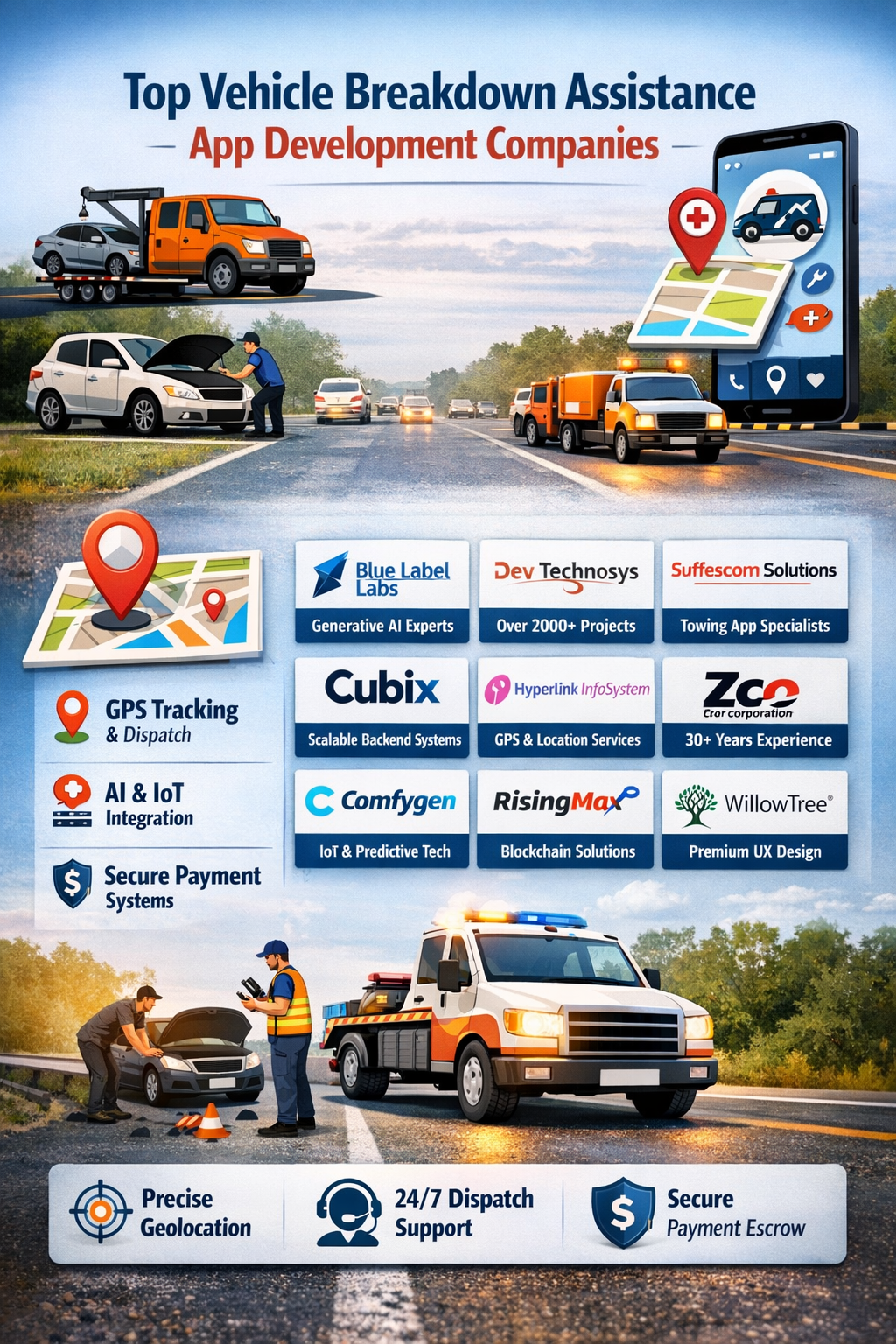
In the modern automotive landscape, the difference between a minor roadside inconvenience and a total travel disaster often comes down to the technology in your pocket. As vehicle ownership shifts toward connected ecosystems, the demand for on-demand assistance has skyrocketed. Businesses looking to enter this space need more than just a functional interface; they need a partner capable of handling real-time logistics, complex GPS integrations, and high-stakes reliability.
This guide explores the industry leaders currently setting the standard for roadside assistance technology, helping you identify the right partner for your venture.
1. Blue Label Labs
Blue Label Labs is a premier digital product agency renowned for transforming ambitious ideas into market-ready applications. They focus on user-centric design and scalable architecture to ensure long-term business success.
- Why They’re Selected:
- Expertise in Generative AI to enhance user interactions.
- Strong focus on Design Sprints for rapid prototyping.
- Award-winning history of high-ROI digital products.
- Key Services:
- Full-stack mobile development.
- Strategic product consulting.
- AI-driven user experience optimization.
2. Dev Technosys
With over 15 years in the industry, Dev Technosys is a powerhouse for custom automotive solutions. They specialize in building “door-to-door” service apps that streamline the entire vehicle maintenance and emergency lifecycle.
- Why They’re Selected:
- Recognized by BBC for automotive service innovations.
- Extensive experience with real-time GPS and automated payments.
- Proven track record with over 2,000 completed projects.
- Key Services:
- On-demand car repair app development.
- IoT-based vehicle diagnostic integration.
- Fleet and driver management systems.
3. Suffescom Solutions
Suffescom Solutions is a leading specialist in “Uber-for-X” models, specifically for towing and roadside recovery. They focus on building multi-stakeholder ecosystems that connect drivers, service providers, and administrators seamlessly.
- Why They’re Selected:
- Deep expertise in creating Uber-like clones for towing services.
- Advanced monetization features like subscription plans and referral systems.
- Comprehensive modules for fuel delivery and battery jumpstarts.
- Key Services:
- Real-time car towing module development.
- Automated accident detection and insurance claim support.
- Multi-language and multi-currency gateway integration.
4. Cubix
Cubix is an engineering-first development company that excels in complex software ecosystems. They are known for their ability to handle high-performance backend systems required for 24/7 emergency dispatch.
- Why They’re Selected:
- Decade-plus experience in scalable mobile architecture.
- Strong focus on hardware-agnostic software solutions.
- Recognized for intuitive UI/UX in high-stress utility apps.
- Key Services:
- Enterprise-grade mobile app development.
- Blockchain-secured payment and data logging.
- Custom AI and Business Intelligence tools.
5. Hyperlink InfoSystem
Hyperlink InfoSystem is one of the world’s most prolific app development firms, particularly skilled in location-based services. They have developed thousands of apps, mastering the art of the Vehicle Breakdown Assistance App Development process through precision and agile methodologies.
- Why They’re Selected:
- Global leader in GPS and GeoLocation-based solutions.
- Massive resource pool of over 1,200 dedicated developers.
- Strict adherence to agile development for timely delivery.
- Key Services:
- Vehicle tracking management systems.
- Cross-platform (Android & iOS) app creation.
- White-label GPS tracking software.
6. Zco Corporation
Zco Corporation has spent three decades building a reputation for reliability. They specialize in enterprise software and hybrid mobile applications that bridge the gap between legacy systems and modern mobile users.
- Why They’re Selected:
- Decades of experience in the software development lifecycle.
- Expertise in custom hardware and mobile app integration.
- Strong post-launch support and maintenance programs.
- Key Services:
- Native and hybrid mobile app development.
- Enterprise software integration (ERP/CRM).
- Staff augmentation for specialized tech stacks.
7. Comfygen Technologies
Comfygen is a top-rated IoT and mobile app firm that focuses on the “Smart” side of roadside assistance. They utilize predictive AI to anticipate vehicle failures before they leave a driver stranded.
- Why They’re Selected:
- Expertise in AI-powered predictive service requests.
- Leaders in IoT-based fleet monitoring and connected cars.
- Focus on offline service request capabilities for remote areas.
- Key Services:
- Tow truck and roadside assistance app clones.
- Route optimization for service providers.
- IoT device and cloud connectivity solutions.
8. Risingmax
Risingmax is a New York-based firm that specializes in the intersection of automotive tech and emerging technologies like Blockchain and AI. They provide high-security solutions for modern automotive brands.
- Why They’re Selected:
- Deep focus on automotive software security and performance.
- Pioneers in integrating Blockchain for transparent service records.
- High client satisfaction ratings for value-to-cost ratio.
- Key Services:
- Telematics and emergency assistance software.
- AI chatbot integration for 24/7 customer support.
- Big data analytics for driver behavior and safety.
9. Hyperlocal Cloud
Hyperlocal Cloud focuses on the “near-me” economy. Their expertise lies in hyper-precise location mapping, ensuring that the nearest help is always the one dispatched, minimizing wait times significantly.
- Why They’re Selected:
- Specialized in connecting vendors and customers in real-time.
- Low-latency data synchronization for live tracking.
- Expertise in building multi-vendor service marketplaces.
- Key Services:
- On-demand service marketplace development.
- Real-time proximity-based dispatching.
- Advanced route and map API integration.
10. WillowTree
WillowTree is a boutique-style agency with enterprise-grade capabilities. They are a Google Developer Certified agency that focuses on the “extraordinary experience,” ensuring every touchpoint in a breakdown app is frictionless.
- Why They’re Selected:
- Certified partners with major tech giants (Google/Forrester).
- Focus on design thinking and pixel-perfect interfaces.
- Expertise in security and compliance for sensitive user data.
- Key Services:
- Product strategy and concept development.
- Native iOS and Android engineering.
- Mobile backend engineering and API scaling.
Critical Features to Look For
When selecting a company for your project, ensure they prioritize these three pillars of breakdown assistance:
- Geolocation Precision: The app must work in low-signal areas and provide exact coordinates for technicians.
- Scalable Dispatch Logic: The backend must handle hundreds of simultaneous requests without lag.
- Secure Payment Escrow: Protecting both the user and the service provider during the transaction.
Conclusion
Building a successful roadside assistance platform requires a blend of high-speed logistics, iron-clad security, and an empathetic user interface. Whether you are a startup looking for a lean MVP or an established automotive brand seeking a digital overhaul, the companies listed above represent the gold standard of development. By choosing a partner that understands the nuances of real-time service delivery, you can ensure that your users are never truly “stuck” on the road.
FAQs
1. How much does it cost to develop a roadside assistance app?
The roadside assistance app cost typically ranges from $10,000 for a basic MVP to $30,000+ for a full-scale enterprise solution with AI and IoT integrations. Factors like platform choice (iOS, Android, or both) and the complexity of the dispatch algorithm significantly impact the final price.
2. How long does the development process take?
A standard vehicle breakdown app usually takes 4 to 9 months to develop. This includes phases for discovery, UI/UX design, frontend and backend development, and rigorous QA testing.
3. Can I integrate third-party towing companies into my app?
Yes. Most top developers build a “Service Provider” panel that allows independent towing companies or mechanics to register, pass a verification check, and accept jobs through your platform.
4. What are the best ways to monetize a breakdown assistance app?
Common monetization strategies include charging a commission fee per service, offering monthly/yearly subscription plans for premium coverage, and in-app advertising for auto insurance or repair shops.
5. How does the app handle users in remote areas with poor internet?
Leading development companies implement “Offline Mode” or SMS-based fallback systems. This allows the app to send a structured text message with the user’s GPS coordinates to the server if data connectivity is lost.
6. Do these companies provide post-launch support and maintenance?
Most reputable firms offer ongoing maintenance packages. This is crucial for roadside apps to ensure GPS APIs remain updated, OS compatibility is maintained, and server security is patched against new threats.
