

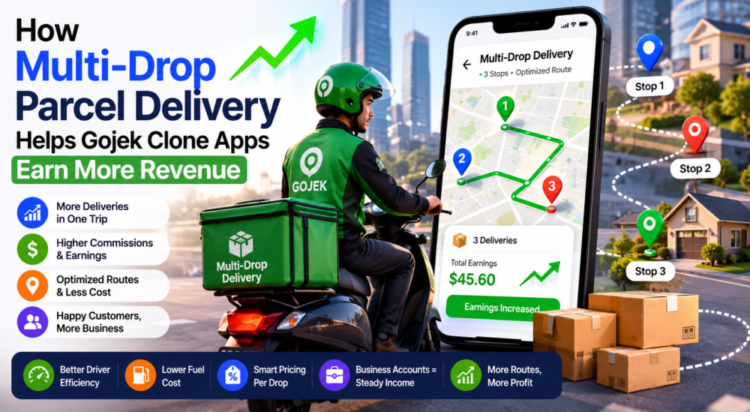
Parcel delivery may look like a simple logistics feature and an important component present inside your Gojek clone app, but at its core, it’s a route-based revenue engine which performs much better if understood the right way.
This component offers a multi-drop delivery option, which allows the users to fulfill several parcel delivery drops while assigning it to the same driver, such that the driver drops these parcels in a single trip.
The economics behind this multi-route system changes everything about the standard parcel delivery business we know today. Understanding this will give you a better overview about the relationship between distance traveled, driver time, and platform income when you launch your super app business with these components.
Why Multi-Drop Delivery Changes the Game
In a standard single-drop delivery, you charge one customer for one trip. Getting a single commission when the driver does the trip and comes back may look like a simple process, but it leaves money on the table. You are spending the same amount of driver time and effort just to earn standard money from one trip when you could be doing more.
Multi-drop delivery changes this completely.
When a driver picks up three parcels going to three different places close to each other, your effort stays the same, but your earnings multiply.
In simple words, the business makes three times the money from one trip if there are three multi-drops, which could be far more in reality. So when the business makes more money, the driver too earns more for their time spent delivering their parcels on different locations. Rather than going back and forth picking up one parcel for their single trips, they are now spending less on fuels per delivery as well.
Recent 2026 data shows that last-mile delivery now makes up 53% of total shipping costs.
Trying to figure out how to group different parcel deliveries into one single trip to cut down expenses is quite normal for most founders.
But there are other things which shapes the customer experience, especially when doing more drops randomly wastes time and makes the last person receive their delivery very late.
So what founders need to understand about the deliveries is they need an app which can handle multiple drops in a proper order, and when made in the right way, a Gojek clone app can do it easily by grouping nearby locations together.
For convenience, the app naturally matches these drop locations in the background so the driver takes a straight path instead of going all over the city.
Because the driver can deliver all these items in one go, the business can actually grow its profits from commissions without keeping customers waiting, and owners easily get this without having to spend time setting it up from scratch.
How to Actually Make Money with Multi-Drop Deliveries
Figuring out how to make money with multi-drop deliveries is quite normal for most founders.
Basically, it just means one driver takes care of two or more parcels in one trip, and while the commissions look small at first, adding them up becomes a huge boost to the profit.
So what founders need to understand is how the “Send Anything” option works in a Gojek clone app.
When a user adds pickup and drop locations, the app maps the route, meaning if a driver makes three drops, the platform makes three separate commissions from one trip instead of just one big fee.
But there are other things which shapes the profit, especially pricing.
See, an average city drivers can comfortably hit 25 to 40 parcel stops a day, and having smart routing in your super app can push that number up by another 20% to 30%.
So charging full price for every stop is a big mistake and scares users away from the multi-drop feature.
Instead, giving a slightly lower rate per drop means the user feels they get a good deal and you still make more money overall, which can be easily adjusted in the admin panel.
For convenience, the app naturally groups nearby stops together so drivers don’t have to drive back empty after just one drop.
Because driving back empty just burns fuel and hurts efficiency, sending more parcels per trip is the best way to keep things profitable without mapping routes manually.
Also founders need to know that regular users only send a parcel sometimes, while small businesses like shops send them every day.
So setting them up with a business account turns those random orders into a steady daily income.
Finally, using the admin panel gives a clear view to track things like busy routes and times, so you don’t need to be an expert, it is just about seeing what works and putting drivers where the money is.
Final Thoughts
Trying to get a piece of the big delivery market by setting prices and connecting with regular senders is quite normal for most founders.
But there are other things which shapes the user habit, especially how people who trust the app with parcels will start trying out other things over time like ordering food and booking rides.
So what founders need to understand about the end user is they need an app which can handle multi-drop trips well to build this starting trust, and when made in the right way, a Gojek clone app can do it easily.
For convenience, a user can easily build a habit of opening the app for everything, and every route becomes a chance for the business to earn more instead of just being another task.
FAQs
1. Does adding more stops to a single trip increase profits?
Yes. But make sure the stops are close to each other so the right prices are set for each and every one. More stops means more commissions for every mile driven.
2. Who gets the most out of a multi-drop delivery service?
Small businesses dealing with a wide variety of things make the most out of this service. They give you steady orders, which lets you plan better and offer slightly lower rates per drop without losing your overall earnings.
3. How do I get a multi-drop parcel feature into my Gojek clone app?
Contact a professional white-label firm. They have apps that already let people send parcels to different addresses in one booking. You can add your name and business logo to launch your business and set prices and send driver or group routes yourself.
4. How does parcel delivery help the rest of a multi-service app grow?
The use of more delivery means more people will open your app which in turn are more likely to try out other services combined with the right discounts and promo codes if used for the first time. Because of this, a multi-delivery parcel feature plays a huge role in the growth of a multi-service app platform.
