

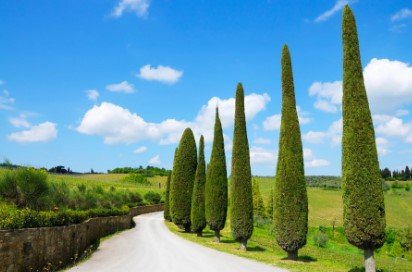
The Cupressus sempervirens is a tall, narrow evergreen widely used in landscape design for its architectural form and vertical emphasis. Native to the Mediterranean region, the Italian cypress tree is recognized for its columnar structure, dark green foliage, and ability to create strong visual lines in gardens and boundary planting systems. Its natural growth habit allows it to function as both a structural accent and a privacy solution in residential and commercial landscapes.
In modern horticulture, this tree is often selected for its minimal horizontal spread, typically growing 30–60 feet tall while maintaining a width of only a few feet. This makes it especially useful in compact spaces where height is desired without consuming a large ground area. The species thrives in full sun conditions and well-drained soil, showing strong drought tolerance once established, which aligns with sustainable landscaping practices in warmer climates.
Growth Characteristics and Environmental Adaptability
The Italian cypress tree is defined by its fastigiate (upright) growth pattern, meaning branches grow tightly along a central leader. This structure reduces the need for heavy pruning and helps maintain a formal appearance with minimal maintenance. Growth rates can vary depending on soil quality, irrigation, and climate, but young trees typically establish quickly under optimal conditions.
From an environmental standpoint, this tree is highly adaptable. It performs well in alkaline to slightly acidic soils and can tolerate dry conditions better than many ornamental evergreens. However, it requires proper drainage, as waterlogged soil can lead to root stress and fungal issues. Its resilience in urban environments also makes it a popular choice for roadside planting, estate boundaries, and structured garden layouts.
Wind exposure and sunlight availability significantly influence growth uniformity. In shaded or restricted airflow areas, the tree may develop uneven density, highlighting the importance of strategic placement during landscape planning.
Functional Uses in Landscape Design Systems
In landscape architecture, the Italian cypress tree is often used as a vertical design element to create rhythm, symmetry, and perspective. Its narrow form allows designers to establish natural borders without obstructing spatial openness. This makes it suitable for driveways, walkways, entrance framing, and formal garden layouts.
It is also commonly used in Mediterranean-inspired landscapes, where repetition of vertical plant forms creates a structured and elegant visual identity. When planted in rows, it functions as a living screen, offering both privacy and wind buffering without requiring dense hedging systems.
Unlike broader evergreen species, the Italian cypress does not dominate surrounding plantings, allowing complementary vegetation layers to coexist. This makes it compatible with mixed garden compositions, including flowering shrubs, ground covers, and ornamental grasses.
Maintenance Requirements and Long-Term Care
One of the key advantages of the Italian cypress tree is its low maintenance requirement. Once established, it needs minimal watering and only occasional pruning to remove dead or damaged branches. Over-pruning is generally discouraged because it can disrupt its natural vertical form.
Proper irrigation during the early establishment phase is essential for root development. After maturity, the tree relies largely on natural rainfall, especially in Mediterranean-style climates. Fertilization is typically light, as excessive nutrients may lead to rapid but weak growth.
Pest and disease resistance is moderate, though issues such as cypress canker, root rot, or mite infestations can occur under poor environmental conditions. Regular monitoring helps ensure long-term health and structural stability.
Comparison With Other Evergreen Options: Boxwoods
While exploring alternatives, many landscapers compare the Italian cypress tree with dense shrubs such as hedging plants often used in structured gardens. However, the two serve very different design functions.
Italian cypress provides vertical height and architectural impact, whereas boxwood varieties are typically used for low hedging, edging, and compact shaping. The cypress defines space vertically, while boxwoods define space horizontally. In many landscape designs, both are used together to create a layered structure, with cypress for height and boxwoods for ground-level formality.
Conclusion
The Italian cypress tree remains a cornerstone of formal and Mediterranean-style landscaping due to its unique vertical growth, adaptability, and minimal maintenance needs. Its ability to provide structure, privacy, and visual rhythm makes it a highly functional species in both residential and commercial environments.
When combined with complementary plantings such as Boxwoods for sale, it allows for balanced landscape compositions that integrate height, texture, and form. In modern garden planning, this tree continues to be valued not only for its aesthetic appeal but also for its structural reliability and long-term landscape performance.
