

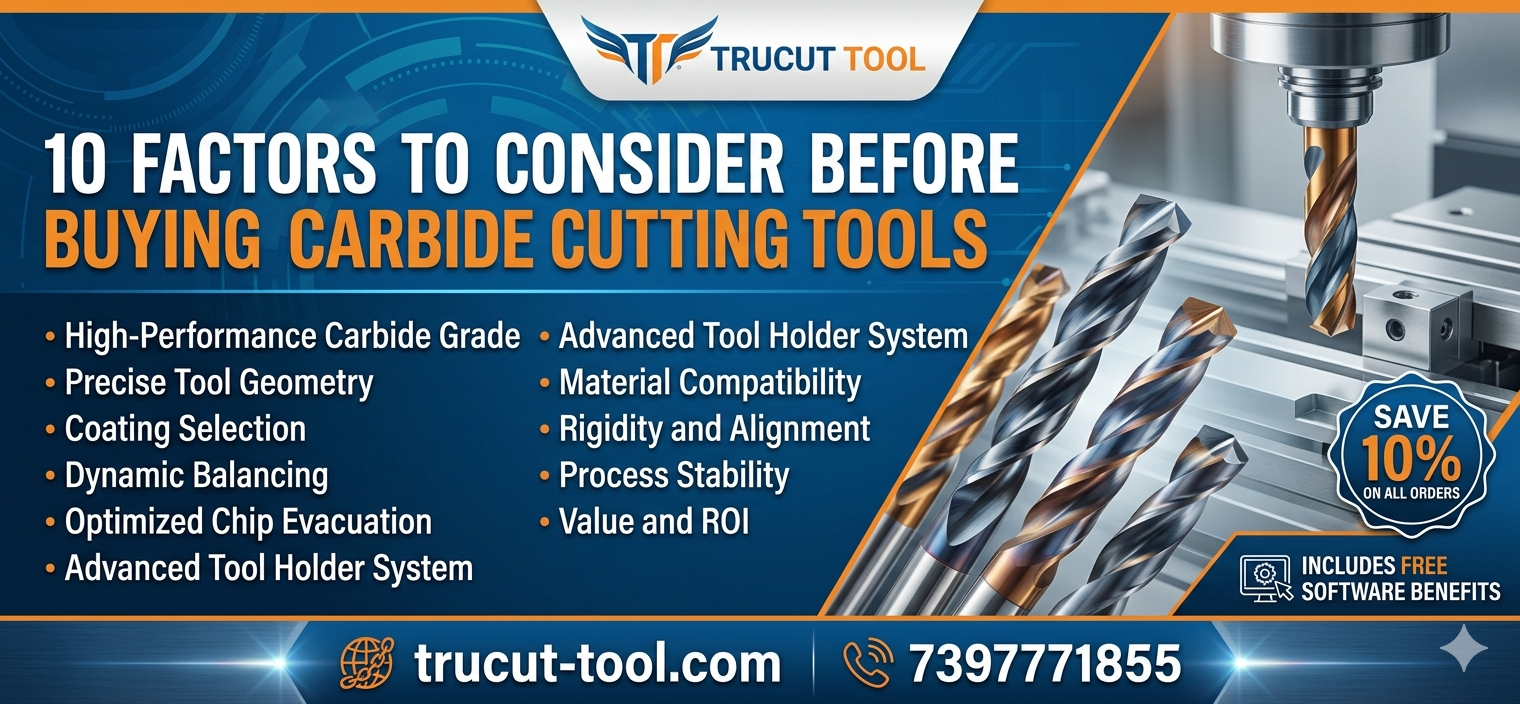
Procuring industrial tooling requires a deep understanding of metallurgy, machine dynamics, and application engineering. In high-precision manufacturing, selecting optimal cutting tools is the primary determinant of cycle efficiency, part quality, and overall cost-per-component. Suboptimal tooling procurement leads directly to premature edge degradation, component warping, and costly machine downtime.
To achieve maximum efficiency on the shop floor, procurement teams and manufacturing engineers must evaluate industrial tools using structural, mechanical, and strategic criteria. Below is the comprehensive technical framework we have established to guide high-end manufacturing operations through the critical factors governing carbide tool procurement.
1. Substrate Micrograin Structure and Cobalt Content
The fundamental performance of any solid carbide tool is governed by its metallurgical composition. Tungsten carbide substrates are a composite material consisting of hard carbide particles bound together by a metallic cobalt binder. The grain size of the tungsten carbide particles dictates the tool’s final mechanical properties.
- Micrograin and Sub-Micrograin Substrates: Smaller grain sizes (0.2–0.5 microns) provide a higher density of grain boundaries, significantly increasing both the hardness and structural toughness of the tool.
- Cobalt Content Ratio: The percentage of cobalt directly affects the balance between brittleness and impact resistance. High-precision operations demanding clean cuts typically require a lower cobalt content (6% to 10%) combined with ultra-fine micrograins to maintain razor-sharp edge profiles.
2. Geometry Optimization for Specific Workpiece Materials
A generic tool profile cannot successfully process diverse material groups like hardened steels, aerospace-grade titanium, and abrasive aluminum alloys. The specific geometry of a tool must be engineered to balance cutting forces and chip formation.
When selecting a specialized solid carbide drill, the point angle (typically varying between 118° and 140°) and the web thickness must match the material’s shear strength. Tough, long-chipping materials require a larger point angle and highly polished flutes to optimize chip evacuation and eliminate internal packing. Conversely, structural geometries designed for an end mill require precise calculation of the helix angle. Higher helix angles (45° or greater) reduce radial forces and provide a smooth lifting action ideal for exotic alloys, while lower helix angles provide the structural rigidity needed for heavy roughing cycles in tough steels.
3. Application-Specific Thin-Film PVD and CVD Coatings
Uncoated carbide is highly vulnerable to thermal shock and chemical wear at elevated speeds. Modern machining demands advanced thin-film coatings applied via Physical Vapor Deposition (PVD) or Chemical Vapor Deposition (CVD).
- Titanium Aluminum Nitride (TiAlN): Forms an aluminum oxide protective layer at high temperatures, making it the industry baseline for dry machining and high-heat alloys.
- Aluminum Chromium Nitride (AlCrN): Offers superior oxidation resistance and mechanical toughness, essential for high-feed roughing operations.
- Diamond Coatings (CVD): Indispensable for non-ferrous, highly abrasive materials like carbon-fiber-reinforced polymers (CFRP) and high-silicon aluminum, where mechanical abrasion would instantly dull a standard tool edge.
4. Rigidity and Runout Tolerances of the Machining System
The inherent brittleness of tungsten carbide makes it highly sensitive to deflection and vibration. Before purchasing premium tooling, the structural integrity of the entire machine setup must be evaluated. Spindle runout must be kept under 3 microns. High-precision carbide tools perform poorly in loose, worn-out collet chucks or on light-duty, unstable machine frames.
Investing in high-end tooling without upgrading to high-rigidity tool holding systems—such as hydraulic expansion chucks or shrink-fit systems—leads directly to micro-chipping along the cutting edges and premature tool failure.
5. Technical Capabilities of the Carbide Tool Manufacturer in India
The global manufacturing supply chain requires reliable sourcing partners capable of delivering consistent metallurgical quality across high-volume batches. Evaluating the manufacturing technology of your tooling partner is essential. A truly proficient Carbide Tool Manufacturer in India must operate multi-axis CNC grinding centers, automated quality inspection systems, and advanced edge-preparation equipment.
Consistency in batch-to-batch substrate purity determines whether a tool setup can run unattended or if it will require constant operator monitoring due to unpredictable tool life variances.
6. Regional Support and Precision Customization Infrastructure
While high-volume standard tools handle routine operations, complex components frequently require custom stepped drills, form tools, and proprietary geometries to combine multiple manufacturing steps into a single tool cycle.
Choosing a partner with a localized, advanced production footprint—such as an established Carbide Tool Manufacturer in Chennai—provides significant strategic advantages. Proximity ensures rapid technical engineering consultations, localized failure analysis, and short lead times for custom-engineered tools that minimize cycle times on high-volume production lines.
7. Core Dynamic Balancing for High-Spindle Velocities
As production facilities move toward High-Speed Machining (HSM) to reduce cycle times, tool balance becomes critical. At rotational speeds exceeding 15,000 RPM, even minor mass asymmetries create significant centrifugal forces.
$$\text{Centrifugal Force } (F_c) = m \times \omega^2 \times r$$
Unbalanced tooling induces high-frequency vibrations that damage the machine spindle bearings, ruin the workpiece surface finish, and trigger micro-fractures in the carbide substrate. All high-speed finishing tools must be dynamically balanced to G2.5 quality standards or better to ensure vibration-free cutting performance.
8. Total Cost per Part vs. Initial Procurement Cost
A common procurement mistake is evaluating cutting tools solely on their initial purchase price. Cheap, sub-standard tooling inevitably inflates the total cost per component through extended cycle times, frequent tool replacement shutdowns, and higher scrap rates.
Premium carbide tools operate at significantly higher cutting speeds ($V_c$) and feed rates ($f_z$), compressing total cycle times. The extended tool life across hundreds of hours of continuous operation distributes the initial capital outlay over a much larger volume of finished parts, delivering a lower overall production cost.
9. Core Edge Preparation and Micro-Geometry
A perfectly sharp, un-deburred grinding edge is structurally weak and prone to immediate micro-chipping under heavy cutting loads. Advanced tooling procurement requires specific edge preparation, often referred to as “edge honing.”
Using specialized brushing or blasting processes, the cutting edge is intentionally rounded or chamfered at a micron level (typically a 10 to 30-micron radius). This controlled micro-geometry reinforces the structural integrity of the cutting edge, distributes initial impact forces evenly, and significantly extends stable tool life.
10. Coolant Delivery Configuration: Internal vs. External
The method chosen to deliver cutting fluid to the shear zone directly affects thermal management and chip control.
- External Flood Coolant: Often fails to reach the cutting zone in deep pocketing or deep-hole drilling Carbide Drills due to the vapor barrier created by high-speed tool rotation.
- Through-Tool Internal Coolant: Delivers high-pressure fluid directly to the cutting edge. This configuration provides immediate cooling, lubricates the tool-chip interface, and forces chips out of deep cavities, preventing recutting and catastrophic tool breakage.
Tooling Performance Grid across Primary Machining Configurations
| Tool Category | Core Geometric Focus | Primary Wear Mechanism | Optimal Application Zone |
| High-Feed End Mill | Shallow indexing angle, high flute density | Flank abrasion, chipping | High-volume pocketing, rapid raw material removal |
| Solid Carbide Drill | Web thinning, refined point angles | Outer corner wear, chisel edge deformation | Deep-hole production, high-tolerance bores |
| Custom Form Tools | Multi-step transition profiles | Concentrated thermal stress, notch wear | High-volume automotive and aerospace component lines |
Frequently Asked Questions
What is the primary cause of sudden tool breakage in solid carbide end mills?
Catastrophic failure in solid carbide tools is almost always caused by structural vibration or chip recutting. If chips are not immediately removed from the cutting path via high-pressure air or internal coolant, the tool will trap and recut them, causing a sudden spike in torque that instantly snaps the brittle carbide substrate.
How do Variable Helix geometries reduce harmonic vibration?
Standard tools have uniform flute spacing, which creates rhythmic, repeating impacts that can trigger harmonic resonance (chatter) in the workpiece. Variable helix and variable pitch designs alter the timing of these impacts, breaking up the harmonic frequencies. This allows for deeper cuts and faster metal removal rates while maintaining a smooth surface finish.
Can used carbide cutting tools be recycled?
Yes. Tungsten carbide is a highly recyclable material. Because tungsten is a scarce and valuable element, many advanced manufacturers manage closed-loop recycling programs. Used and broken carbide tools are collected, chemically or mechanically broken down into raw powders, and processed back into premium-grade substrate material without any loss in performance.
