

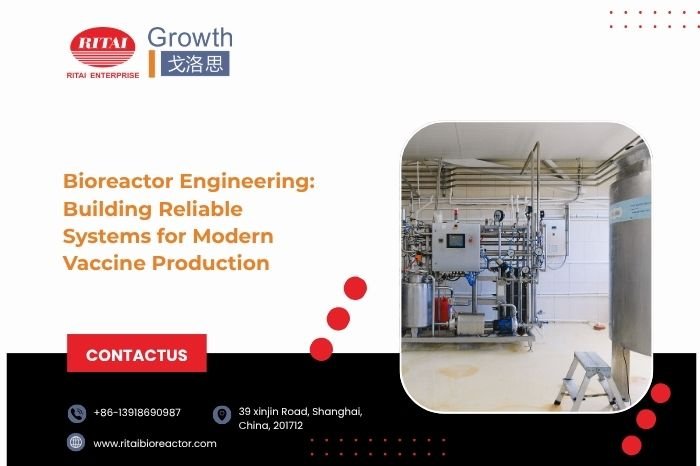
Bioreactor engineering sits at the heart of modern biotechnology. Whether a company is producing vaccines, therapeutic proteins, enzymes, antibodies, or cell-based products, the quality of the final result depends heavily on how well the bioreactor is designed, controlled, cleaned, scaled, and validated.
In vaccine manufacturing, this becomes even more important. A vaccine bioreactor is not just a stainless steel vessel or a single-use bag where cells grow. It is a controlled production environment where biology and engineering work together. Temperature, pH, dissolved oxygen, agitation, sterility, nutrient supply, foam control, pressure, and contamination prevention all affect product yield and safety.
For biotechnology companies, research labs, and manufacturing teams, understanding bioreactor engineering is no longer optional. It is a core skill for building consistent, scalable, and compliant vaccine production systems.
What Is Bioreactor Engineering?
Bioreactor engineering is the design and operation of systems used to grow cells, microorganisms, or biological materials under controlled conditions. It brings together mechanical engineering, biochemical engineering, microbiology, process control, automation, and quality assurance.
A well-designed bioreactor supports the biological process without damaging the cells or reducing product quality. For example, mammalian cells used in vaccine production are sensitive to shear stress. If the impeller speed is too high, the cells may be damaged. If mixing is too low, nutrients and oxygen may not reach all parts of the culture evenly.
This is where bioreactor engineering becomes practical. Engineers must balance mixing, oxygen transfer, heat transfer, sterility, and scalability while keeping the biological needs of the process in mind.
Why Bioreactor Engineering Matters in Vaccine Production
Vaccine production demands accuracy and repeatability. A small change in process conditions can affect cell growth, viral yield, antigen quality, or batch consistency. This is why bioreactor engineering plays such a strong role in vaccine manufacturing.
A vaccine bioreactor helps create a controlled environment where cells or microorganisms can produce the required biological material. Depending on the vaccine type, the bioreactor may be used for growing viruses, bacteria, yeast, insect cells, or mammalian cells.
For example, viral vaccines often require cell culture systems where host cells are grown first, then infected with a virus under controlled conditions. The bioreactor must support healthy cell growth before infection and then maintain the right environment for virus replication. If the engineering design is poor, the process may suffer from low yield, contamination risk, or inconsistent results.
Good bioreactor engineering helps manufacturers improve batch reliability, reduce production losses, support regulatory compliance, and scale from research to commercial manufacturing.
Key Components of a Vaccine Bioreactor
A vaccine bioreactor includes several important components, and each has a direct impact on process performance.
The vessel or chamber holds the culture. In traditional manufacturing, stainless steel bioreactors are widely used because they are durable, reusable, and suitable for large-scale production. In many modern facilities, single-use bioreactors are also common because they reduce cleaning requirements and lower cross-contamination risks.
The agitation system keeps the culture mixed. It helps distribute nutrients, oxygen, and cells evenly throughout the medium. However, the agitation must be gentle enough to protect sensitive cells.
The aeration system supplies oxygen and removes carbon dioxide. Oxygen transfer is one of the most important parts of bioreactor engineering because many biological processes depend on stable oxygen levels.
Sensors monitor critical parameters such as pH, temperature, dissolved oxygen, pressure, foam, and sometimes cell density. These sensors provide real-time data so operators can adjust the process quickly.
The control system manages the bioreactor automatically. Modern systems can adjust gas flow, agitation speed, acid/base addition, feed rate, and temperature based on sensor feedback.
Together, these parts allow a vaccine bioreactor to maintain a stable and controlled production environment.
Types of Bioreactors Used in Vaccine Manufacturing
Different vaccine platforms require different bioreactor designs. The most common types include stirred-tank bioreactors, single-use bioreactors, packed-bed bioreactors, and wave bioreactors.
Stirred-tank bioreactors are widely used in industrial biotechnology. They offer strong mixing and control, making them suitable for many microbial and cell culture processes.
Single-use bioreactors are popular in vaccine development and flexible production facilities. They use disposable bags or liners, which reduces cleaning time and supports faster changeover between batches.
Wave bioreactors are often used for cell culture applications at smaller or medium scale. They use gentle rocking motion instead of mechanical impellers, making them useful for shear-sensitive cells.
Packed-bed bioreactors are used when cells need a surface to attach and grow. They can be helpful for certain vaccine production processes that depend on adherent cells.
The right choice depends on the cell type, vaccine platform, production scale, regulatory needs, and facility design.
Important Process Parameters in Bioreactor Engineering
Successful bioreactor engineering depends on controlling critical process parameters. These are the conditions that directly influence culture performance and product quality.
Temperature is one of the most basic but important controls. Cells and microorganisms grow best within a narrow temperature range. Any major deviation can slow growth or affect product formation.
pH control is equally important because cellular activity changes when the culture becomes too acidic or alkaline. In vaccine production, unstable pH can reduce yield and affect product quality.
Dissolved oxygen must be carefully managed. Too little oxygen can limit cell growth, while too much aeration or agitation can create stress.
Agitation affects mixing and oxygen transfer. The challenge is to mix the culture effectively without damaging cells.
Foam control is also important because excessive foam can block filters, increase contamination risk, and interfere with sensors.
Nutrient feeding must be planned carefully. In fed-batch processes, nutrients are added during the run to support longer growth and higher productivity.
These parameters may look simple on paper, but in real production, they interact with each other. This is why practical bioreactor engineering requires both process knowledge and hands-on experience.
Scale-Up Challenges in Bioreactor Engineering
One of the biggest challenges in bioreactor engineering is scale-up. A process that works well in a 5-liter lab bioreactor may not behave the same way in a 500-liter or 5,000-liter production bioreactor.
Mixing time changes as the vessel size increases. Oxygen transfer becomes more difficult. Heat removal can become a problem. Cell sensitivity may become more visible. Even small differences in impeller design or gas flow can affect the final batch.
For vaccine production, scale-up must be handled carefully because product quality and safety cannot be compromised. Engineers usually study parameters such as oxygen transfer rate, power input, mixing efficiency, shear levels, and process reproducibility before moving to larger volumes.
A vaccine bioreactor used at commercial scale must produce consistent results across multiple batches. That consistency comes from careful process development, strong engineering design, and validated operating procedures.
Sterility and Contamination Control
Sterility is one of the strongest requirements in vaccine manufacturing. A contaminated batch can lead to major financial loss, production delays, and serious safety concerns.
Bioreactor engineering supports sterility through clean design, closed processing, sterilization systems, sterile filters, validated cleaning methods, and proper material selection.
Stainless steel bioreactors are usually cleaned and sterilized using CIP and SIP systems. CIP means clean-in-place, and SIP means sterilize-in-place. These systems allow cleaning and sterilization without dismantling the equipment.
Single-use systems reduce some cleaning and sterilization steps because the product-contact parts are disposable. However, they still require strong supplier qualification, leak testing, material compatibility checks, and proper handling.
In both cases, contamination control depends on good engineering and disciplined manufacturing practices.
Automation in Modern Bioreactor Engineering
Automation has become a major part of bioreactor engineering. Modern vaccine production facilities use advanced control systems to monitor and adjust process conditions in real time.
Automation improves consistency because it reduces manual errors. It also helps collect process data, which is important for batch records, troubleshooting, validation, and regulatory review.
For example, if dissolved oxygen drops below the target range, the system can automatically increase agitation speed or oxygen flow. If pH moves outside the set limit, the system can add acid or base.
In a vaccine bioreactor, this level of control is valuable because biological systems can change quickly. Real-time monitoring allows operators to respond before a small issue becomes a batch failure.
Role of Bioreactor Engineering in Quality and Compliance
Vaccine manufacturing must meet strict quality standards. Bioreactor engineering supports compliance by creating repeatable, traceable, and validated processes.
Every part of the bioreactor system must be suitable for the intended use. Materials must be compatible with the process. Sensors must be calibrated. Software must be validated. Cleaning and sterilization must be documented. Process parameters must be controlled within approved limits.
A strong engineering approach also supports process validation. Manufacturers must show that their vaccine bioreactor can produce consistent results under defined conditions. This includes equipment qualification, process performance qualification, and ongoing monitoring.
In simple terms, bioreactor engineering helps connect scientific development with safe commercial production.
Future Trends in Bioreactor Engineering
The future of bioreactor engineering is moving toward flexible, data-driven, and faster production systems. Single-use technologies are growing because they allow faster setup and easier product changeover. Continuous bioprocessing is also gaining attention because it can improve productivity and reduce facility footprint.
Digital tools are becoming more common as well. Advanced sensors, process analytics, automation software, and data modeling can help teams understand culture behavior more clearly.
For vaccine production, these improvements can support faster development, better yield, and stronger process control. The goal is not just to produce more, but to produce safely, consistently, and efficiently.
Conclusion
Bioreactor engineering is one of the most important foundations of modern vaccine manufacturing. It combines biology, engineering, automation, process control, and quality systems into one working production environment.
A vaccine bioreactor must do more than hold a culture. It must support cell growth, protect product quality, maintain sterility, control critical parameters, and perform reliably at scale.
For companies working in vaccine development or biopharmaceutical manufacturing, strong bioreactor engineering can make the difference between a process that works only in the lab and a process that delivers consistent commercial results.
As vaccine technologies continue to grow, the demand for skilled bioreactor engineers, process scientists, and manufacturing teams will continue to rise.
FAQs About Bioreactor Engineering
1. What is bioreactor engineering?
Bioreactor engineering is the design, operation, and control of systems used to grow cells, microorganisms, or biological products under controlled conditions.
2. Why is bioreactor engineering important for vaccines?
It helps maintain stable conditions for cell growth, virus production, antigen formation, sterility, and batch consistency in vaccine manufacturing.
3. What is a vaccine bioreactor?
A vaccine bioreactor is a controlled system used to produce biological materials required for vaccines, such as viruses, proteins, antigens, or cell-based components.
4. Which type of bioreactor is best for vaccine production?
The best type depends on the vaccine platform, cell type, production scale, and facility needs. Stirred-tank, single-use, wave, and packed-bed bioreactors are commonly used.
5. What parameters are controlled in a bioreactor?
Common parameters include temperature, pH, dissolved oxygen, agitation, gas flow, pressure, foam, nutrient feeding, and culture volume.
6. What is the difference between stainless steel and single-use bioreactors?
Stainless steel bioreactors are reusable and suitable for large-scale production. Single-use bioreactors use disposable product-contact parts and are useful for flexible, faster production setups.
7. Why is scale-up difficult in bioreactor engineering?
Scale-up is difficult because mixing, oxygen transfer, heat transfer, and shear stress change as the bioreactor size increases.
8. How does automation help in vaccine bioreactors?
Automation helps monitor and control process conditions in real time, reducing manual errors and improving batch consistency.
9. What role does sterility play in bioreactor engineering?
Sterility prevents contamination and protects product safety. It is managed through clean design, closed systems, sterilization, filtration, and validated procedures.
10. Is bioreactor engineering a good career field?
Yes. Bioreactor engineering is highly relevant in biotechnology, vaccine production, pharmaceuticals, cell culture, fermentation, and biomanufacturing industries.
