

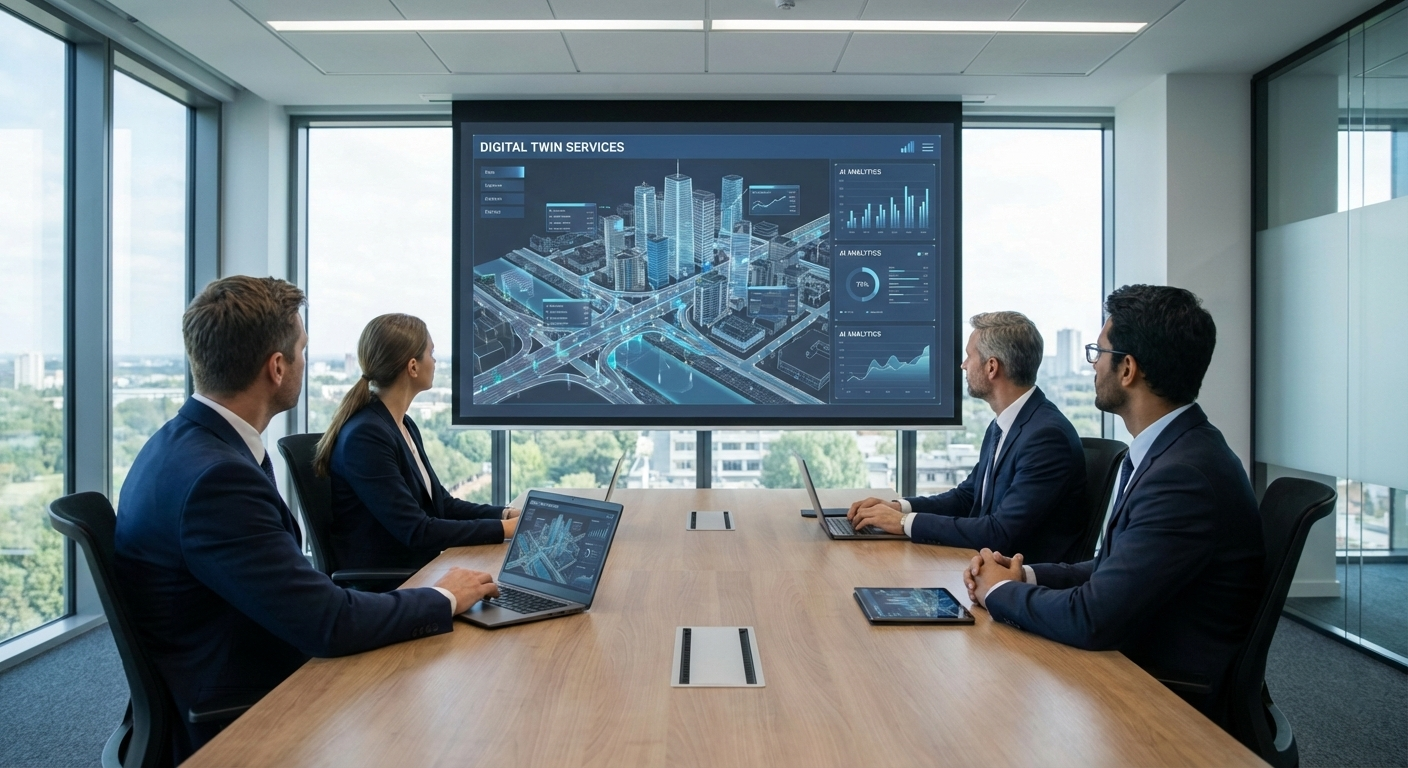
We live in an era where data drives decisions, speed determines survival, and innovation separates leaders from followers. Businesses across every sector are under increasing pressure to predict outcomes before they occur, optimize processes in real-time, and eliminate costly trial-and-error cycles. In the midst of this transformation, digital twin services have emerged as one of the most powerful and versatile technologies reshaping the modern enterprise. By creating precise virtual replicas of physical systems, processes, or assets, digital twin technology provides organizations with an unprecedented ability to simulate, analyze, and innovate without the risks and costs associated with real-world experimentation.
From smart manufacturing and supply chain resilience to healthcare modeling and smart city planning, the scope of digital twin solutions is expanding rapidly. As companies sharpen their competitive edge, they must understand what digital twin services offer and strategically deploy them. This is no longer optional, it is essential.
What Are Digital Twin Services?
At their core, digital twin services refer to the complete ecosystem of offerings from design and deployment to monitoring and analytics that enable organizations to build and operate digital counterparts of physical entities. A digital twin is more than just a 3D model or a dashboard; it is a living, dynamic simulation that ingests real-time data from sensors, machines, workflows, or human systems and reflects that information in a continuously updated virtual environment.
These services typically encompass data integration, IoT connectivity, simulation modeling, AI-powered analytics, and visualization tools. When fully implemented, a digital twin solution allows decision-makers to observe how a system behaves under different conditions, test changes virtually before applying them in the real world, and gain insights that would be impossible to derive from static data alone.
The concept originated in aerospace and defense, where NASA used early digital twin principles to simulate and troubleshoot spacecraft systems remotely. Today, the technology has matured dramatically, becoming accessible to enterprises of all sizes and applicable across virtually every vertical.
The Core Components of Digital Twin Technology
To understand why digital twin technology is so transformative, it helps to break down its foundational components:
Data Acquisition Layer: IoT sensors, RFID tags, cameras, and other connected devices continuously feed raw data into the twin. This real-time data stream is what breathes life into the virtual model, enabling it to reflect actual conditions rather than static snapshots.
Integration and Middleware: APIs, cloud platforms, and data pipelines connect disparate systems and ensure that information from multiple sources can be unified and normalized for the twin to consume.
Simulation Engine: Advanced modeling algorithms replicate the physics, chemistry, or operational logic of the real-world entity, allowing the twin to run predictive scenarios and stress-test outcomes.
AI and Machine Learning: Intelligent algorithms analyze patterns within the twin’s data to generate predictions, detect anomalies, recommend optimizations, and trigger automated responses.
Visualization and Interface: User-facing dashboards, augmented reality interfaces, and 3D environments make the twin’s insights actionable and accessible to stakeholders at all levels of the organization.
Industries Being Transformed by Digital Twin Solutions
One of the most compelling aspects of digital twin solutions is their adaptability. The same fundamental architecture can be applied to radically different use cases across a wide range of industries.
Manufacturing and Industrial Operations
Perhaps no sector has adopted digital twin technology more enthusiastically than manufacturing. Factories use digital twins of production lines to predict equipment failures before they occur, a practice known as predictive maintenance, slashing downtime and repair costs. Engineers can simulate changes to assembly workflows, test new configurations, or evaluate the impact of material substitutions entirely within the virtual environment. Global manufacturers like Siemens and GE have reported significant reductions in production costs and time-to-market as a direct result of their digital twin programs.
Healthcare and Life Sciences
In healthcare, digital twin services are opening new frontiers in personalized medicine and hospital management. Researchers are developing patient-specific organ twins that allow surgeons to plan complex procedures virtually, reducing the risk of complications. Hospital administrators use building-level twins to model patient flow, optimize resource allocation, and prepare for emergency scenarios. Pharmaceutical companies are using molecular-level digital twins to simulate how drugs interact with biological systems, compressing drug discovery timelines from years to months.
Smart Cities and Infrastructure
Urban planners and government agencies use digital twin solutions to model entire cities. They map transportation networks, utility grids, environmental conditions, and population patterns. These city-scale twins help planners evaluate infrastructure projects before construction begins. Teams simulate disaster response scenarios and optimize energy distribution in real time. Virtual Singapore stands as one of the world’s most advanced examples. The platform provides a 3D city twin for solar planning and emergency evacuation modeling.
Energy and Utilities
Energy companies use digital twins for wind turbines, oil rigs, power grids, and pipelines. They improve safety, performance, and sustainability through real-time insights. Operators monitor structural integrity and operational efficiency continuously. This helps extend asset lifespans and reduce maintenance costs. Companies also lower environmental risks with predictive monitoring. As the energy transition accelerates, digital twins support renewable energy integration. They help stabilize and optimize existing grid infrastructure efficiently.
The Strategic Business Value of Digital Twin Services
Beyond their technical elegance, digital twin services deliver measurable strategic value that resonates at the C-suite level. The business case for investment is grounded in four core value drivers.
Risk Reduction: Testing changes, innovations, or process modifications in a virtual environment eliminates the financial and reputational risks of failed real-world experiments. A digital twin allows organizations to fail fast, fail cheaply, and learn decisively before committing resources to physical implementation.
Operational Efficiency: Continuous monitoring and AI-driven optimization through a digital twin solution can identify inefficiencies that would be invisible to human operators reviewing static reports. Organizations consistently report improvements in throughput, energy usage, and asset utilization after implementing digital twins.
Accelerated Innovation: The ability to prototype, simulate, and iterate in a virtual space dramatically shortens the product development cycle. Companies can explore more ideas in less time, bringing innovative products and services to market faster than competitors who rely on traditional development processes.
Enhanced Decision-Making: Leaders equipped with digital twin insights make decisions grounded in real-time data and predictive modeling rather than gut instinct or outdated reports. This translates into a measurable competitive advantage in markets where timing and precision determine profitability.
Overcoming Challenges in Digital Twin Adoption
Despite their enormous promise, digital twin services are not without implementation challenges. Organizations considering adoption should be prepared to address several key hurdles.
Data quality and integration remain the most fundamental challenges. A digital twin is only as accurate and useful as the data that feeds it. Organizations with fragmented, siloed, or low-quality data infrastructure will find it difficult to achieve the real-time fidelity that makes digital twins powerful. Investing in robust data governance and IoT infrastructure is therefore a prerequisite for success.
Cybersecurity requires serious attention. Digital twins connect to physical systems and store sensitive operational data, making them prime targets for cyberattacks. A breach can expose critical vulnerabilities and even allow attackers to manipulate connected systems. Organizations must build strong security from the start and protect every layer of the digital twin solution.
Finally, the cultural dimension of adoption should not be underestimated. Digital twin technology requires cross-functional collaboration between IT, operations, engineering, and leadership. Organizations that treat it as a purely technical project rather than a strategic transformation initiative often fail to capture its full value. Building digital literacy, establishing clear ownership, and aligning twin objectives with broader business goals are essential success factors.
The Future of Digital Twin Services
The digital twin market is growing rapidly. Industry analysts expect the global market to exceed $110 billion by 2028. Advances in AI, 5G, edge computing, and IoT drive this growth. As these technologies mature, costs continue to decline. Organizations will adopt digital twins as standard infrastructure. Forward-thinking companies will treat them as essential, not optional.
Several emerging trends will shape the next generation of digital twin services. Digital twins now integrate with generative AI to monitor, predict, and recommend optimizations automatically. Some systems can even implement improvements without human intervention. Federated digital twins connect multiple systems across organizations and model entire supply chains and ecosystems. Low-code platforms and cloud services make these tools more accessible. Mid-market companies can now use capabilities that only large enterprises once afforded.
The integration of augmented and virtual reality with digital twin solutions will also redefine how operators interact with complex systems. Technicians will be able to walk through a virtual replica of a facility, identify maintenance issues in real time, and receive AI-guided repair instructions overlaid on the physical world a seamless fusion of the digital and physical that will fundamentally transform how work gets done.
Conclusion: Embracing Digital Intelligence
Digital twin services represent more than a technological upgrade. They redefine how businesses interact with the physical world. Organizations create intelligent, data-driven replicas of assets and processes. This helps leaders make smarter decisions. Teams operate more efficiently and innovate faster with confidence.
Companies that invest in digital twin technology build long-term value. As they collect more data, their systems become more powerful. AI models grow more accurate over time. Connected devices also expand the digital ecosystem. In competitive markets, digital twin solutions provide a rare advantage. They help organizations anticipate outcomes before they happen.
The future of intelligent business innovation is already here. It is virtual, predictive, and continuously learning. And it begins with a digital twin.

1 Comment
Pingback: How Do SDS Services Support Regulatory Compliance - atechvibe