

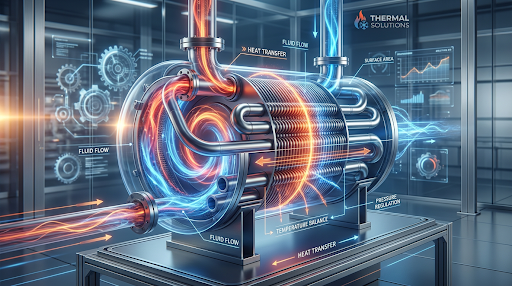
A heat exchanger is a thermal system designed to transfer heat between two fluids without allowing them to mix. It plays a critical role in industrial cooling, heating, energy recovery, and process efficiency. For engineers, specifying a heat exchanger is not just about achieving a target outlet temperature. It requires balancing:
- Heat Transfer Coefficient (U)
- Pressure Drop (ΔP)
- Log Mean Temperature Difference (LMTD)
- Fouling Factors
- Mechanical design standards (TEMA, ASME, API)
When these elements are precisely defined, the result is a high-efficiency system that performs reliably for years. When they are not, the outcome is wasted energy, high maintenance costs, and premature failure.
Why Heat Exchanger Specifications Matter
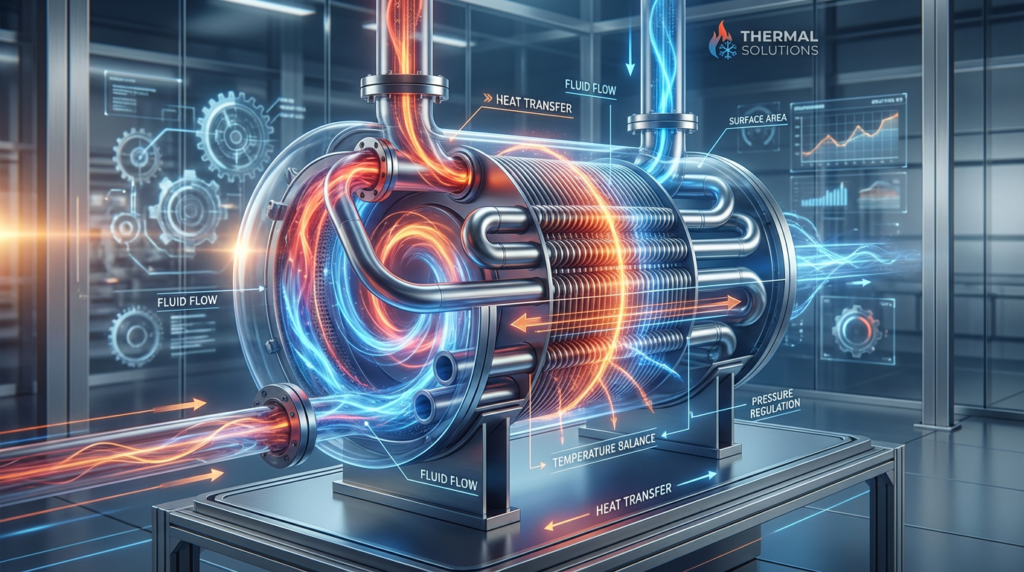
Heat exchangers are essential in:
- Oil & gas processing
- Chemical manufacturing
- HVAC systems
- Power plants
- Food and beverage production
However, efficiency depends entirely on correct design and specification. A poorly specified heat exchanger can lead to:
- Oversized equipment
- Excessive pressure drop
- Pump overloading
- Increased fouling
- Higher energy consumption
- Reduced lifecycle performance
Precision is not optional. It is the difference between long-term reliability and recurring operational problems.
The Physics Behind Every Heat Exchanger
Heat naturally moves from hot to cold this is dictated by the Second Law of Thermodynamics. A heat exchanger simply accelerates this natural process by maximizing surface area between two fluids. But effective thermal management is not just about moving heat. It is about moving heat:
- Efficiently
- With minimal pressure loss
- Under real-world fouling conditions
- Across years of operation
Engineers must design not only for today’s clean fluid conditions but also for the scaling, corrosion, and deposits that occur over time.
Key Heat Exchanger Specifications Every Engineer Must Define
When creating a heat exchanger specification sheet, clarity is critical. Below are the five essential design parameters manufacturers need.
1. Log Mean Temperature Difference (LMTD)
LMTD is the driving force of heat transfer. It represents the effective temperature difference between the hot and cold fluids across the exchanger.
- A low LMTD requires a larger surface area.
- Larger surface area increases size and cost.
- Incorrect LMTD assumptions lead to inefficient designs.
Proper LMTD calculation ensures optimal performance without unnecessary oversizing.
2. Allowable Pressure Drop (ΔP)
Pressure drop is the energy cost of heat transfer. Higher turbulence improves heat transfer performance. However, it also increases:
- Pumping power requirements
- Operating costs
- Mechanical stress
The goal is balance maximize heat transfer without overloading pumps. Think of ΔP as the “energy tax” of thermal efficiency.
3. Fouling Factor
No industrial fluid is perfectly clean. Over time, deposits build up on heat transfer surfaces, reducing performance. The fouling factor accounts for this degradation. Underestimating fouling leads to:
- Performance loss
- Frequent shutdowns
- Cleaning costs
Overestimating fouling leads to:
- Oversized equipment
- Lower velocities
- Increased future fouling
A properly calculated fouling margin ensures durability without sacrificing efficiency.
4. Flow Arrangement
Flow configuration significantly impacts performance.
Counter-Current Flow (Preferred)
In counter-current flow, fluids move in opposite directions. This configuration:
- Maximizes temperature difference
- Improves thermal efficiency
- Enables temperature cross
What Is Temperature Cross?
A temperature cross occurs when the cold outlet temperature exceeds the hot outlet temperature. This is only achievable in counter-current systems and indicates high heat recovery efficiency. For applications demanding maximum energy recovery, counter-current flow is the gold standard.
5. Material of Construction (MOC)
Performance means nothing if corrosion destroys the unit. The material of construction must match:
- Fluid chemistry
- Temperature range
- Pressure conditions
- Corrosion potential
Common materials include:
- Stainless Steel
- Titanium
- Hastelloy
- Carbon Steel (where applicable)
Selecting the correct material ensures long service life and lower lifecycle costs.
Essential Mechanical Standards for Heat Exchangers
A heat exchanger is also a pressure vessel. Mechanical integrity is non-negotiable. Engineers must specify relevant industry codes to ensure safety and durability.
TEMA Classification

The Tubular Exchanger Manufacturers Association (TEMA) defines construction standards.
- TEMA Class R – Heavy-duty refinery and petroleum service
- TEMA Class C – General commercial applications
- TEMA Class B – Chemical processing
For demanding environments, Class R is typically required.
ASME Section VIII
ASME Section VIII certification ensures the heat exchanger meets pressure vessel design standards and can withstand:
- Pressure spikes
- Thermal stress
- Operational shocks
This is critical in high-pressure plants.
API 660
API 660 applies specifically to shell-and-tube heat exchangers in refinery services. It prioritizes:
- Safety
- Reliability
- Severe operating conditions
For refinery applications, API compliance is essential.
Common Heat Exchanger Design Mistakes
Oversizing “for safety”
Oversizing reduces fluid velocity. Lower velocity reduces the surface “scrubbing” effect, increasing fouling risk. Precision design always outperforms excessive margins.
Ignoring Fluid Viscosity
High-viscosity fluids (oils, resins, polymers) create thick boundary layers that act as insulation. Solutions may include:
- Increased turbulence
- Specialized plate geometry
- Enhanced surface design
Viscosity must be specified accurately for proper performance.
How to Optimize Heat Exchanger Performance
A high-performance heat exchanger balances:
- Thermal efficiency
- Pressure drop
- Fouling resistance
- Mechanical integrity
- Lifecycle cost
At Glacient, we design tailored heat exchanger solutions based on precise operating conditions not assumptions. If you want a system optimized for long-term reliability and maximum energy efficiency, our engineering team can help.
Contact us today to review your specifications and improve your thermal performance.
FAQs
A temperature cross occurs when the cold outlet temperature exceeds the hot outlet temperature. It indicates highly efficient heat transfer and is typically achieved using counter-current flow.
No. Oversizing reduces fluid velocity and increases fouling risk. Accurate engineering is more effective than excessive margins.
High-viscosity fluids create insulating boundary layers, reducing heat transfer efficiency. Designs must increase turbulence or modify surface geometry to compensate.
Read More:- Latest Tech News
