

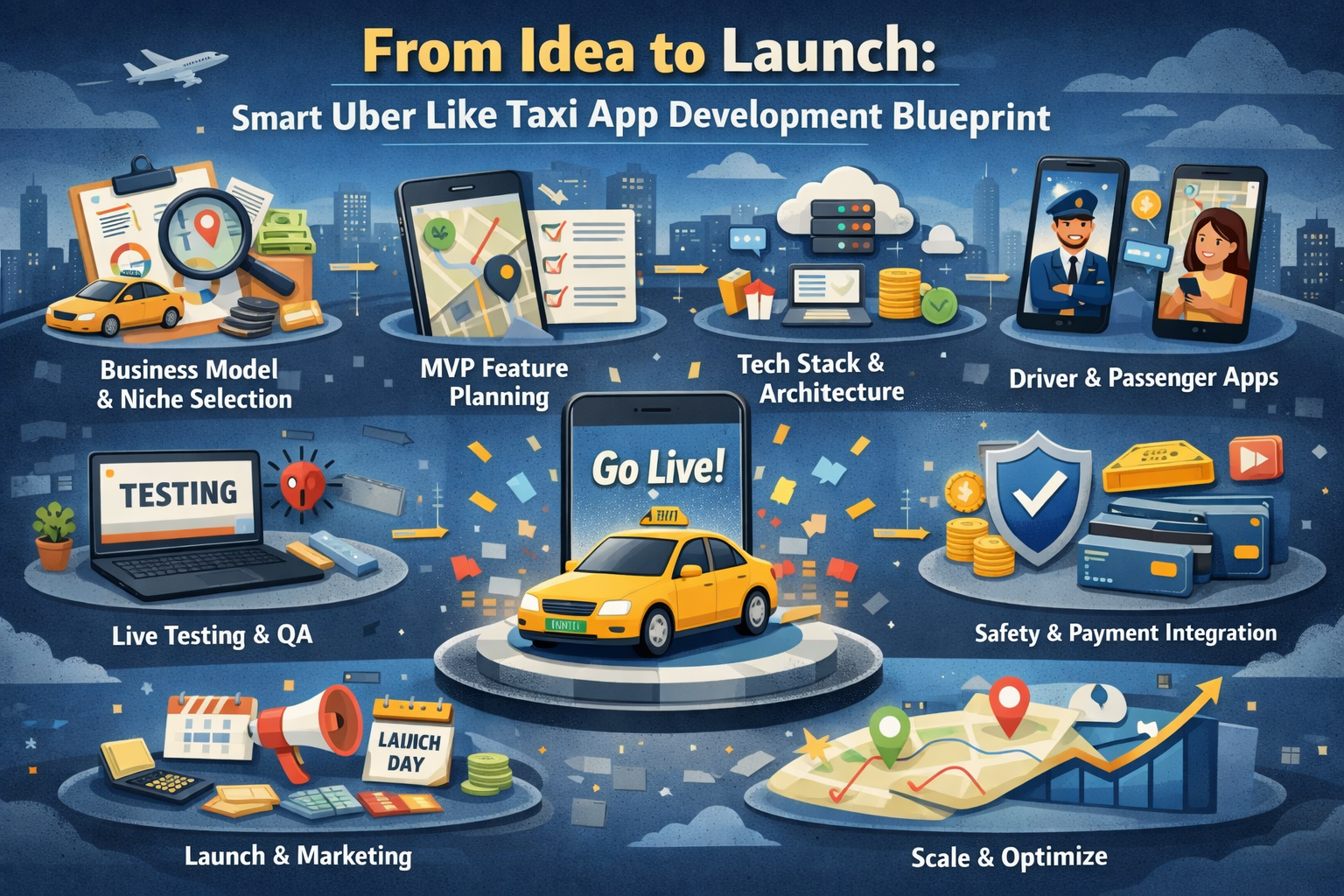
Building an Uber like taxi app is no longer just a “startup dream.” It’s a real, scalable business model that works for local city taxi operators, ride-hailing startups, corporate transport providers, airport transfer businesses, and even niche services like women-only rides or electric vehicle fleets.
However, the difference between a successful taxi platform and a failed one is not only about “having an app.” It’s about planning the right features, choosing the correct tech stack, designing for real-world operations, and launching with a blueprint that avoids expensive mistakes.
This guide walks you through the full lifecycle, from idea validation to launch and scaling.
Step 1: Define the Real Business Model Before You Write a Single Line of Code
Most people start taxi app development by talking about features. But features only matter after you lock the business model. A taxi app can be built in many ways, and each one requires different logic, workflows, and backend rules.
Common Uber like taxi app business models that actually work
A taxi app is not “one product.” It can be any of these models:
Aggregator ride-hailing model
You connect riders with drivers who use their own vehicles. You earn commission per ride.
Fleet owner model
You own vehicles and drivers, and you manage operations centrally. This is common for local taxi businesses upgrading to digital.
Hybrid model
You have your own fleet plus onboarded independent drivers. This is often the best model for early-stage scaling.
Dispatch-based model (local taxi)
A dispatcher assigns rides manually or semi-automatically. This is ideal for small cities where drivers prefer dispatch.
Corporate and subscription rides model
You sell ride packages to companies, schools, hospitals, or hotels. The app supports scheduled rides and monthly billing.
How your business model affects development decisions
Your model decides critical things like:
- Whether drivers need document verification
- Whether vehicle management is required
- Whether dispatch panel is mandatory
- Whether you need wallet, cash, or invoice billing
- Whether ride pricing is dynamic or fixed
- Whether you need multi-city expansion controls
If you skip this step, you will rebuild the app later at a high cost.
Step 2: Identify Your Target Niche and Winning Differentiator
The ride-hailing market is competitive. A generic Uber clone with no differentiation is hard to grow. Your goal is not to copy Uber, but to build a smarter Uber like taxi app that fits your market.
Strong niche ideas for taxi app startups in 2026
Some of the most scalable niches include:
- Airport transfers with fixed pricing
- EV-only taxi service
- Women-only ride service with enhanced safety features
- Luxury rides with chauffeur-style experience
- Local city taxi service with scheduled rides and phone booking support
- Intercity rides and outstation travel
- Medical and senior transport services
- Delivery + ride hybrid model (multi-service)
Differentiators that matter more than discounts
Discounts are not a long-term strategy. Strong differentiators include:
- Faster driver matching using smart dispatch logic
- Better driver onboarding and retention tools
- Safety and trust-first UI
- Transparent pricing with zero surprise charges
- Subscription plans for frequent riders
- Better support and dispute resolution
A winning taxi platform feels reliable, not cheap.
Step 3: Plan the Complete Taxi App Ecosystem (Not Just One App)
A professional Uber like taxi app is never a single app. It is an ecosystem of multiple products that work together.
The essential modules you must plan
A complete blueprint includes:
Passenger app
Used by riders to book rides, pay, track driver, and manage trips.
Driver app
Used by drivers to accept rides, navigate, manage earnings, and receive notifications.
Admin panel
Used by business owners to manage users, drivers, pricing, disputes, promotions, and analytics.
Dispatcher panel (optional but powerful)
Used by operations teams to manually assign rides, handle phone bookings, and resolve real-time issues.
Customer support panel (optional)
Used by support teams to handle tickets, refunds, and ride issues.
When startups skip modules like dispatcher and support, they end up struggling with day-to-day operations after launch.
Step 4: Decide the Right Feature Set for MVP vs Full Product
One of the biggest mistakes in taxi app development is trying to build everything in the first version. A smarter approach is to build an MVP that is launch-ready and expandable.
What a real MVP for an Uber like taxi app should include
An MVP should not be “basic.” It should be operationally complete.
Passenger MVP features
- Phone number OTP login
- Location selection (pickup and drop)
- Map view and live tracking
- Fare estimation
- Ride booking and driver matching
- Trip status updates
- Payment (cash + one online method)
- Trip history
- Ratings and reviews
- In-app support or help center
Driver MVP features
- Driver registration
- Document upload
- Vehicle details
- Online/offline toggle
- Ride request accept/reject
- Navigation integration
- Earnings summary
- Trip history
- Basic support access
Admin MVP features
- Driver approval and verification
- Ride monitoring
- Fare configuration
- Commission settings
- User management
- Promo code management
- Basic reporting
Features you should delay to Phase 2
- Loyalty programs
- Multi-stop rides
- Advanced fraud detection
- Subscription plans
- Driver incentives engine
- Heatmaps and demand prediction
- AI-based support chatbot
- Multi-language expansions
- Multi-country compliance
A strong MVP launches fast, collects real user data, and avoids wasting budget.
Step 5: Create a Smart User Experience That Reduces Booking Friction
A taxi app lives or dies by how quickly a user can book a ride. Your UI should reduce cognitive load, minimize steps, and create trust.
UX principles that matter in taxi app development
- The booking flow must be completed in under 20 seconds
- Users should always know what happens next
- The fare and ETA must be visible before confirming
- Cancellation policies must be clear
- Driver details and vehicle details must be easy to find
- The app must work well on low-end devices
High-converting booking flow structure
A strong booking flow is usually:
- Confirm pickup location
- Select destination
- Choose ride type
- See fare estimate and ETA
- Confirm ride
- Track driver
- Ride completion and rating
Every extra screen reduces conversions.
Step 6: Build a Pricing and Commission System That Works in the Real World
Pricing is one of the most complex parts of Uber like taxi app development. Many startups copy Uber pricing without adapting it to local market behavior.
Common pricing models in ride-hailing apps
- Distance + time pricing
- Base fare + per km pricing
- Fixed zone-based pricing
- Airport fixed pricing
- Surge pricing based on demand
- Subscription pricing (monthly ride packs)
What you must include in pricing logic
A real-world pricing engine must support:
- Minimum fare
- Waiting charges
- Night charges
- Cancellation fees
- Toll handling
- Surge multiplier rules
- Ride-type based pricing
- Driver commission percentage
- Platform fee (optional)
Pricing is not just math. It’s business strategy.
Step 7: Choose the Right Tech Stack for Performance, Scalability, and Cost
Your tech stack determines how fast your app runs, how stable it is, and how expensive it becomes to scale.
Recommended taxi app technology architecture
A modern taxi app is typically built using:
- Mobile apps for rider and driver
- Backend APIs
- Real-time location tracking system
- Database and caching
- Notification system
- Payment integration
- Admin dashboard
- Analytics and monitoring tools
Best mobile development approach
You have two practical options:
Native development (Swift + Kotlin)
Best for performance and long-term scaling, but higher cost and longer timelines.
Cross-platform development (Flutter or React Native)
Best for faster development and cost efficiency while still achieving good performance.
For most startups and taxi businesses, Flutter is often the strongest choice due to UI speed and faster iteration.
Backend technology options
Common and reliable backend stacks include:
- Node.js (fast, real-time friendly)
- Python (great for AI and analytics)
- Java or .NET (enterprise-grade stability)
Databases commonly used in taxi apps
- PostgreSQL (highly recommended for reliability)
- MySQL (also widely used)
- MongoDB (useful for flexible data, but needs careful design)
Real-time features and location tracking
Taxi apps require:
- WebSockets or similar real-time protocol
- Background location updates
- Geo-fencing
- Map services integration
This is why ride-hailing is not the same as building a standard ecommerce app.
Step 8: Design the System Architecture for Live Matching and Dispatch
The core of an Uber like taxi app is not the UI. It is the ride matching system.
What driver matching must handle
A good matching engine must consider:
- Driver distance from pickup
- Driver acceptance rate
- Driver rating
- Driver vehicle type
- Driver online status
- City zone or service area
- Surge demand zones
- Driver fatigue or maximum working hours (optional)
Smart dispatch logic for better ride completion rates
Your dispatch logic should include:
- Auto-assign to nearest driver
- Multi-driver broadcast if the first driver rejects
- Time-limited acceptance window
- Reassignment rules if driver cancels
- Manual dispatch override for support team
This reduces cancellations and improves customer trust.
Step 9: Integrate Maps, Navigation, and Real-Time Tracking Properly
Many taxi apps fail because they treat maps as a simple plugin. Maps and tracking are the backbone of the product.
What maps must support
- Pickup pin placement
- Destination search with autocomplete
- Route preview and distance calculation
- ETA estimation
- Live driver movement tracking
- Driver route navigation
- Multi-stop routing (future phase)
Common map providers
Most taxi apps use:
- Google Maps Platform
- Mapbox (more customizable)
- Apple Maps (iOS-first markets)
Your choice should be based on:
- Pricing per request
- Coverage in your target city/country
- Accuracy of routes and ETAs
Step 10: Build a Payment System That Supports Local Customer Behavior
Payments are not just about Stripe integration. Taxi customers behave differently by region.
Essential payment methods for taxi apps
- Cash payments (still crucial in many markets)
- Card payments
- Wallet payments
- UPI or local payment gateways (depending on region)
- Corporate invoicing (for business clients)
Payment features you should include early
- Fare breakdown transparency
- Refund workflow
- Promo code discounts
- Driver payout reports
- Admin commission tracking
Why a wallet system is useful
A wallet improves retention because it:
- Makes repeat booking faster
- Enables refunds without bank delays
- Supports loyalty points and cashback later
However, wallet systems require stronger compliance and ledger tracking, so they must be implemented carefully.
Step 11: Implement Safety Features That Increase Trust and Reduce Risk
Safety is no longer optional. It is a core expectation.
Safety features passengers expect in 2026
- Driver profile verification
- Vehicle details before pickup
- Ride sharing link
- SOS button
- Emergency contact
- Trip recording and tracking logs
- Live location sharing
- Driver rating and reporting system
Safety features that protect drivers too
Drivers also face risks. Smart taxi platforms include:
- Rider verification (phone OTP, optional ID)
- Cash ride limits
- Flagged user alerts
- Driver emergency button
- Trip history visibility
When both sides feel protected, the platform grows faster.
Step 12: Create a Strong Driver Onboarding and Retention System
Your taxi business is not built on users alone. Drivers are your supply engine. If drivers churn, your app fails.
A smooth driver onboarding system should include
- Simple registration
- Document upload
- Vehicle verification
- Background check workflow (optional)
- Training content or onboarding tips
- Fast approval timeline
- Transparent commission rules
Driver retention features that increase supply
- Daily earnings visibility
- Weekly payout summaries
- Incentive campaigns (phase 2)
- Heatmap of demand areas
- Low cancellation penalties with fair rules
- Support access inside the driver app
If your driver app feels confusing or unfair, you will constantly struggle with driver shortages.
Step 13: Build an Admin Panel That Actually Helps You Run the Business
Many taxi startups build a basic admin panel and later realize it cannot handle real operations.
Core admin panel functions for taxi app success
- Driver approvals and verification
- Ride monitoring and live ride view
- Fare and pricing rule management
- Commission and payout management
- Promo code and referral management
- Dispute management
- Refund and cancellation management
- User and driver blocking tools
- Reports and analytics
Advanced admin controls for scaling
- Multi-city expansion settings
- Zone-based pricing
- Driver segmentation
- Automated fraud alerts
- Role-based access control for staff
Your admin panel is your business control room.
Step 14: Ensure Your Taxi App Is Legally and Operationally Compliant
Compliance varies by country, state, and city. You must plan this early, not after launch.
Common compliance requirements
Depending on your market, you may need:
- Driver background checks
- Vehicle inspection records
- Local transport authority registration
- Tax and invoice requirements
- Data privacy compliance (GDPR, CCPA, etc.)
- Payment compliance (PCI DSS)
- Insurance coverage requirements
Operational policies you must define
- Cancellation rules
- Refund policies
- Driver payout schedule
- Customer support response time
- Dispute resolution workflow
These policies must be built into the app logic and admin tools.
Step 15: Testing Strategy for a Ride-Hailing App (What Most Teams Underestimate)
Taxi apps have more edge cases than most industries because real-world behavior is unpredictable.
Critical testing areas
- Location accuracy in different environments
- Background GPS tracking stability
- Network switching (Wi-Fi to mobile data)
- Battery consumption
- Driver matching correctness
- Payment success and failure flows
- Cancellation and refund scenarios
- Notifications delivery delays
- Peak-hour surge pricing stability
Types of testing you should include
- Manual QA testing for user flows
- Automated testing for critical modules
- Load testing for peak demand
- Security testing for payments and data
- Real device testing on low-end Android phones
If you skip load testing, your launch day can become your biggest failure.
Step 16: Launch Strategy: How to Go Live Without Losing Money
Launching a taxi app is not the same as publishing an app to the App Store and Play Store. Launch is an operational event.
A practical pre-launch checklist
- Onboard at least 50–200 drivers (depending on city size)
- Run internal test rides daily for 2–3 weeks
- Finalize pricing and commission rules
- Train drivers on app usage
- Set up customer support workflow
- Prepare cancellation and refund policies
- Create marketing landing pages and referral offers
- Monitor live tracking and matching performance
Soft launch vs full launch
A soft launch is strongly recommended. You launch in:
- One city zone
- One small city
- One airport route
- One niche segment
Then expand once operations are stable.
Step 17: Post-Launch Growth: Scaling Your Uber Like Taxi App the Smart Way
After launch, the real work begins. The best taxi apps are built with continuous improvement.
Growth levers that work for taxi apps
- Referral program for riders
- Driver referral bonuses
- Corporate ride partnerships
- Airport and hotel partnerships
- Subscription ride packs
- Local SEO + Google Business optimization
- Paid ads with strong targeting
- Partnerships with local events and venues
Product improvements that increase retention
- Faster matching and reduced ETAs
- Better customer support
- Transparent pricing
- Cleaner UI and fewer steps
- Smarter driver incentives (phase 2)
- Better dispute handling
Retention is cheaper than acquisition, especially in ride-hailing.
Step 18: Cost Breakdown and Timeline for Taxi App Development
Taxi app cost depends heavily on:
- Feature scope
- Platform choice (Android, iOS, or both)
- Native vs cross-platform
- Admin and dispatcher requirements
- Third-party API usage (maps, SMS, payment)
- Compliance and security requirements
Typical development timeline ranges
- MVP version: 8–14 weeks
- Full-featured version: 4–7 months
- Enterprise multi-city system: 7–12 months
What drives cost the most
- Real-time location tracking stability
- Matching and dispatch logic
- Admin controls and reporting
- Payment and wallet features
- Security and fraud prevention
- Multi-city pricing complexity
A cheaper build often becomes expensive later due to rebuilding.
Step 19: Common Mistakes to Avoid When Building an Uber Like Taxi App
Even strong teams make mistakes in taxi app development. Avoid these to protect your budget and timeline.
Building too many features too early
You delay launch and burn cash without validation.
Ignoring driver experience
Drivers leave, and your marketplace collapses.
Weak admin tools
Your operations become manual, slow, and chaotic.
No dispatch panel in local taxi markets
Many local markets still rely on dispatch workflows.
Underestimating maps and tracking complexity
Poor tracking destroys trust immediately.
Launching without enough drivers
Users uninstall after 1–2 failed booking attempts.
No clear policies for cancellation and refunds
This leads to disputes and negative reviews.
Conclusion
A smart Uber like taxi app is not built by copying features. It is built by creating a complete ride-hailing ecosystem that works operationally, scales reliably, and matches your local market needs. The most successful taxi platforms start with a clear business model, launch with an operational MVP, build strong driver supply systems, and scale using data-driven improvements. If you follow this blueprint step by step, you dramatically increase your chances of launching a stable, profitable taxi platform instead of an expensive app that struggles after release.
FAQs
How long does it take to build an Uber like taxi app from idea to launch?
A strong MVP can typically be built and launched in 8 to 14 weeks, depending on the complexity of dispatch, admin controls, and integrations. A full-featured multi-city platform usually takes 4 to 7 months, especially if you include advanced pricing logic, wallet systems, and safety modules.
What is the best technology stack for Uber like taxi app development in 2026?
For most businesses, a modern stack includes Flutter or React Native for mobile apps, Node.js or Python for backend APIs, PostgreSQL for database reliability, and WebSockets for real-time driver tracking and ride status updates. The best stack ultimately depends on your budget, scaling goals, and whether you need enterprise-grade compliance.
Do I need a dispatcher panel for my taxi app?
If your market includes phone bookings, local taxi operations, or corporate transport workflows, a dispatcher panel is highly recommended. It improves ride completion rates, helps resolve real-time issues, and allows your team to assign rides manually when driver matching fails.
What are the must-have features in a taxi app MVP?
A real MVP should include passenger booking, driver matching, live tracking, ride status updates, payments (cash and at least one online method), trip history, ratings, driver onboarding with document upload, and an admin panel for approvals, pricing, and ride monitoring.
How do taxi apps make money after launch?
Taxi apps commonly earn through commission per ride, platform service fees, subscription plans, corporate ride contracts, advertising placements, and partnerships. Some platforms also generate revenue through premium ride categories like luxury vehicles or airport transfers.
What is the biggest challenge in Uber like taxi app development?
The most difficult part is building a stable real-time system that handles location tracking, driver matching, dispatch logic, payments, cancellations, and peak-hour load without failures. Operational readiness is also a major challenge, especially onboarding enough drivers before launch.
Can I launch an Uber like taxi app in one city and expand later?
Yes, and it is one of the smartest strategies. A city-first launch allows you to validate pricing, demand patterns, driver onboarding workflows, and customer support operations before expanding into additional cities or service zones.
How can I reduce cancellations and improve ride completion rates?
You can reduce cancellations by improving matching accuracy, showing transparent fare and ETA, implementing driver penalties fairly, enabling multi-driver broadcast logic, adding scheduled rides, and improving driver onboarding and retention. Strong support workflows also help resolve issues before they turn into cancellations.
