

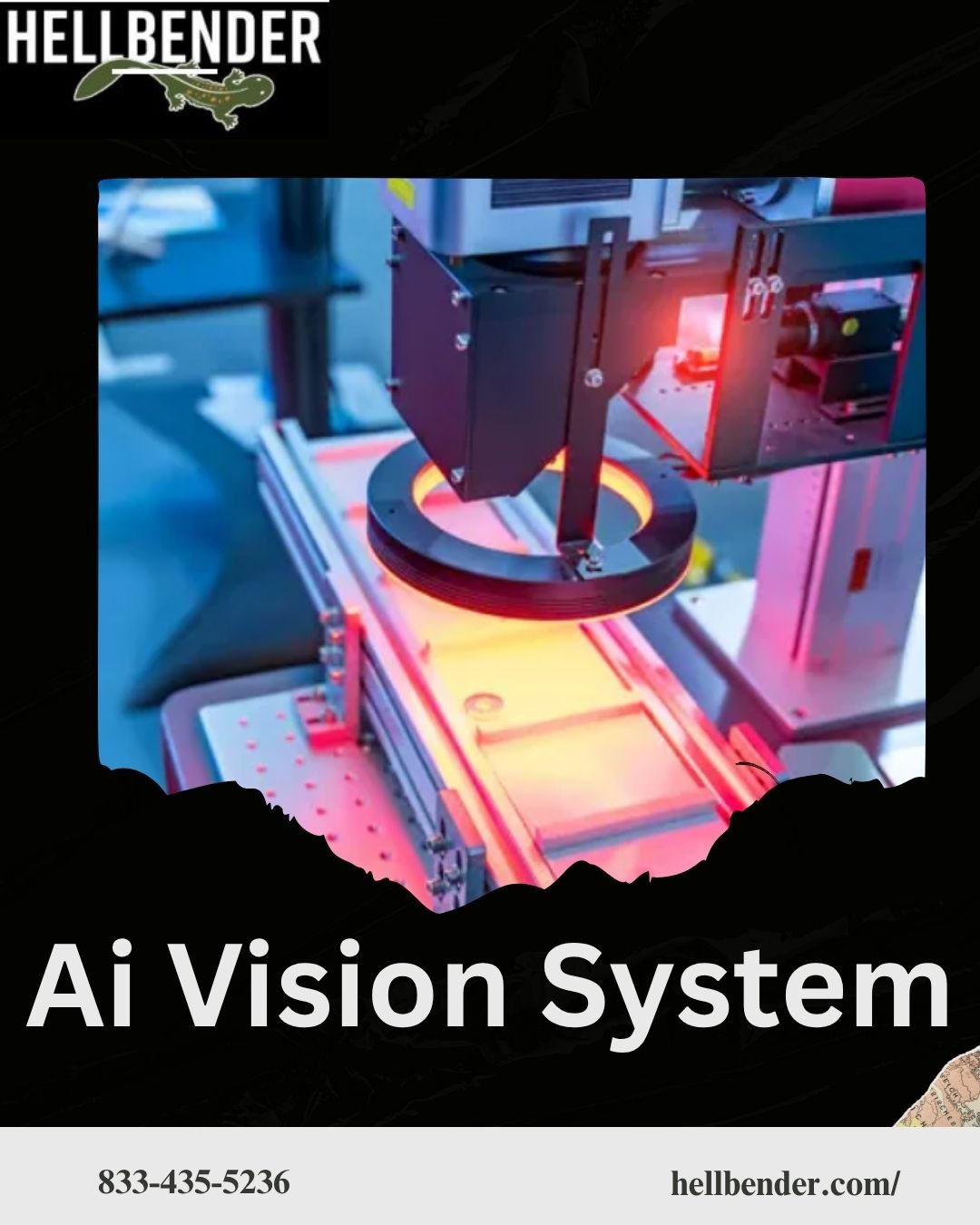
Manufacturing has always been a proving ground for the latest in automation and precision engineering. But today, a new wave of technology is fundamentally transforming how factories see, learn, and adapt. Generative AI — the same technology behind next-generation language and image models — is being integrated into AI computer vision systems, creating a new class of intelligent sensing that is smarter, faster, and far more capable than anything that came before.
This isn’t incremental improvement. It’s a paradigm shift. Production lines that once required human inspectors for quality control can now be monitored continuously by an AI camera system that not only detects anomalies but learns to anticipate them. And platforms like Hellbender are at the forefront, offering purpose-built computer vision AI platforms designed specifically for the demands of modern manufacturing environments.
What Is Generative AI’s Role in Industrial Vision?
Beyond Traditional Machine Vision
Traditional machine vision systems operate on rigid rule sets — they identify defects only when they match pre-programmed patterns. The moment a new product variant or an unforeseen type of defect enters the picture, these systems struggle. Generative AI changes this entirely by enabling vision systems to synthesize understanding from limited data, adapting to novel inputs without requiring a complete re-training cycle.
Generative models can produce synthetic training data — simulated images of rare defect types, for example — dramatically accelerating how quickly an AI computer vision system can be trained and deployed. This is especially valuable in high-mix, low-volume environments where gathering thousands of real defect samples is simply not practical.
Key Capabilities Unlocked by Generative AI
- Synthetic data generation — Creating realistic training images of rare defects without waiting for them to occur naturally on the production line
- Anomaly detection at scale — Identifying deviations from normal operating parameters in real time, even for patterns never seen during training
- Contextual scene understanding — Enabling vision systems to interpret complex, multi-component assemblies with near-human contextual awareness
- Adaptive learning loops — Continuously improving model accuracy as new edge cases and production scenarios are encountered
- Natural language interfaces — Allowing engineers to query vision system outputs or configure inspection logic using plain language commands
Core Applications on the Manufacturing Floor
Quality Control and Defect Inspection
The most immediate application of AI-enhanced vision in manufacturing is automated quality inspection. An advanced AI camera system can scan thousands of components per minute, flagging surface defects, dimensional inconsistencies, and assembly errors with sub-millimeter precision. Generative AI amplifies this capability by enabling the vision system to reason about defects in context — distinguishing, for example, between a cosmetic blemish and a structural flaw that could cause field failure.
This level of nuance has historically required skilled human inspectors. Today, manufacturers deploying intelligent machine vision inspection systems are reporting defect escape rates dropping by as much as 90%, while simultaneously increasing throughput.
Industry insight: Manufacturers integrating generative AI into their vision pipelines are seeing inspection cycle times reduced by 60–80%, with simultaneous improvements in first-pass yield and reduction in false-positive rejection rates.
Predictive Maintenance and Asset Monitoring
Beyond product inspection, AI vision systems are increasingly being applied to equipment health monitoring. By continuously observing machinery for subtle visual indicators of wear — unusual vibration signatures captured on high-speed cameras, thermal anomalies, early-stage surface degradation — a computer vision AI platform can predict failures days or weeks before they occur.
Generative AI enhances this by constructing predictive models that draw on both visual data and operational context, giving maintenance teams not just alerts but actionable, prioritized recommendations. This transforms maintenance from a reactive cost center into a proactive competitive advantage.
Process Optimization and Assembly Guidance
Modern assembly lines are complex, high-variability environments. Generative AI-powered vision systems can provide real-time automated visual inspection of assembly sequences, detecting out-of-order steps, missing components, or incorrect orientations the instant they occur. Some systems can also deliver augmented reality guidance directly to assembly workers, overlaying step-by-step instructions that adapt dynamically based on what the camera sees.
Why a Purpose-Built Computer Vision AI Platform Matters
Not all vision AI is created equal. General-purpose computer vision tools built for web or consumer applications often fall short of the demands of industrial environments — where lighting conditions are harsh, throughput requirements are extreme, and the cost of a missed defect or false positive can cascade across an entire supply chain.
A dedicated computer vision AI platform built for manufacturing brings several critical advantages:
- Edge deployment capability — Processing data on-site rather than in the cloud, reducing latency and keeping sensitive production data secure
- Integration with existing MES and ERP systems — Feeding inspection data directly into manufacturing execution systems for closed-loop quality control
- Industrial-grade camera compatibility — Support for line-scan, hyperspectral, thermal, and 3D imaging modalities beyond standard RGB
- Explainability and audit trails — Providing traceable records of every inspection decision for regulatory compliance and continuous improvement
- Rapid model deployment — Getting new inspection models into production in days, not months, with minimal labeled data requirements
Platforms like Hellbender are purpose–designed to address these industrial requirements, combining the latest generative AI capabilities with robust deployment infrastructure built for the realities of factory-floor operation.
The Road Ahead: Autonomous Visual Intelligence
The convergence of generative AI and industrial vision is still early, but the trajectory is clear. The next generation of AI camera systems will not simply report what they see — they will reason about it, predict consequences, and take autonomous corrective action, all within the time constraints of a live production line.
Manufacturers who invest now in intelligent vision infrastructure — choosing platforms that are built to evolve alongside the rapid advances in generative AI — will be best positioned to capture the full productivity and quality benefits this technology promises. The factories of tomorrow will be defined not just by their machines, but by how well those machines can see.
Conclusion
Generative AI is not a distant future for manufacturing vision — it is an operational reality today. From synthetic data generation that solves the cold-start problem in defect detection, to adaptive anomaly recognition that handles the unexpected, the integration of generative AI into AI computer vision systems is delivering measurable gains in quality, uptime, and efficiency.
For manufacturers seeking to stay ahead, the imperative is clear: invest in a purpose-built computer vision AI platform that can harness these capabilities at scale. Explore what the latest AI vision technology can do for your operation at hellbender.com.
