

Digital transformation is no longer a long-term initiative—it has become a continuous business requirement. Companies today are expected to launch digital products faster, test ideas quickly, and improve customer experience without being slowed down by long development cycles or heavy engineering dependencies.
This shift has led to a major rise in visual development and no-code tools that allow businesses to build applications without traditional programming. These platforms are now being widely adopted by startups, enterprises, and even established product teams looking to innovate faster.
Instead of relying entirely on software engineers, teams can now use intuitive interfaces, drag-and-drop builders, and automated workflows to create fully functional applications.
Why Businesses Are Moving Toward Visual Development
Modern businesses operate in highly competitive environments where speed and adaptability are critical. Traditional software development, while powerful, often involves long planning cycles, multiple dependencies, and higher costs.
Visual development platforms solve several key challenges:
Faster experimentation
Businesses can validate product ideas in days instead of months. This is especially useful for startups testing market fit.
Reduced technical bottlenecks
Product managers, designers, and operations teams can actively contribute to app creation without waiting for engineering bandwidth.
Lower operational costs
Reducing dependency on large development teams helps optimize budgets, especially for early-stage companies.
Faster iteration cycles
Feedback from users can be implemented quickly without long redevelopment timelines.
These benefits are driving widespread adoption across industries such as retail, logistics, healthcare, education, and financial services.
How No-Code Platforms Fit into Modern Business Strategy
No-code platforms are no longer limited to simple prototypes. They are now part of broader digital transformation strategies.
Businesses typically use them in three key stages:
1. Idea validation and MVP development
Companies use no-code tools to quickly build and test minimum viable products. This helps determine whether a concept is worth scaling before investing heavily in custom development.
2. Internal digitalization
Many organizations use these platforms to build internal tools such as dashboards, reporting systems, HR portals, and workflow automation tools.
3. Customer-facing applications
With improvements in scalability and integrations, many companies now use no-code platforms for full-scale applications such as marketplaces, booking systems, and SaaS products.
This layered approach allows businesses to innovate at different speeds depending on complexity and risk.
Key Platforms Leading the Market in 2026
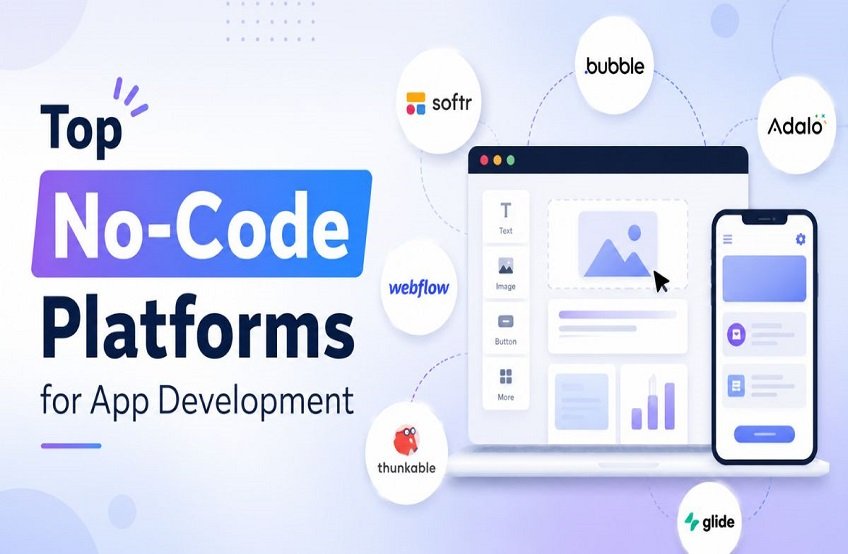
Several platforms have emerged as reliable options for building applications without traditional coding. Each serves different business needs.
Bubble
Bubble is widely used for building complex web applications. It provides strong workflow logic, database handling, and plugin support, making it suitable for SaaS products and marketplaces.
FlutterFlow
FlutterFlow focuses on mobile application development with a strong emphasis on design flexibility and native performance. It is especially popular among teams building cross-platform apps for Android and iOS.
Adalo
Adalo is designed for simplicity. It is often used by startups and non-technical founders who want to quickly create mobile app prototypes and MVPs.
Glide
Glide is known for turning spreadsheets into functional applications. It is widely used for internal tools, operational dashboards, and lightweight business apps.
Webflow
Webflow is a powerful visual development tool for building responsive websites. It is widely used by marketing teams to create high-performance landing pages and brand websites without developer involvement.
SAP Build Apps
SAP’s platform targets enterprise-grade use cases. It is designed for large organizations that need integration with existing systems and strong governance controls.
Business Use Cases Driving Adoption
The flexibility of these platforms has enabled businesses to build a wide range of applications without traditional engineering cycles.
Internal business tools
Companies are building HR management systems, employee dashboards, inventory trackers, and approval workflows using visual tools. This reduces reliance on IT departments for every small change.
Customer engagement platforms
Businesses are creating customer portals, loyalty apps, and service booking systems to improve user experience.
Marketplaces and platforms
Startups are using no-code tools to build multi-vendor marketplaces where users can list, browse, and purchase services or products.
Automation systems
From lead tracking to email automation, companies are building workflows that reduce manual operations and improve efficiency.
Data-driven dashboards
Organizations are consolidating data from multiple sources into centralized dashboards for better decision-making.
These use cases demonstrate how no-code tools are moving beyond simple app building into full-scale business enablement systems.
Comparing No-Code and Traditional Development
While no-code platforms offer speed and accessibility, traditional software development still plays a critical role in complex systems.
A balanced comparison looks like this:
- Speed: No-code wins due to rapid deployment
- Customization: Traditional development offers deeper flexibility
- Cost efficiency: No-code is generally more affordable for early stages
- Scalability: Traditional systems still lead in highly complex architectures
- Maintenance: No-code reduces ongoing maintenance overhead
In practice, many companies now adopt a hybrid model. They use no-code tools for rapid experimentation and internal systems, while relying on traditional engineering for core infrastructure and high-performance applications.
Role of Development Partners in the No-Code Ecosystem
Even though these platforms are designed for non-technical users, many businesses still work with experienced development partners to maximize value.
Modern app development companies and specialized no-code development companies now help businesses with platform selection, integrations, scalability, and production-ready deployments.
For example, companies like Hyperlocal Cloud support businesses in building scalable applications by combining modern development practices with no-code and low-code platforms, ensuring faster delivery without compromising long-term performance and architecture.
- Platform selection based on business needs
- System architecture planning
- API and third-party integrations
- UI/UX optimization for scalability
- Migration from prototype to production-grade systems
This combination of business strategy and technical expertise ensures that applications built on no-code platforms remain scalable and maintainable.
Challenges Businesses Should Be Aware Of
While no-code adoption is growing rapidly, businesses should also understand its limitations:
Platform dependency
Applications are often tied to a specific platform ecosystem, which can create migration challenges later.
Performance constraints
Highly complex applications may face limitations in speed or scalability depending on the platform.
Governance and security
Enterprises must ensure compliance with data security standards when using third-party platforms.
Learning curve
Although simpler than coding, these tools still require time to learn effectively.
Understanding these challenges helps businesses make more informed decisions when adopting no-code solutions.
How to Choose the Right Platform
Selecting the right tool depends on several factors beyond just features.
Define your use case clearly
Different platforms serve different purposes—mobile apps, internal tools, or web applications.
Consider long-term scalability
Even if you’re starting small, the platform should support future growth.
Evaluate integration capabilities
Most modern businesses require connections with CRMs, payment gateways, and APIs.
Check team usability
Ensure that non-technical team members can actively use and maintain the platform.
Review community and ecosystem
A strong support community can significantly reduce development challenges.
The Future of Application Development
The future of software creation is becoming increasingly automated and accessible. With the integration of artificial intelligence, these platforms are evolving into intelligent systems that can generate entire applications based on simple prompts.
We are moving toward a world where:
- Business ideas can be converted into apps instantly
- AI assists in logic creation and UI design
- Deployment becomes fully automated
- Non-technical teams can build enterprise-grade systems
This evolution will significantly reduce the gap between idea and execution, enabling faster innovation cycles across industries.
Final Thoughts
No-code development is fundamentally reshaping how businesses approach software creation. It is no longer limited to prototypes or small-scale projects—it is now a core part of modern digital transformation strategies.
While traditional development remains essential for complex and highly customized systems, visual development platforms are enabling organizations to move faster, reduce costs, and empower more teams to participate in innovation.
As businesses continue to prioritize speed and adaptability, these tools will play an even greater role in shaping the future of application development.
