

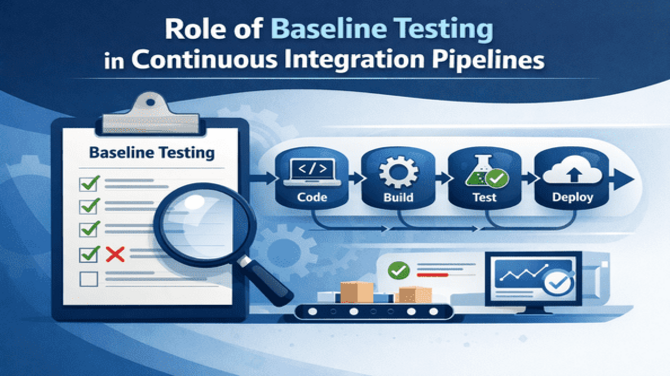
Software teams release updates frequently, but not every change should redefine what “correct” means. Before new features, performance optimizations, or refactoring efforts move forward, teams need a stable reference point. That reference point is established through baseline testing.
Understanding how this works can prevent confusion, reduce regression risk, and improve release confidence across environments.
Understanding the Core Concept
To answer the question what is baseline testing, it helps to think in terms of comparison. Baseline testing is the process of validating an application against a previously approved and stable version. That approved version becomes the benchmark for future changes.
Instead of testing features in isolation, QA teams compare current outputs, system behavior, or performance metrics against an established baseline build. If deviations appear, teams investigate whether they are expected improvements or unintended defects.
This approach is especially valuable in structured QA processes where version control, configuration management, and release validation play a central role.
Why Modern Teams Need Baseline Testing?
Frequent deployments increase the risk of unintended side effects. Even minor updates can impact dependent modules, APIs, or integrations.
Baseline testing helps teams:
- Confirm system stability after updates
- Detect unexpected behavioral changes
- Maintain consistent user experience
- Protect critical workflows
For organizations practicing continuous integration and continuous delivery, having a defined benchmark build ensures that automated test suites compare results against known-good outputs.
Without a baseline, every release becomes harder to evaluate objectively.
Where Baseline Testing Fits in the QA Lifecycle?
Baseline testing typically occurs after a stable build has been approved. Once stakeholders sign off on functionality and performance, that version becomes the reference point.
Future builds are then validated against this approved version during:
- Regression testing cycles
- System testing phases
- Release candidate validation
- Performance benchmarking
When teams ask what is baseline testing in the context of QA workflows, the practical answer is that it is a comparison-based validation method anchored to a trusted build.
It does not replace regression testing, but it complements it by focusing on stability against a known benchmark.
Baseline Testing vs Regression Testing
These two terms are often confused.
Regression testing verifies that new code changes have not broken existing functionality. It focuses on previously tested features.
Baseline testing, by contrast, compares the entire system or specific outputs against an approved baseline version. It checks whether current behavior aligns with the established reference.
For example:
- Regression testing confirms a login feature still works after a database update.
- Baseline testing confirms that the updated system behaves consistently compared to the last approved release.
Regression testing protects functionality. Baseline testing protects consistency.
Types of Baseline Testing
Modern QA teams apply baseline testing in different ways depending on project needs.
Functional Baseline Testing
This ensures that application behavior remains consistent compared to the benchmark build. Automated test cases often compare:
- API responses
- UI rendering
- Business rule outputs
Performance Baseline Testing
Performance benchmarking is one of the most common uses. Teams record response times, throughput, and resource usage from a stable release. Future builds are measured against those metrics.
If response times increase significantly, performance regression is flagged.
Configuration Baseline Testing
In large systems, configuration management is critical. QA teams verify that deployment configurations, environment variables, and infrastructure setups match approved baseline configurations.
This reduces environment-specific defects.
How to Establish a Baseline
Creating a reliable baseline requires discipline.
1. Identify a Stable Build
Select a release candidate that has passed full system testing, user acceptance testing, and security validation. This version becomes the approved reference.
2. Document Key Metrics
Capture measurable indicators such as:
- Functional outputs
- Performance benchmarks
- Error rates
- Resource utilization
These metrics become comparison standards.
3. Automate Comparison
Modern test automation frameworks can compare outputs between builds. Snapshot testing, API response validation, and performance monitoring tools support this process.
Automation ensures consistency and reduces manual effort.
When teams understand what is baseline testing from an operational perspective, they recognize that automation is essential for scalability.
Integrating Baseline Testing in Agile and CI/CD
In agile teams, baseline testing fits naturally into release validation cycles.
After each sprint, if a build is approved, it can serve as the next reference baseline. CI pipelines can:
- Store baseline artifacts
- Run automated comparison tests
- Generate reports highlighting deviations
This structured approach supports faster feedback while maintaining stability.
For teams practicing DevOps, baseline testing strengthens release governance without slowing deployment velocity.
Common Challenges
While baseline testing is powerful, it can introduce complexity if not managed properly.
Outdated Baselines
If teams fail to update the baseline after legitimate improvements, comparison results may produce false alarms.
Excessive Comparisons
Not every change requires full baseline validation. Strategic selection of components reduces overhead.
Lack of Clear Approval Criteria
A baseline must be formally approved. Without defined acceptance criteria, the reference loses credibility.
Clear QA processes and documentation prevent these issues.
When Should You Use Baseline Testing?
Baseline testing is particularly useful in:
- Enterprise systems with strict release controls
- Performance-sensitive applications
- Regulated industries requiring traceability
- Large applications with multiple integration points
If your team regularly asks what is baseline testing and whether it is necessary, consider the risk profile of your application. The more critical the system, the more valuable a defined reference point becomes.
Final Thoughts
Baseline testing provides stability in fast-moving development environments. By comparing current builds against an approved benchmark, QA teams gain objective insight into system consistency and performance trends. It strengthens quality assurance practices, supports regression validation, and enhances release confidence.
In modern software delivery, maintaining a trusted reference build is not just a documentation exercise. It is a structured way to ensure that progress does not unintentionally compromise stability.
