

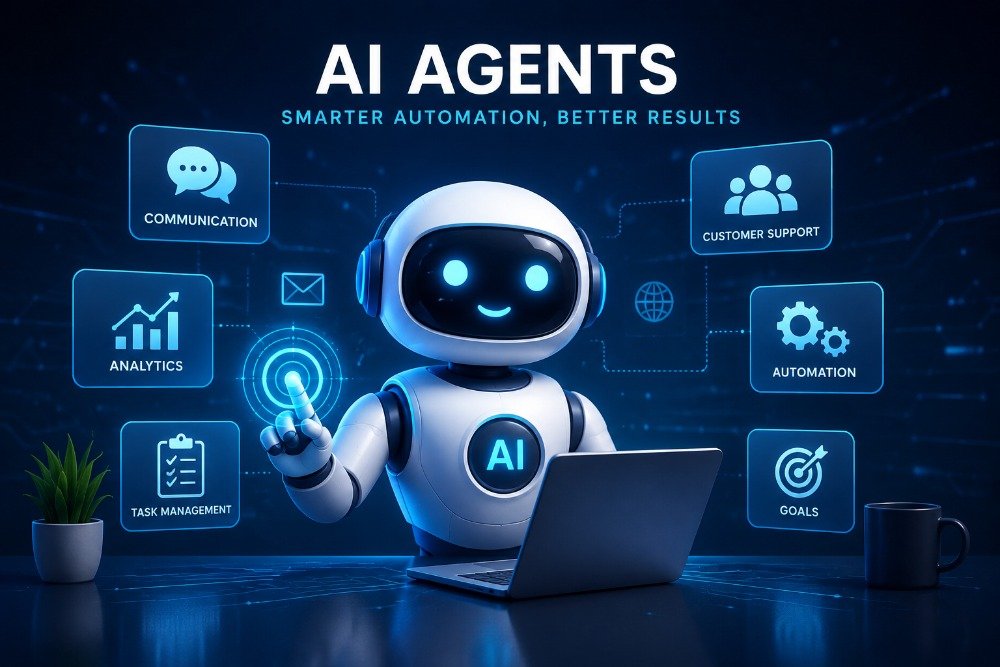
A few years ago, “AI” mostly meant a chatbot that could answer questions or write an email draft. Useful, sure. But it needed you to babysit every step.
That’s not the case anymore.
Walk into almost any company today and you’ll hear people talking about AI agents like they’re just another member of the team. Not a tool you poke at once in a while, but something that actually gets work done on its own. This is really the heart of AI automation: less manual clicking, more tasks that finish themselves while someone focuses on other work. At AtechVibe, we’ve been tracking this shift closely, and it’s clear the way businesses think about “getting help from AI” has fundamentally changed.
So What Changed?
The shift didn’t happen overnight, but 2026 feels like the year it became normal. AI agents can now plan a task, break it into steps, use different apps and tools to complete those steps, and check their own work before handing it back to a human. That’s a big jump from typing a prompt and copying the output into a spreadsheet.
For businesses, this changes the math. Instead of asking “how can AI help me write this faster,” teams are now asking “what can I hand off entirely?” That single question is why AI agents for businesses have moved from a nice-to-have experiment to something leadership teams actively plan around, and it’s a big part of why AI workflow automation keeps coming up in meetings that used to be about hiring more people instead.
Where AI Agents for Businesses Are Making the Biggest Difference
You don’t need to look far to see it happening. Customer support teams are using agents that don’t just answer FAQs they can look up an order, issue a refund, and follow up by email, all without a person clicking a single button. Sales teams are letting agents research leads, draft outreach, and update the CRM automatically, so reps spend more time actually talking to people instead of doing data entry. And operations teams are probably getting the most value out of AI workflow automation, since agents can now handle multi-step processes pulling data from one system, checking it against rules, and pushing it into another the kind of work that used to eat up someone’s entire afternoon.
None of this means humans are out of the picture. It means the boring, repetitive parts of the job are finally getting handled by something that doesn’t get tired or make copy-paste mistakes.
Why AI Automation Feels Different This Time
Plenty of companies tried automation before and got burned. Rigid scripts that broke the moment something changed. Rules that needed a developer every time a process shifted slightly. Old-school AI automation was brittle in a way that made people nervous to rely on it.
AI agents work differently because they can adapt. If a step fails or a website layout changes, a good agent can figure out a new way to get the job done instead of just crashing. That’s a meaningful upgrade over the older style of AI automation, which usually just stopped and waited for a human to fix it.
That flexibility is why so many businesses that avoided automation in the past are giving it another look. It’s less “set it and forget it” and more “set it, and it actually adjusts.”
The Real Advantage: Time Back
Ask any business owner what they’d do with an extra ten hours a week, and you’ll rarely hear “nothing.” That’s really what AI workflow automation is about. It isn’t replacing the need for smart people it’s giving those people room to focus on the parts of the job that actually need a human brain: judgment calls, relationships, creative problem-solving.
The companies leaning into AI agents for businesses right now aren’t doing it because it sounds impressive on a slide deck. They’re doing it because it frees up time that used to disappear into busywork, and that time adds up fast once a few processes are running on their own.
What This Means Going Forward
If 2023 and 2024 were about companies experimenting with AI, 2026 is about companies actually building it into how they run day to day. We’re not talking about some far-off future anymore. Small teams are running agents that handle scheduling, reporting, and follow-ups without anyone thinking twice about it, and the businesses that figure this out early aren’t just saving time they’re rethinking what their teams should even be spending time on in the first place.
Conclusion
AI agents aren’t a trend that’s going to fade out next quarter. They’re becoming a normal part of how companies get things done, quietly picking up the repetitive tasks that used to slow everyone down. Whether it’s AI agents for businesses handling customer replies, AI automation running in the background of daily operations, or AI workflow automation connecting tools that never used to talk to each other, the pattern is the same: less time on busywork, more time on the things that actually need a person’s judgment.
You don’t have to overhaul your entire company to get started either. Most businesses begin with one process something repetitive and rule-based and let an agent take it over before expanding from there. That small first step is usually enough to show what’s possible, and it tends to snowball once people see the time it frees up.
The bigger takeaway isn’t really about the technology itself. It’s that the definition of “work” is quietly shifting, and the companies paying attention now are the ones who’ll be ahead of the curve later. That’s the shift AtechVibe is here to help businesses navigate.
FAQs
What exactly is an AI agent?
An AI agent is a program that can complete a task on its own, from start to finish, instead of just responding to a single prompt. It can plan steps, use different tools or apps, and adjust if something doesn’t go as expected.
How are AI agents for businesses different from regular chatbots?
A chatbot mostly answers questions. An AI agent takes action it can look things up, make changes in a system, send follow-ups, and complete multi-step tasks without someone guiding every move.
Is AI automation only useful for big companies?
Not at all. Small businesses often see faster results because they can automate one specific process, like invoicing or customer follow-ups, without needing a big IT team to set it up.
What kind of tasks work best for AI workflow automation?
Repetitive, rule-based tasks are the easiest place to start things like data entry, scheduling, report generation, or moving information between systems. Anything that follows a clear pattern is a good candidate.
Do AI agents replace human workers?
Not really. They take over the repetitive parts of a job so people can spend more time on things that need judgment, creativity, or a personal touch the parts of work that are harder to hand off.
Is it hard to start using AI agents in a business?
Getting started is usually simpler than people expect. Most companies pick one process, test an agent on it, and expand once they see it working reliably.
