

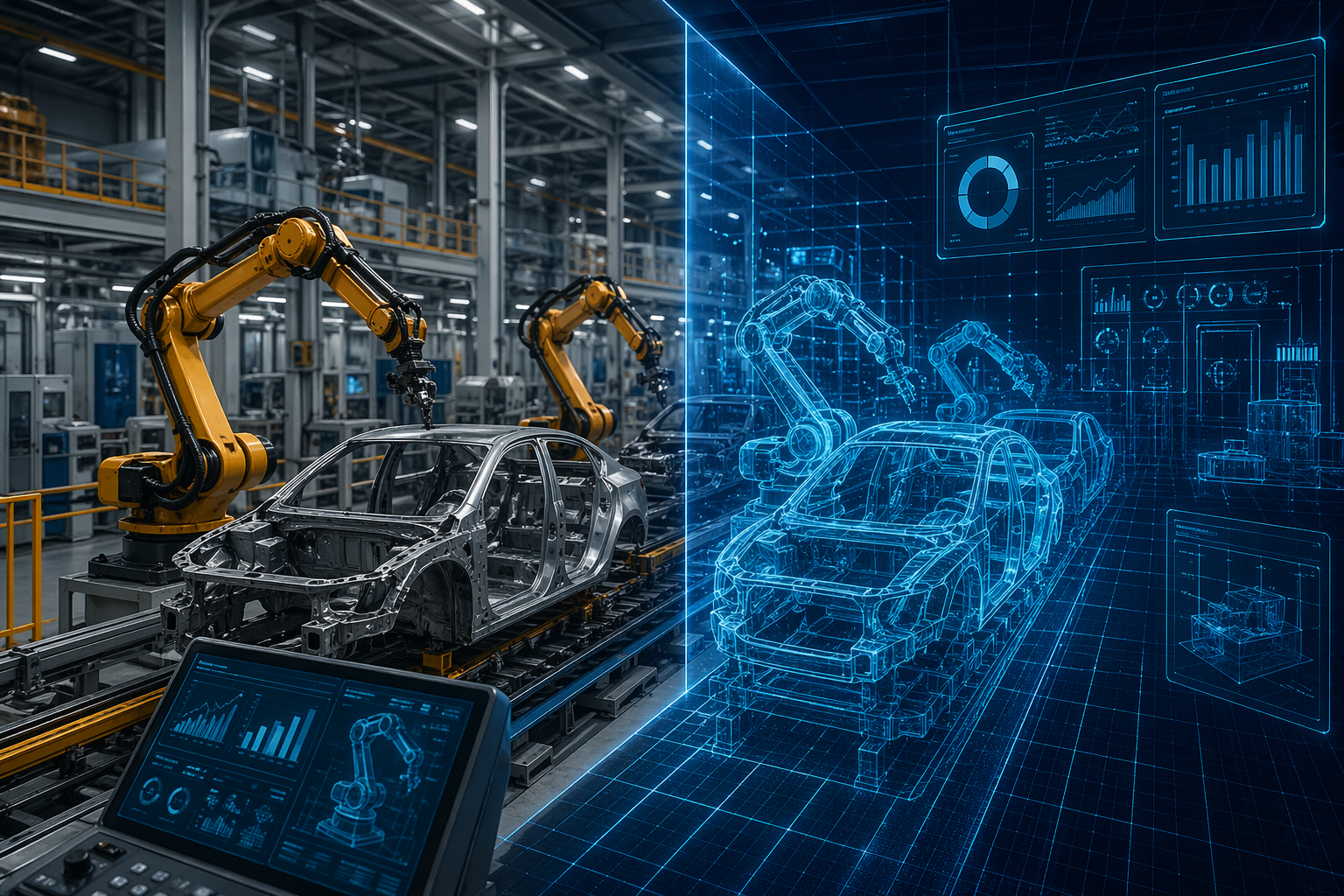
Walk into any modern manufacturing facility and you will notice something different. The machines are still running, the conveyors are still moving, but somewhere in a control room, engineers are watching a live digital replica of the entire factory floor every motor, every sensor, every production line all mirrored in real time on a screen. That replica is a digital twin, and it is quietly becoming one of the most powerful tools in modern manufacturing.
If you have been following trends in industrial technology, you have likely heard the term thrown around. But beyond the buzzword, there is a very real and measurable impact happening on factory floors around the world.
Companies are reporting downtime reductions of up to 40%, and in manufacturing, where a single hour of unplanned downtime can cost hundreds of thousands of dollars, that number is not just impressive it is transformative.
What Is a Digital Twin in Manufacturing?
A digital twin is a virtual model of a physical asset, process, or system that is continuously updated with real-world data. In manufacturing, this means creating a dynamic, data-driven replica of a machine, a production line, or even an entire factory.
It is not a static 3D model or a simple dashboard. It is a living simulation that reflects exactly what is happening on the shop floor at any given moment.
The concept has been around since the early 2000s, but it became practically viable only when the cost of IoT sensors dropped, cloud computing became scalable, and machine learning matured enough to make sense of massive volumes of operational data.
Today, the combination of these technologies has made digital twins accessible not just to aerospace giants like NASA and GE, but to mid-sized manufacturers across industries.
Think of it this way: your factory floor is the physical twin, and its digital counterpart is the virtual twin.
Every time a motor runs hot, a conveyor belt slows by a fraction, or a hydraulic system builds up excess pressure, that data is fed into the digital twin in real time. Engineers can then monitor, analyze, and simulate scenarios without ever touching the physical machine.
Why Downtime Is the Manufacturing Industry’s Biggest Pain Point
Before diving deeper into how digital twins solve the problem, it is worth understanding just how damaging unplanned downtime really is. According to industry research, unplanned downtime costs industrial manufacturers an estimated $50 billion per year globally.
A single hour of downtime on an automotive assembly line can cost upward of $1.3 million. For a mid-sized manufacturer, even a few hours of unexpected equipment failure per month can significantly eat into profit margins and damage customer relationships.
The frustrating reality is that most downtime is preventable. Equipment rarely fails without warning. There are almost always early signals a slight increase in vibration, a gradual rise in operating temperature, a pattern of micro-stoppages that point to an impending failure.
The problem has always been that human operators cannot watch every machine all the time, and traditional monitoring systems are either too basic or too reactive to catch these signals early enough.
This is exactly where digital twins change the game.
How Digital Twins Actively Reduce Manufacturing Downtime
Predictive Maintenance That Actually Predicts
The biggest contributor to the 40% downtime reduction is predictive maintenance. Traditional maintenance schedules are either time-based (service the machine every 90 days regardless of its condition) or reactive (fix it after it breaks).
Both approaches are wasteful in different ways. Time-based maintenance often replaces parts that still have plenty of life left, while reactive maintenance means you are always playing catch-up.
Digital twins enable a third approach: maintaining equipment exactly when it needs it, based on actual performance data. The digital twin continuously analyzes sensor data from the physical machine and compares it against historical performance baselines. When the pattern of data starts diverging from what is normal, the system flags it as a risk and alerts maintenance teams well before a failure occurs.
In practical terms, this means a pump that is showing early signs of bearing wear gets serviced during a planned production window, not during a critical production run.
A compressor that is building up heat abnormally gets inspected before it trips an emergency shutdown. The maintenance becomes surgical rather than reactive or routine.
Real-Time Monitoring Across Every Asset
Another significant advantage of digital twins is full visibility. In a traditional factory, monitoring tends to be siloed certain critical machines have sensors, but many others are running without any real-time visibility.
Digital twins create a unified monitoring environment where every asset, from a small conveyor motor to a large CNC machine, feeds data into a single system.
This level of visibility makes it much easier to spot cascade failures before they happen. Many manufacturing breakdowns are not caused by a single dramatic failure but by a chain of smaller issues that compound over time.
A digital twin can detect these interconnected patterns and alert engineers to upstream problems before they create downstream disruptions.
Simulation and Scenario Testing Without Risk
One underappreciated feature of digital twins is the ability to run simulations on the virtual model without touching the physical system.
Need to test what happens when you increase production speed by 15%? Run it on the digital twin first. Considering a process change that might affect downstream equipment? Simulate the impact before committing.
This is enormously valuable for reducing downtime caused by process changes and reconfigurations. In traditional manufacturing, every major change carries the risk of unplanned stoppages during the adjustment period.
With a digital twin, engineers can validate changes in the virtual environment, iron out problems, and then implement them in the physical facility with much greater confidence.
Faster Root Cause Analysis When Issues Do Occur
Even with the best predictive systems, some level of unplanned downtime is inevitable. When it does happen, the speed of recovery matters enormously. Digital twins compress the time it takes to diagnose a problem by providing a complete historical record of every parameter leading up to the failure.
Instead of manually inspecting multiple systems and working backwards from the failure point, maintenance teams can review the digital twin’s data log and identify the root cause in minutes rather than hours.
This faster root cause analysis means repairs are done correctly the first time, reducing the likelihood of repeat failures and shortening the total duration of each downtime event.
Industries Seeing the Greatest Impact
Digital twins are being deployed across manufacturing sectors, but some industries are seeing particularly strong results.
In automotive manufacturing, digital twins are used to monitor robotic assembly lines, track weld quality in real time, and optimize paint shop environments.
Volkswagen, for example, has implemented digital twins across multiple factories to simulate production processes and reduce both downtime and material waste.
In heavy industry and energy, companies use digital twins of turbines, compressors, and rotating equipment to predict maintenance needs and avoid catastrophic failures. Siemens and GE have both built digital twin platforms specifically designed for these high-stakes industrial assets.
In electronics and semiconductor manufacturing, where production tolerances are extraordinarily tight, digital twins help maintain equipment precision and reduce the risk of quality failures that would require costly reprocessing.
For a broader look at the numbers backing all of this up, the data around adoption rates and ROI is compelling. You can explore a comprehensive set of Digital Twin Statistics that captures how the technology is being adopted across industries and what organizations are reporting in terms of measurable outcomes.
What It Takes to Implement a Digital Twin in a Manufacturing Environment
Knowing the benefits is one thing. Actually implementing a digital twin is another. Companies that have succeeded with digital twin projects share a few common practices.
Start With a Specific Problem, Not the Entire Factory
The most common mistake manufacturers make is trying to digitally twin everything at once. The more effective approach is to identify a specific bottleneck or high-risk asset and build a digital twin around that first.
Maybe it is your highest-throughput production line, or a critical piece of equipment with a history of unpredictable failures. Starting focused allows you to prove value quickly, build internal expertise, and then scale methodically.
Invest in the Right Sensor Infrastructure
A digital twin is only as good as the data it receives. This means having the right IoT sensors installed on physical assets and ensuring that data is transmitted reliably and at the right frequency. For some applications, a reading every minute is sufficient.
For others, you need millisecond-level data to capture fast-moving processes accurately. Working with experienced partners to design the sensor architecture upfront saves significant headaches down the line.
Integrate with Existing Systems
Digital twins do not exist in isolation. They need to connect with your existing systems ERP, SCADA, CMMS, MES to provide truly actionable insights.
For example, when a digital twin flags a predictive maintenance alert, the ideal workflow involves that alert automatically triggering a work order in your maintenance management system.
Without these integrations, the digital twin becomes an isolated tool rather than a core part of your operational infrastructure.
Choose the Right Technology Partner
The technology stack behind a digital twin the IoT platform, the data pipeline, the simulation engine, the analytics layer is complex and evolving rapidly.
Most manufacturers do not have the internal expertise to build all of this from scratch, which is why working with a specialized Digital Twin Service provider is often the faster and more cost-effective path.
The right partner brings domain expertise, proven frameworks, and the ability to customize the solution to your specific operational context.
The Bigger Picture: Digital Twins as the Foundation of the Smart Factory
Reducing downtime by 40% is a compelling headline, but digital twins are part of a much larger shift in how manufacturing works.
The smart factory or Industry 4.0 vision is built on the idea that every physical process has a digital counterpart that can be monitored, analyzed, and optimized continuously. Digital twins are the connective tissue that makes this vision real.
As the technology matures, the capabilities expand. Digital twins are increasingly being combined with AI and machine learning to move beyond predictive maintenance into truly autonomous optimization systems that not only predict problems but automatically adjust operating parameters to prevent them.
They are being used to model supply chain disruptions, optimize energy consumption, and train operators in virtual environments before they interact with real equipment.
The manufacturers who invest in digital twin capabilities today are building a competitive foundation that will only become more valuable as the technology evolves.
Those who wait risk finding themselves behind competitors who have already operationalized these insights and built the organizational muscle to act on them.
Final Thoughts
Digital twins are not science fiction, and they are not just for the largest enterprises with the biggest technology budgets. They are a practical, deployable technology that is delivering real results including that 40% reduction in downtime for manufacturers across industries and sizes.
The key is approaching implementation with clarity: start with a clear problem to solve, build on solid data infrastructure, integrate deeply with existing systems, and partner with people who have done this before.
Done right, a digital twin does not just reduce downtime. It fundamentally changes how your organization relates to its own equipment from reactive and uncertain to proactive and confident.
And in an industry where time quite literally equals money, that shift in operating posture might be the most valuable thing you can invest in.
