
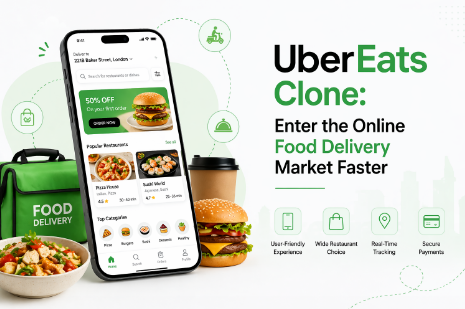
The online food delivery industry has become one of the most competitive digital business spaces. Customers now expect quick ordering, real-time tracking, multiple payment options, and reliable delivery experiences. For new businesses, entering this market quickly is often the difference between gaining traction and getting lost among established players.
This is where an UberEats Clone becomes a practical solution. Instead of building a complex food delivery system from scratch, businesses can start with a ready-made foundation and focus on customization, branding, and scaling.
Why Speed Matters in the Food Delivery Industry
The food delivery market moves fast. Consumer preferences change frequently, and competitors continuously introduce new features. A delayed launch can mean losing early adopters and valuable market share.
Building a platform from scratch often takes several months due to planning, design, development, testing, and deployment cycles. During this time, market conditions can shift, making the final product less competitive.
A faster launch allows businesses to validate ideas early, collect user feedback, and improve their product iteratively. This is why many startups look for faster development approaches rather than fully custom builds.
What an UberEats Clone Actually Is
An UberEats Clone is a pre-built food delivery system designed with core functionalities similar to leading delivery platforms. It includes essential modules such as customer ordering, restaurant management, delivery tracking, and admin control.
However, it is not a rigid copy. Instead, it serves as a flexible base that can be customized according to business needs. Companies can modify design, features, workflows, and integrations without building the entire system from scratch.
This approach significantly reduces development time while maintaining scalability and performance.
Core Structure of a Food Delivery System
A modern food delivery platform is built using multiple interconnected layers. Each layer plays a specific role in ensuring smooth operations.
Frontend Layer
This includes mobile apps and web interfaces used by customers, restaurants, and delivery partners. The goal is to provide a simple and intuitive user experience.
Backend Layer
The backend handles business logic such as order processing, authentication, payments, and notifications. It acts as the core engine of the system.
Database Layer
All critical data like user profiles, order history, restaurant menus, and transactions are stored here. Performance and data integrity are essential at this level.
Real-Time Communication Layer
This enables live order tracking, instant updates, and communication between system components using technologies like WebSockets or Firebase.
A well-structured architecture ensures the platform can handle growth without performance issues.
Key Features Required in a Food Delivery Platform
Any competitive food delivery system must include essential features that ensure smooth user experience and efficient operations.
Customer Side
- Easy search and browsing
- Real-time order tracking
- Multiple payment methods
- Order history and reordering
- Ratings and feedback
Delivery Partner Side
- Live navigation support
- Order notifications
- Earnings dashboard
- Delivery history
Restaurant Side
- Menu and pricing management
- Order acceptance tools
- Performance analytics
- Inventory updates
Admin Panel
- User and vendor management
- Commission configuration
- System monitoring
- Reports and analytics
These features form the backbone of any successful food delivery ecosystem.
Technology Stack Behind Modern Platforms
A reliable food delivery system relies on a strong and scalable technology stack. Most modern applications use a combination of frontend, backend, and cloud technologies.
Frontend technologies like React Native or Flutter help build cross-platform mobile apps. Backend systems are often developed using Node.js, Django, or similar frameworks that support high concurrency.
Databases such as PostgreSQL or MongoDB manage large volumes of structured and unstructured data. Cloud platforms like AWS or Google Cloud provide scalability and uptime reliability.
Real-time features are powered by WebSockets or Firebase, while Google Maps API is commonly used for navigation and tracking.
How Clone-Based Solutions Speed Up Development
One of the biggest advantages of using a clone-based system is the reduction in development time. Instead of building every feature from zero, developers work on a pre-existing structure.
Core modules such as user management, ordering systems, and delivery tracking are already implemented. This allows teams to focus on customization and business logic rather than foundational coding.
Testing time is also reduced since core workflows are already validated. This leads to faster deployment cycles and quicker market entry.
Role of Development Companies in the Process
A professional development partner plays a crucial role in customizing and scaling the platform. A Food delivery app development company typically handles architecture planning, UI/UX design, API integration, and system optimization.
Similarly, an On demand app development company helps businesses adapt the platform for specific requirements such as multi-city operations, advanced analytics, or AI-based features.
Their expertise ensures that the system is not only functional but also scalable and secure for long-term use.
Importance of Scalability and Performance
As user demand increases, the system must handle higher traffic without performance drops. Scalability is a key factor in food delivery platforms.
Microservices architecture is often used to separate different functions into independent services. This allows individual scaling without affecting the entire system.
Load balancing distributes traffic efficiently across servers, while caching mechanisms improve response times. These techniques ensure smooth performance even during peak hours.
Also Read: Launching an Uber Clone? Here Are 5 Secrets No One Tells You
Real-Time Tracking and User Experience
Real-time tracking is one of the most important features in any food delivery system. It enhances transparency and builds user trust.
GPS integration allows customers to track delivery progress live. Delivery partners receive optimized routes, and restaurants can monitor order status in real time.
This seamless flow of information improves overall user satisfaction and operational efficiency.
Payment Systems and Security
Secure payment integration is essential for any digital food delivery platform. Multiple payment options such as cards, wallets, UPI, and cash on delivery improve user convenience.
Security measures like encryption, tokenization, and secure authentication protect sensitive data. Proper API security also prevents unauthorized access and fraud.
A secure system builds customer trust, which is critical for long-term success.
Automation and AI in Food Delivery Platforms
Modern platforms are increasingly using automation and artificial intelligence to improve efficiency.
AI can analyze user behavior to suggest personalized food options. Machine learning models help predict delivery times more accurately. Route optimization systems reduce delivery time and fuel costs.
Automation also helps restaurants manage inventory and reduce wastage. These technologies improve both customer experience and business performance.
Challenges in Using Pre-Built Systems
While clone-based systems offer speed, they are not without challenges. Customization can sometimes be limited depending on the base architecture.
Integration with third-party services may require additional development effort. Poor implementation can also lead to scalability issues if not designed properly.
Regular maintenance and updates are necessary to keep the system secure and efficient.
Best Practices for Faster Market Entry
Businesses aiming for quick entry into the food delivery market should focus on a few key strategies.
Starting with a minimum viable product helps validate the idea quickly. Focusing on core features avoids unnecessary complexity in early stages.
Using scalable cloud infrastructure ensures smooth growth. Continuous user feedback helps improve the platform over time.
These practices help reduce risks while maximizing launch speed.
Conclusion
Entering the online food delivery market requires a balance of speed, functionality, and scalability. Using an UberEats Clone allows businesses to skip the lengthy initial development phase and focus on customization and growth.
With the right architecture, technology stack, and development support, companies can build a competitive food delivery platform in significantly less time. Instead of reinventing the entire system, they can leverage existing frameworks and accelerate their journey to market success.
