

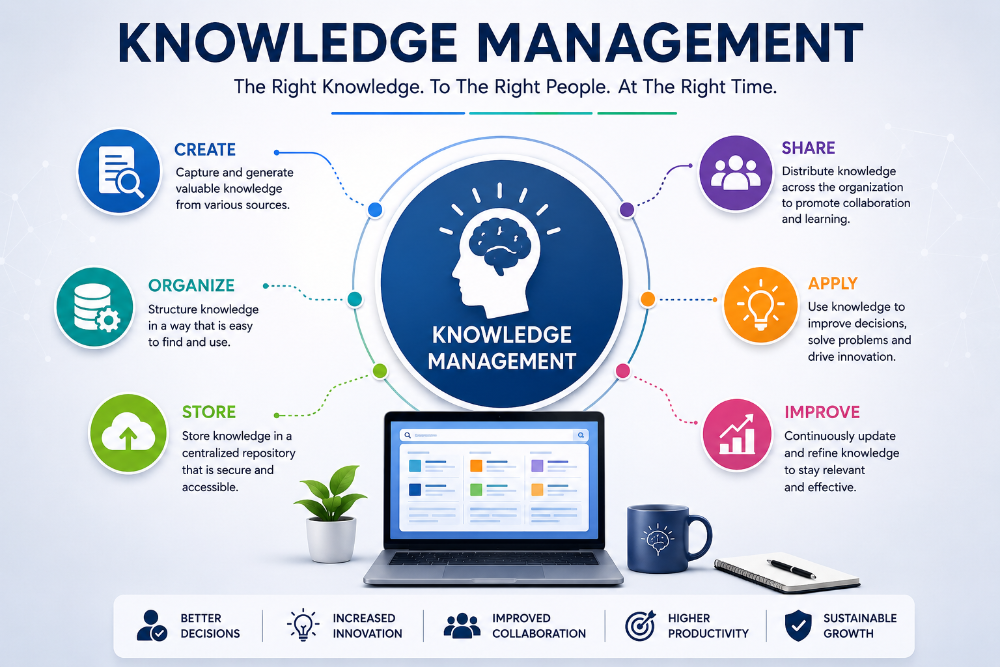
A new employee spends their first three weeks asking the same five people the same five questions. The answers are already sitting somewhere in the company’s systems. They’re just impossible to find. This happens at almost every organization, and it points to a problem that good knowledge management is supposed to solve but rarely does.
On paper, knowledge management sounds straightforward: capture what people know, store it somewhere useful, make it easy to find later. In practice, most companies end up with the opposite. Documents pile up across a dozen different tools, nobody bothers updating the old ones, and searching for anything feels like guessing the right combination of words. AI is starting to change that — not by replacing how people work, but by making the information they already have far more usable.
Why Old-School Knowledge Management Doesn’t Work
Most knowledge management systems were built around folders and tags. Someone had to manually sort files, label them correctly, and hope future employees searched using the same terms they did. That almost never happens. People phrase questions differently than whoever wrote the original document.
Over time this builds up into a pile of information nobody trusts. Employees stop checking the wiki because half of it is stale. They ask a coworker instead, and the answer ends up buried in a Slack message that vanishes into scroll history a week later. The knowledge is there. It’s just scattered and, for practical purposes, unsearchable.
How AI Changes the Way Search Works
This is where enterprise AI has made a real dent. Rather than relying on exact keyword matches, AI-powered search can pick up on the intent behind a question and pull relevant information from documents, emails, and chat threads that a normal search would miss entirely.
Someone can type something plain, like “what’s our refund policy for enterprise clients,” and the system finds the answer even if it’s buried in a PDF from eighteen months ago with completely different wording. That shift — from matching words to understanding meaning — is what actually helps teams drowning in scattered files.
Companies working with platforms like Atechvibe are seeing this firsthand, where AI tools plug into existing document systems instead of forcing teams to rebuild everything from the ground up.
Where People Actually Notice the Difference
This isn’t some abstract improvement. It shows up in small, everyday ways:
- Support teams stop repeating the same troubleshooting steps because past resolutions are easy to pull up.
- New hires get correct answers without dragging a manager away from their own work.
- Project history stays intact even after the person who ran it moves to a different role.
- Sales and customer teams give consistent answers instead of contradicting each other.
None of this replaces good documentation habits. Outdated or wrong information doesn’t become accurate just because AI can find it faster. But the friction of searching drops a lot, and that alone changes how often people actually bother using the tools available to them.
Getting Started Without Overhauling Everything
Bringing AI into knowledge management doesn’t mean tossing out every tool you already use. Most companies start small — connecting AI search to the platforms they already rely on, whether that’s a document repository, a ticketing system, or internal chat.
A reasonable starting point looks something like this:
- Figure out where most of your team’s knowledge already lives, even if it’s a mess.
- Connect AI search tools to those existing systems instead of building something new from scratch.
- Set up a routine for flagging and updating outdated documents — AI can surface information, but it can’t judge whether it’s still accurate.
- Ask employees what’s still hard to find, and adjust from there.
A gradual rollout tends to work better than a full system overhaul, partly because people adapt faster when the change feels incremental rather than disruptive.
A Few Things to Watch Out For
AI search tools won’t fix bad documentation habits. If something was never written down, no tool can dig it up. Teams still need someone responsible for deciding what gets archived, what gets updated, and what should just be deleted.
There’s a learning curve too. Employees used to browsing folders sometimes need a bit of time to trust search-based results, especially if early searches turn up outdated files mixed in with current ones. Setting clear expectations about what the system can and can’t do goes a long way toward avoiding frustration during that adjustment period.
Wrapping Up
Good knowledge management has always been about making information usable, not just stored somewhere. AI hasn’t changed that goal, but it’s made it a lot more achievable for companies stuck with messy, imperfect systems. The businesses seeing the biggest payoff aren’t the ones with perfect documentation — they’re the ones willing to connect what they already have to tools that can actually make sense of it.
FAQs
What is enterprise knowledge management?
It’s the practice of organizing, storing, and making a company’s collective information accessible to the people who need it — everything from internal documents to customer support history.
How does AI improve knowledge management compared to older systems?
AI-powered search can understand the meaning behind a question rather than relying on exact keyword matches, which makes it much easier to find relevant information even when the wording doesn’t line up with the original document.
Do we need to replace our current systems to use AI for knowledge management?
Usually not. Most AI tools connect to existing platforms like shared drives, ticketing systems, or internal chat rather than requiring a full replacement.
Can AI fix outdated or incorrect documentation?
No. It can help surface information faster, but someone still needs to review and update content regularly to keep it accurate.
Is this only useful for large enterprises?
No. Smaller teams often see results faster since they have less legacy documentation to sort through and can roll out changes more quickly.
