

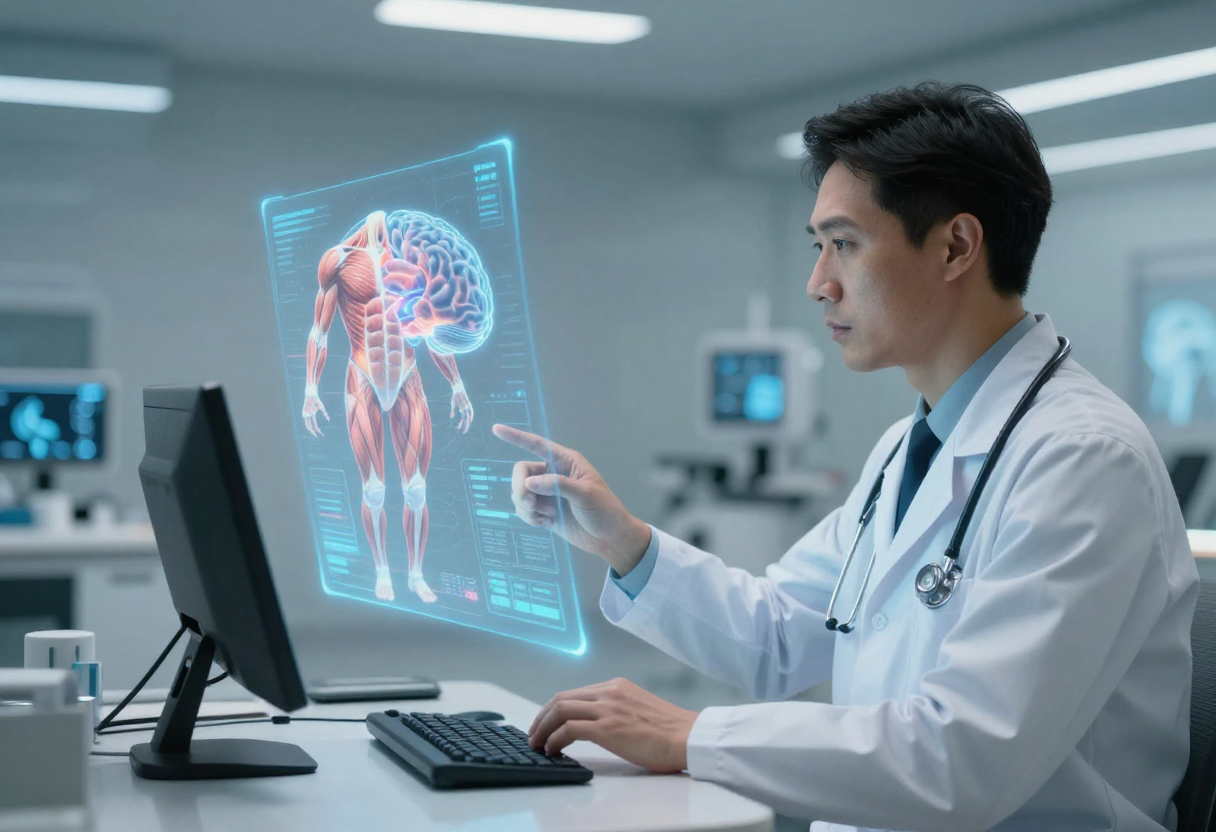
Artificial Intelligence (AI) is no longer just a futuristic concept—it’s actively reshaping healthcare as we know it. From aiding in complex diagnoses to improving patient outcomes, AI technologies are revolutionizing medical practice. As AI continues to evolve, it promises to make healthcare more precise, efficient, and personalized. In this article, we explore the potential of AI in modern healthcare, highlighting its role in managing rare conditions, enhancing patient experiences, and streamlining medical operations.
1. AI-Powered Diagnostics: Detecting Rare Conditions
One of the most promising applications of AI in healthcare is diagnostic support. AI algorithms can analyze vast amounts of medical data, identifying patterns that human practitioners may overlook. For instance, conditions like a missing pectoralis major muscle, a rare congenital anomaly, can be detected early using AI-assisted imaging analysis. This early identification allows for better planning of surgical interventions or physical therapy, improving patient outcomes.
By integrating AI into radiology and pathology, healthcare providers can increase the accuracy of diagnoses while reducing human error. Machine learning models trained on thousands of images can spot subtle anomalies that might otherwise go unnoticed, ensuring that even rare conditions receive proper attention.
2. AI in Patient Monitoring and Personalized Care
AI is also transforming patient monitoring. Wearable devices and smart sensors collect real-time health data, which AI systems analyze to provide insights into a patient’s condition. This approach is particularly beneficial for chronic illnesses and sleep disorders, including narcolepsy. Sharing and analyzing narcolepsy stories through AI platforms helps clinicians better understand symptom patterns, triggers, and treatment efficacy.
By personalizing treatment plans based on continuous data, AI ensures that patients receive care tailored to their unique needs. For example, predictive models can alert clinicians if a patient is at risk of complications, enabling proactive intervention. This real-time monitoring enhances patient safety and improves quality of life.
3. Revolutionizing Treatment Plans with AI
AI-driven decision support systems are changing the way treatment plans are developed. In oncology, cardiology, and neurology, AI can simulate different treatment scenarios and predict outcomes, helping doctors choose the most effective therapies. Even for rare conditions like congenital muscular anomalies, AI can suggest tailored physical therapy regimens or surgical strategies.
Moreover, by analyzing narcolepsy stories, AI can identify trends in symptom management, such as the effectiveness of medications or lifestyle adjustments. This enables healthcare providers to recommend interventions that have shown success across similar patient cases, bridging the gap between anecdotal experiences and clinical practice.
4. Enhancing Medical Research and Drug Discovery
AI’s impact extends beyond patient care into medical research and drug development. Traditional drug discovery processes are time-consuming and expensive, but AI accelerates these efforts by analyzing molecular structures, predicting interactions, and identifying potential therapeutic targets.
For rare conditions like missing pectoralis major muscle or sleep disorders, AI helps researchers uncover genetic markers or pathways that were previously difficult to study. By simulating clinical trials and predicting patient responses, AI reduces development costs and brings innovative treatments to patients faster.
5. Ethical Considerations and Patient Privacy
While AI offers numerous benefits, its integration into healthcare raises ethical and privacy concerns. Patient data must be handled with strict confidentiality, and AI systems should be transparent in their decision-making processes. Misinterpretation of data or biases in AI algorithms could lead to misdiagnoses, particularly for rare conditions.
Healthcare providers must balance AI-driven insights with human expertise. AI should enhance, not replace, the clinician-patient relationship. Encouraging patients to share narcolepsy stories or experiences with rare conditions ensures that AI models are informed by real-world experiences, improving accuracy and empathy in healthcare delivery.
6. The Road Ahead: AI as a Healthcare Partner
The future of AI in healthcare is collaborative. AI will act as a partner to medical professionals, augmenting their capabilities rather than replacing them. From early diagnosis of rare anomalies like a missing pectoralis major muscle to analyzing patient experiences such as narcolepsy stories, AI is set to make healthcare more efficient, personalized, and patient-centric.
As technology advances, we can expect AI to play an even larger role in preventive care, mental health support, and global health initiatives. Embracing AI responsibly ensures that its benefits are accessible to all, leading to better outcomes and a healthier future for patients worldwide.
Conclusion
Artificial Intelligence is transforming modern healthcare, offering tools that enhance diagnostics, personalize treatments, and accelerate research. By integrating AI responsibly and leveraging patient experiences, the medical field can address rare conditions, chronic illnesses, and complex disorders more effectively. The future of healthcare is intelligent, data-driven, and compassionate—and AI is at its core.
