

Every email marketing campaign starts with the same fundamental question: what should I send to whom and when?
For most of the history of email marketing, the answer was determined by demographic data and manual segmentation. You sent the promotional email to everyone on your list. You sent the product update to paying customers. You sent the welcome sequence to new subscribers in the order you wrote it, on the schedule you set, regardless of what any individual recipient actually did with your emails.
The result was email that performed at the average of your audience rather than at the potential of each individual within it. Open rates hovered around 20 to 25 percent not because email was a weak channel but because most of what was being sent was only loosely relevant to most of the people receiving it.
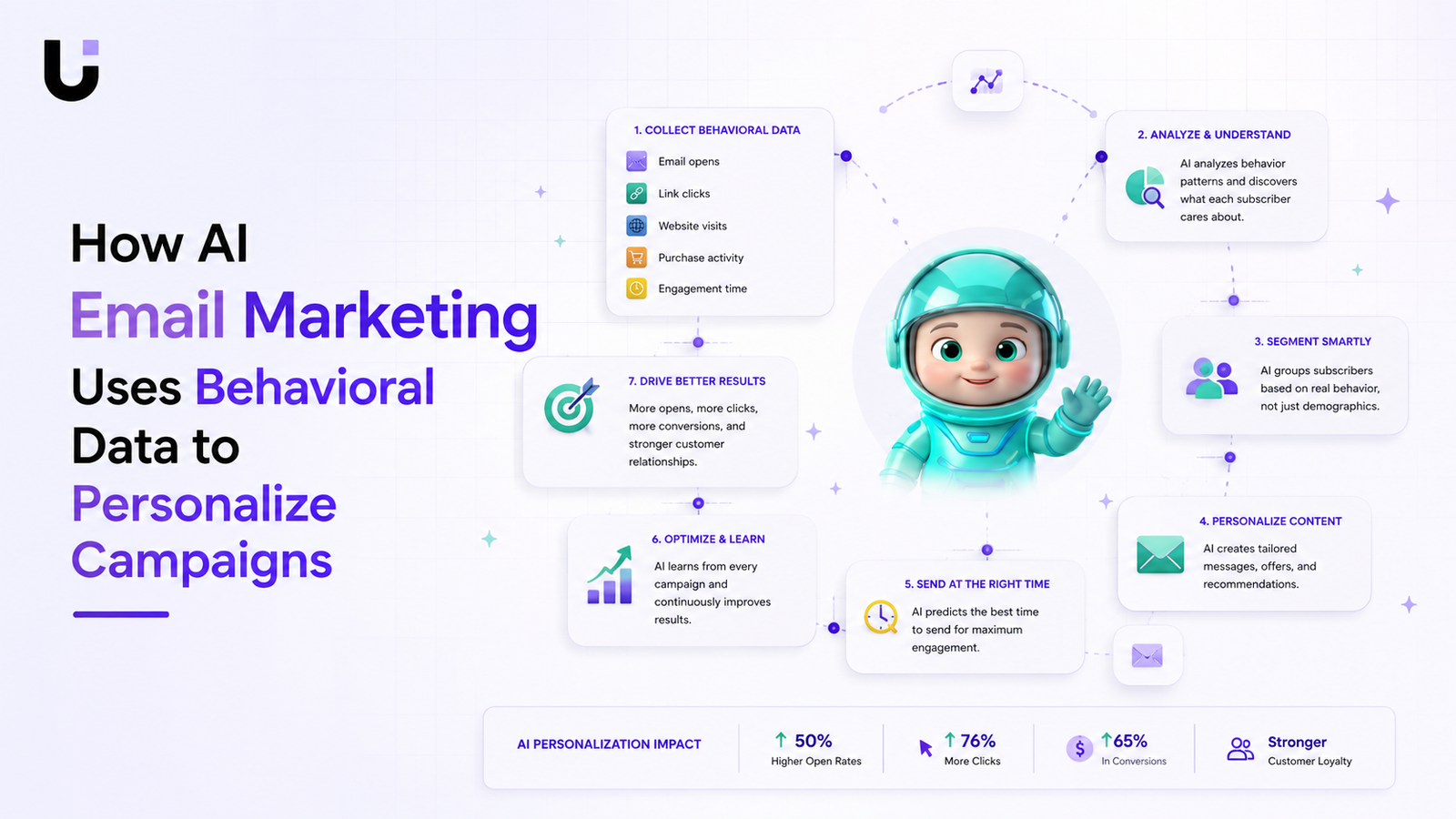
Behavioral data changes this equation entirely. When AI email marketing systems read what each subscriber actually does, which emails they open, which links they click, which pages they visit after clicking through, how long they spend reading, and when they typically engage, and use that data to drive every content and timing decision, the gap between average performance and individual potential closes dramatically.
This post breaks down exactly how behavioral data powers AI email marketing personalization, what the data architecture looks like, and how email marketing automation systems use that intelligence to send the right email to the right person at the right moment without a human making each decision manually.
The Behavioral Data Foundation
Before personalization can happen, the right data needs to be collected and structured in a way that AI can reason about. Most email platforms collect surface-level engagement data: opens, clicks, unsubscribes. That data is useful but shallow. Genuine behavioral personalization requires a richer signal set.
The behavioral signals that matter most for AI email marketing fall into four categories.
Email engagement signals are the baseline. Open rate, click rate, click-to-open ratio, time spent reading, which specific links were clicked, and whether the subscriber forwarded or replied. These signals tell you how engaged a contact is and what content they find worth their attention.
Website behavior signals are where intent becomes visible. Which pages a contact visited after clicking through from an email, how long they spent on those pages, whether they visited pricing, whether they started but did not complete a form or checkout. These signals reveal where a contact is in their decision process far more accurately than any demographic data point.
Purchase and conversion signals close the loop between marketing activity and revenue outcome. What a contact bought, when they bought it, how frequently they purchase, and what their average order value looks like. These signals drive product recommendation logic and repurchase timing in ways that campaign-level segmentation never could.
Recency and frequency signals measure relationship health. How recently did this contact engage with any email or any page on your site? How often do they engage? A contact who has not opened anything in sixty days needs a fundamentally different approach than one who opened your last four emails within an hour of receiving them.
The difference between businesses running basic email automation and those running genuine AI email marketing personalization is almost always in this data layer. Collecting the right behavioral signals and structuring them in a way AI can act on is the foundation everything else is built on.
How AI Translates Behavioral Data Into Personalization Decisions
With behavioral data structured and continuously updated, the AI personalization engine uses it to make intelligent decisions about what to send each contact. This is where email marketing automation crosses from rule-based to genuinely intelligent.
A rule-based system can say: if a contact has not opened in thirty days, send the re-engagement email. An AI personalization engine can say: this contact consistently opens on Tuesday mornings, clicked three articles about workflow automation in the last month, visited the pricing page twice last week but did not convert, and historically takes two to three weeks from first pricing visit to purchase. The optimal next email is a case study focused on workflow automation ROI, sent Tuesday morning, with a soft CTA toward a demo rather than a direct purchase push.
That level of decision granularity cannot be encoded in rules. There are too many variables, too many combinations, and too many individual contact histories to anticipate every scenario. AI does not need rules for every scenario because it reasons from the behavioral profile rather than matching conditions to predetermined actions.
The personalization decisions AI makes from behavioral data cover three dimensions simultaneously. Content selection, meaning which campaign, which angle, which specific message will resonate with this contact based on what they have demonstrated interest in. Send time optimization, meaning when is this individual contact most likely to open and engage based on their historical behavior patterns. Sequence pacing, meaning how quickly or slowly should the next email come based on how engaged this contact has been.
Getting all three right simultaneously for every contact on a list of any meaningful size is operationally impossible for a human team. It is what AI email marketing systems were built to do.
Send Time Optimization: Moving Beyond Fixed Schedules
Fixed send times are one of the most persistent inefficiencies in email marketing. Sending a campaign at 9am Tuesday because conventional wisdom says that is when engagement is highest is a population-level approximation that is wrong for most individuals on any given list.
The research supporting industry-standard send times is based on averages across millions of sends. Your list is not an average. It is a collection of individuals whose engagement patterns are as varied as their daily routines. A contact who commutes by train checks email during that commute. A contact who works late shifts engages in the evening. A contact in a different time zone is asleep when your 9am email arrives.
Behavioral data makes individual-level send time optimization possible because every contact generates their own engagement history. AI analyzes when each individual contact has historically opened emails, how quickly they opened after delivery, and which time windows produce the highest click engagement for that specific person. From that history it identifies the optimal send window for each contact individually.
The practical impact of individual send time optimization is consistently significant. When emails arrive at the moment each contact is most likely to be in an email-reading mindset, open rates improve not because the subject line got better but because the timing stopped fighting against natural behavior patterns.
For email marketing automation systems running at scale, this means every contact on a list of ten thousand receives their email at a different time, each optimized for that individual’s behavior. That level of operational precision is not possible manually. It is precisely the kind of task AI executes better than any human process could.
Dynamic Behavioral Segmentation: From Static Lists to Living Cohorts
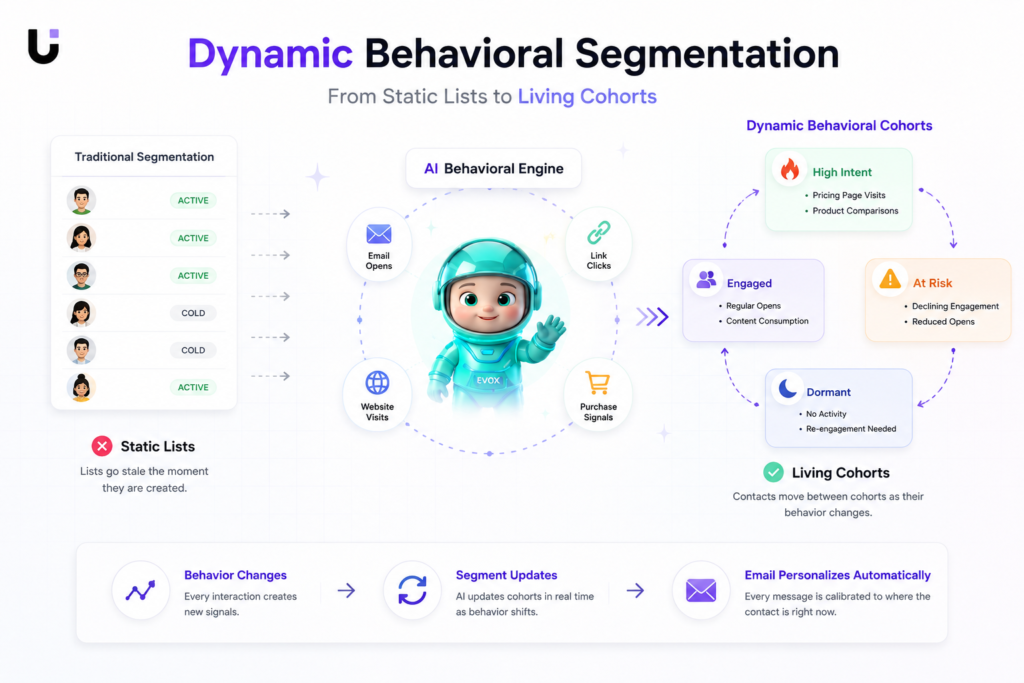
Traditional segmentation creates static lists that go stale the moment they are created. A contact categorized as “active” six weeks ago may be drifting toward disengagement today. A contact sitting in the “cold” segment may have just visited your pricing page three times this week, which is a high-intent signal that the static segment will never surface.
AI email marketing replaces static lists with dynamic behavioral cohorts that update continuously based on incoming behavioral signals. Every email opened, every link clicked, every page visited, and every day that passes without engagement shifts a contact’s behavioral profile and potentially their segment classification.
The segments that matter most for behavioral email marketing are not demographic slices. They are behavioral states that determine what kind of communication will drive the next step in the relationship.
A high-intent cohort contains contacts showing strong purchase signals: frequent email opens, pricing page visits, product comparison behavior, and engagement with bottom-of-funnel content. These contacts need direct, specific communication that removes friction from the decision they are clearly moving toward.
An engaged but unconverted cohort contains contacts who regularly open and click but have not shown purchase intent signals yet. These contacts need content that continues building the case and surfaces the specific angle that finally creates intent.
An at-risk cohort contains contacts whose engagement is declining relative to their historical baseline. A contact who used to open every email and now opens one in five is trending toward disengagement. AI identifies this trend before the contact goes fully cold and triggers re-engagement content calibrated to bring them back.
A dormant cohort contains contacts who have not engaged in an extended period. These contacts need a fundamentally different approach, a re-engagement sequence that acknowledges the silence and gives them a compelling reason to re-engage rather than another campaign email that treats them as if nothing has changed.
The critical distinction between static and dynamic segmentation is that behavioral cohorts reflect what is true about a contact right now, not what was true when they were last manually classified. AI keeps every contact in the segment that matches their current behavior, which means every email they receive is calibrated to where they actually are in their relationship with your business.
Disengagement Prediction and Churn Prevention
One of the most undervalued applications of behavioral data in AI email marketing is predicting disengagement before it happens rather than reacting to it after a contact has already gone cold.
Most email marketing automation systems handle churn reactively. A contact does not open for sixty days, they get a re-engagement email. This approach has two problems. First, sixty days of inactivity is often too late. The relationship has already cooled significantly and win-back rates on fully dormant contacts are low. Second, it treats all disengagement the same way, when in reality some contacts disengage because of content relevance, some because of send frequency, and some because they are no longer in the market for what you offer.
AI analyzes behavioral trends rather than binary engagement states. A contact whose open rate has declined by 40 percent over the last eight weeks is showing a disengagement trend even if they are still technically opening some emails. A contact whose time-to-open is increasing steadily is showing reduced urgency and interest even without a dramatic drop in raw open rate. These trend signals are invisible to rule-based systems that look at current engagement status. They are exactly the kind of pattern AI is built to detect.
When AI email marketing identifies a disengagement trend early, the intervention can be much more targeted. Rather than a generic re-engagement email, the system can analyze what kind of content the contact engaged with most strongly earlier in the relationship and surface a new piece of high-relevance content. It can reduce send frequency to prevent the contact from feeling overwhelmed. It can test a different content angle to determine whether relevance, not engagement, is the underlying issue.
Early disengagement intervention driven by behavioral trend analysis consistently outperforms reactive re-engagement campaigns because it addresses the problem while the relationship still has momentum rather than after the contact has already emotionally unsubscribed.
How WorksBuddy Evox Implements Behavioral Personalization
Every pattern described in this post runs inside WorksBuddy Evox in production.
Evox is WorksBuddy’s AI communication and email marketing automation agent. It does not operate as a standalone email tool. It runs as a connected communication layer with full visibility into what is happening across your entire business operation, which is what makes its behavioral personalization genuinely intelligent rather than just technically sophisticated.
When a lead enters through Lio, Evox begins tracking behavioral signals immediately. Which emails they open, which links they click, which pages they visit after clicking through. As those signals accumulate, Evox continuously reclassifies the contact’s behavioral segment and adjusts its personalization decisions accordingly. A lead who visits the pricing page twice in a week gets a high-intent sequence with a direct demo invitation. A lead who consistently opens but never clicks gets a content angle shift designed to surface what actually drives them to engage further.
Because Evox sits inside WorksBuddy alongside Taro, Inzo, Sigi, and Lio, its behavioral data is richer than any standalone email tool can produce. It knows when a project milestone was completed and sends the relevant client update automatically. It knows when an invoice is overdue and adjusts the payment reminder sequence accordingly. It knows when a contract was just signed and triggers the onboarding sequence without waiting for a human to start it.
This is the difference between email marketing automation that reads email behavior and email marketing automation that reads business behavior. The personalization is not just based on what a contact did with your emails. It is based on what is actually happening in their relationship with your business, which produces communication that is relevant in a way that purely email-signal-driven personalization never fully achieves.
The Bottom Line
Behavioral data is not a feature inside an email marketing platform. It is the foundation of a fundamentally different approach to how email decisions get made.
The shift from demographic segmentation to behavioral personalization, from fixed send schedules to individual send time optimization, from static lists to dynamic cohorts, and from reactive churn response to predictive disengagement intervention represents the full arc of what AI email marketing personalization makes possible.
The businesses building on this foundation are not just improving their open rates. They are building a communication system that gets smarter with every interaction, more relevant with every signal, and more autonomous with every campaign cycle that runs without manual intervention.
That is what the shift from email marketing automation to AI email marketing actually means in practice. Not faster execution of the same manual decisions, but a system that makes better decisions than a human team could sustain at the scale and speed that modern business communication requires.
See how WorksBuddy Evox transforms your email marketing automation at worksbuddy.ai
