

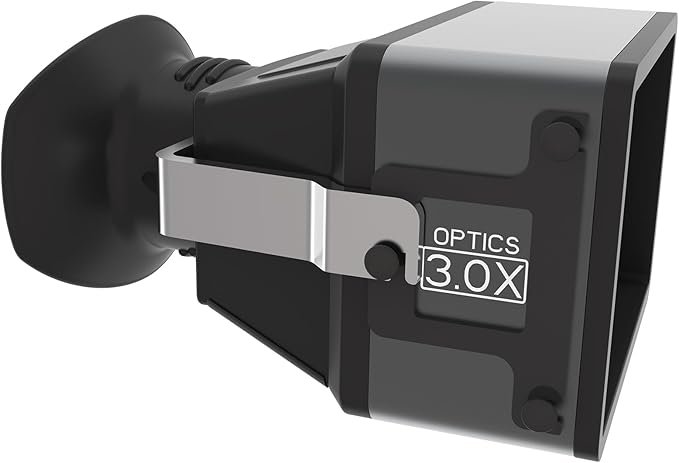
In the transition from Digital Single-Lens Reflex (DSLR) to mirrorless architectures, the EVF optical module has moved from being a secondary convenience to the primary interface between the photographer and the subject. For B2B camera manufacturers, medical endoscope designers, and defense contractors building thermal sights, the Electronic Viewfinder (EVF) is no longer just a small screen—it is a sophisticated optical system that must mimic the “zero-latency” experience of human sight.
However, many integration teams encounter a persistent problem: a “digital disconnect.” When the optical path is poorly optimized, the user experiences eye strain, motion sickness, or a lack of critical focus. To solve these issues, we must look beyond the resolution of the micro display and address the complex physics of the optics that deliver that image to the eye.
The Problem: The Three Pillars of Viewfinder Fatigue
For engineers developing high-end imaging platforms, the EVF optical module presents three major technical bottlenecks:
- Geometric Distortion and Edge Softness: Because EVFs require high magnification in a very short physical distance, the image often suffers from “pincushion” or “barrel” distortion. In a professional setting, edge-to-edge clarity is vital for monitoring frame-wide data or peripheral hazards.
- The Latency-Display Synergy: While electronic latency is often blamed on the sensor, “perceived latency” is frequently caused by the display’s refresh rate and the optical module’s inability to handle fast motion without smearing. This is catastrophic in sports photography or high-speed industrial inspection.
- Exit Pupil and Eye Relief Constraints: Many compact EVF designs have a tiny “sweet spot.” If the user’s eye is not perfectly centered, the image vignettes or disappears. For professionals wearing glasses or goggles (in tactical or medical fields), insufficient eye relief makes the module practically unusable.
Engineering the Solution: High-Index Aspherics and Micro-OLED Integration
To bridge the gap between “digital screen” and “optical reality,” the next generation of EVF optical module design focuses on multi-element aspheric stacks and high-density backplanes.
1. Correcting the Path with Aspheric Lens Elements
Traditional spherical lenses are prone to spherical aberration, especially at the high magnifications required for a 0.5-inch display. By utilizing precision-molded Aspheric Lenses, engineers can correct for aberrations with fewer elements.
- The Result: A lighter, more compact module that maintains a flat field of view. This ensures that the HUD (Heads-Up Display) data in the corners of the viewfinder is just as sharp as the central subject.
2. Eliminating the “Rainbow Effect” with Achromatic Doublets
In high-contrast scenes, “color fringing” or lateral chromatic aberration can occur at the edges of the viewfinder. By integrating an Achromatic Doublet—pairing a low-dispersion lens with a high-dispersion lens—the EVF can align the focal points of different wavelengths. This is essential for focus-peaking accuracy and medical color-matching.
Technical Specifications: The B2B Checklist for EVF Excellence
When specifying an EVF optical module for an industrial or consumer-pro platform, the following metrics are non-negotiable for high-performance indexing and reliability:
- Magnification Ratio: Typically ranging from 0.7x to 0.9x. High magnification improves immersion but requires more complex distortion correction.
- Diopter Adjustment Range: Professional units should support -4.0 to +2.0m⁻¹ to accommodate the widest range of users without needing external corrective lenses.
- Eye Point (Eye Relief): Aim for 20mm or greater. This ensures that users wearing protective eyewear can see the full frame without shadowing.
- Micro-OLED vs. LCoS: For high-end B2B applications, Micro-OLED is preferred for its superior contrast ratio and lack of “color breakup” during fast eye movement.
Semantic Keywords for B2B SEO and Authority
To ensure this article reaches the R&D directors and system integrators searching for technical solutions, we have integrated semantic keywords that signal industry expertise:
- Modulation Transfer Function (MTF): The primary metric for measuring the contrast and resolution of the optical stack.
- Refresh Rate (Hz): Critical for reducing flicking and motion artifacts in digital viewfinders.
- Exit Pupil Diameter: Determining how much freedom of movement the user has before the image cuts out.
- Thermal Drift: Managing how the focal point changes as the internal electronics heat the lens housing.
Using these terms positions your brand as a technical leader capable of solving the “hard” problems of optoelectronic integration.
Conclusion
The EVF optical module is the final gatekeeper of image quality. No matter how powerful your sensor or how fast your processor, the user’s perception is dictated by the few millimeters of glass and silicon in the viewfinder.
By prioritizing high eye relief, aspheric correction, and low-latency display pairings, B2B manufacturers can move beyond the “digital look” and provide a natural, fatigue-free viewing experience that meets the demands of modern professional imaging.
